#21: So I went to Slovenia - March in review
I joke on occasion that my true hobby is collecting hobbies. The detritus from a baker’s dozen fleeting interests lies scattered about my apartment: embroidery kits, stacks of empty notebooks, an entire glass grinder, a half-sorted jigsaw puzzle I haven’t touched since Christmas. Some interests stick for longer than others, but even my longest-standing hobbies have been put on the high shelf at one point or another to make room for new obsessions.
I spent a lot of my childhood being told that my tendency to flit between projects meant I was unreliable. That it was a waste to put time and money into something unless I planned to stick with it, become proficient, yield some return on investment. After all, time is a finite resource; why squander it on a passing fancy, instead of something that could matter in the long run?
As an adult, though, I’ve come to really value the creative rolodex I’ve cultivated through the years. I love having an arsenal of haphazard skills that I can deploy to turn creative visions into reality, or even just flip through in periods of boredom or creative drought. Far from being evidence of a fickle nature, it’s a testament to my ever-burning curiosity, and my penchant for throwing myself headlong toward my goals without (overmuch) hesitation.
There’s a tweet I saw several years ago that I think about whenever I dive into a new project:
Reading this tweet, I had one of those moments where something clicked into place. I felt a previously inarticulable core belief sharpen into focus. There is, of course, the optimization-minded reading of this tweet, where failures are valuable because they’re useful in their own way.
But there’s another, gentler reading—the reading that nestled into the cradle of my ribcage—wherein the act of loving something is innately worthwhile. Where you are made better not for what you’ve loved, but for having loved at all.

Fueled partly by nostalgia and partly by dismay for my diminishing attention span, I’ve spent the past year nursing a longing for analog media. I miss writing longhand; I miss Redbox and Blockbuster; I miss my parents’ shelf of old Bollywood cassettes.
In an effort to reintroduce physical media and longhand projects to my life, I’ve started sending mail to my friends. I already had a wax seal kit and a collection of postcards from a flight of fancy circa 2024; I’ve since acquired a collection of decorative postage stamps, an overengineered fountain pen, a stack of 30% cotton paper, and a 1948 Smith-Corona Sterling typewriter.
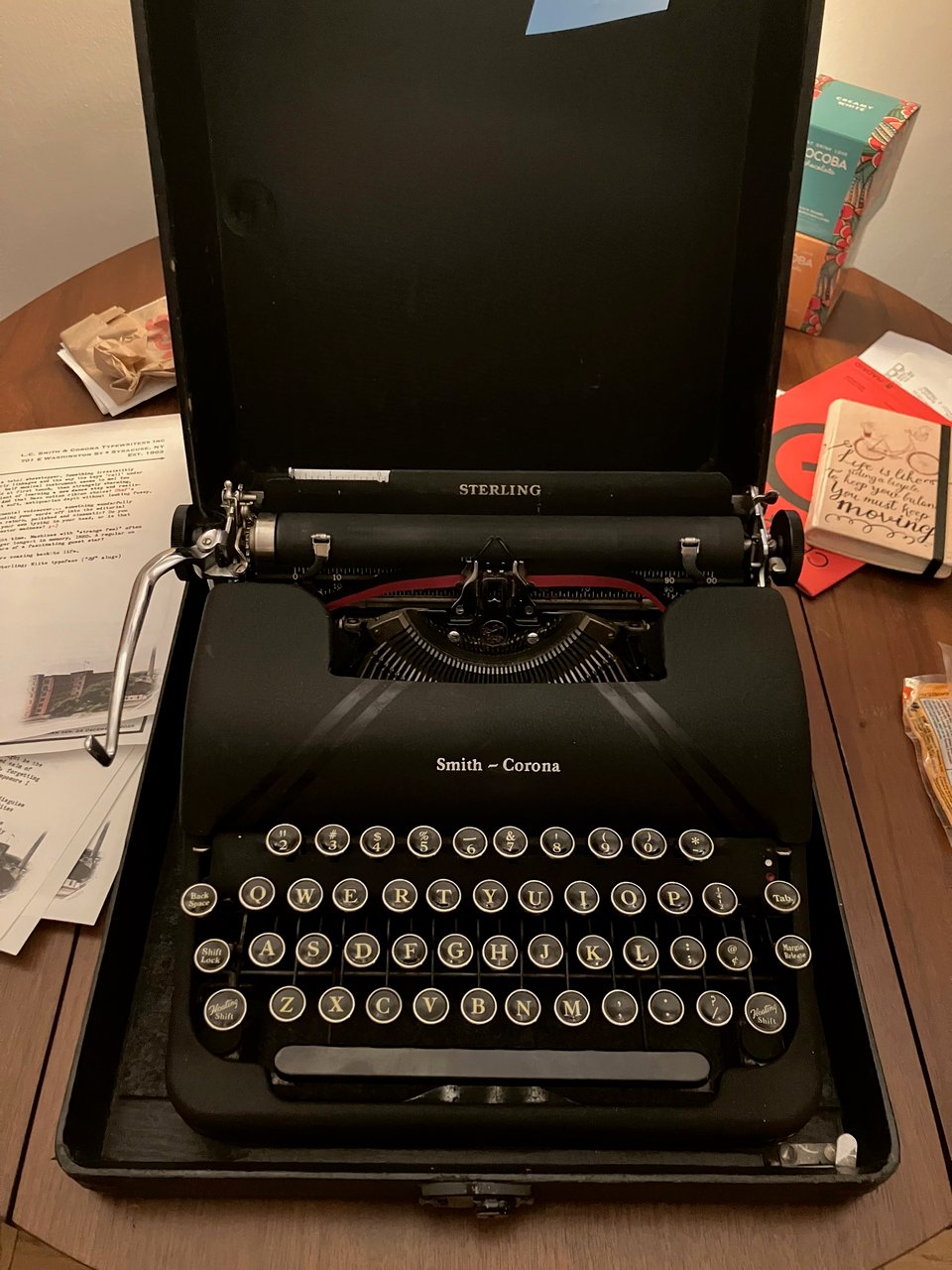
I’ll admit, I have a romanticized view of correspondence, undoubtedly stoked by the flames of the countless historical and epistolary romance novels I’ve read, wherein you and your loved ones regularly cover multiple pages front and back with aesthetically slanted scrawl. But writing letters is surprisingly unintuitive! Especially if you’re writing to people whom you see regularly via Discord or phone call or text message. It’s not enough to provide an accounting of recent events; you have to add your own voice somehow. You have to give the other person a reason to read your pages of thoughts and ramblings. And you have to pepper in openings where the person on the other end can respond—questions to answer, interesting stories to react to, recipes they can try. Despite being a writer by trade, I find myself at a loss nearly every time I sit down with pen and paper.
So I’ve also started making zines! At the very least, popping a zine into an envelope gives me an excuse to fill half a page with an explanation of what the zine is and how I made it.
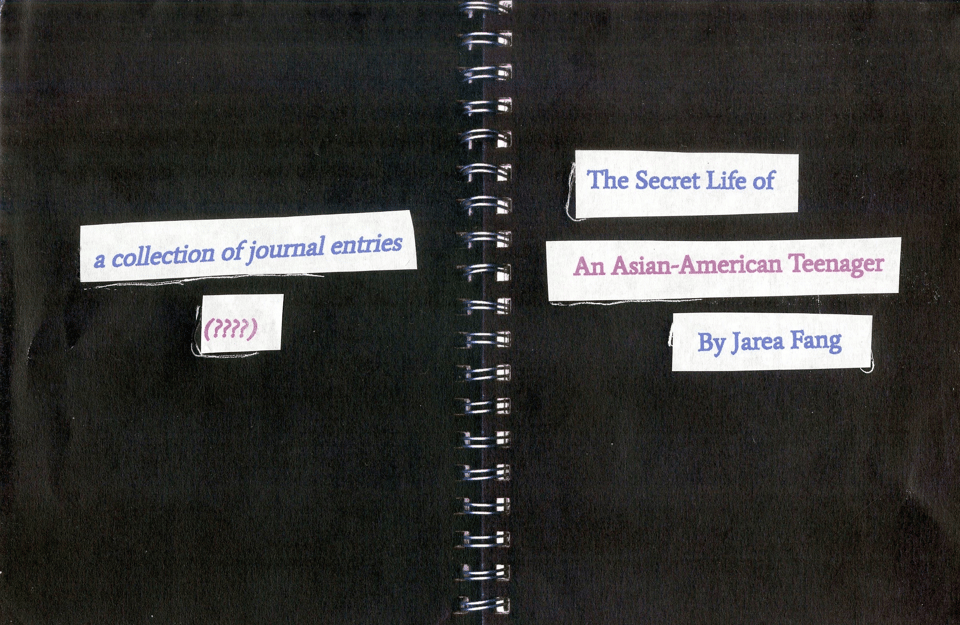
I encountered my first zine in 2021: The Secret Life of an Asian-American Teenager by Jarea Fang. I remember feeling seen in a way that cut right to my core, leaving me slightly flayed and fully in awe of how much emotion and vulnerability could be packed into a handful of collages of cut paper. This started me thinking about which of my own introspections might make adequate zine fodder.
Then a couple of years ago, I encountered this Tumblr post that explains how to make your own zine, emphasizing that zines are first and foremost about accessibility. You don’t need anything fancy to make a zine, to hear this post tell it, just “the simplest materials and you.”
For better or for worse, I’ve got a lot of me. So I snagged some simple materials from my local Buy Nothing group, and I embarked on a journey of pinning myself to paper.
Thus far, I’ve got 2 zines fully compiled and a third in progress. Unlike Jarea’s series, my zines do not share a unified theme or any coherent throughline. Instead, they’re random compilations of whatever tangentially related thoughts are running through my head at the moment.
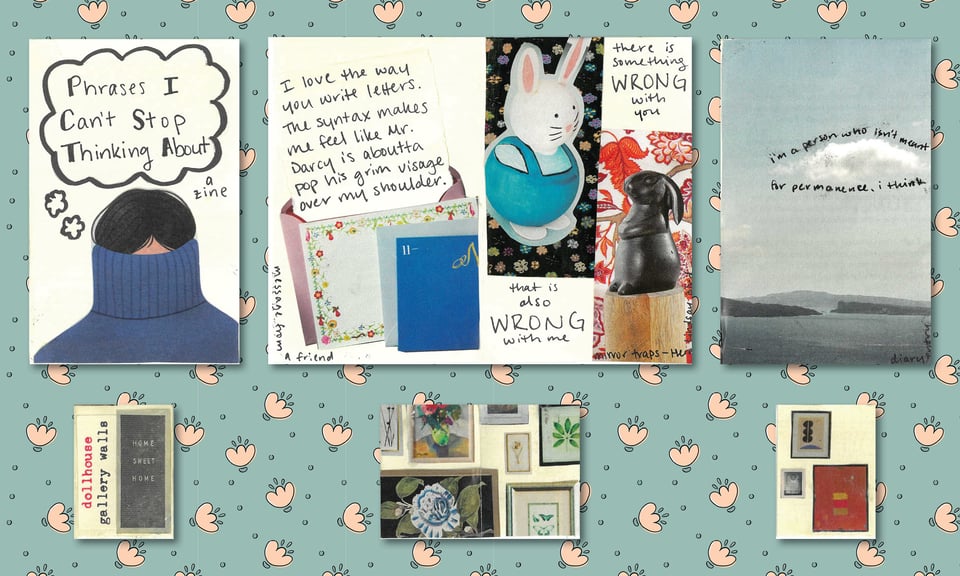
bottom: excerpts from dollhouse gallery walls, a mini-zine.
Making zines has provided me a surprising amount of creative fulfillment. I’m discovering a love for collage and found-object artwork, and for the painstaking process of sifting through 50+ magazines to find the perfect image to recontextualize alongside a pseudo-pretentious quote. And I love the physical feeling of a fully assembled zine, too: the texture of the paper, the ridges of each cutout in a collage, the leftover patches of dried glue, the weight of a turning page.
I don’t know how many zines I’ve got in me; I suspect this, like many of my creative projects, will run its course before long. But in the meantime, I’m enjoying every moment of it, and doubly enjoying sharing the ensuing output with others.
If you’d like to receive any of my zines in the mail, let me know! Otherwise, you can download them to print, cut, and fold yourself at the links below.
Download zine 1 here | Download zine 2 here


In late 2024, I was reading a book at my favorite cafe-slash-bar when the man sitting next to me struck up a conversation. We ended up chatting for the next 2 hours, during which I learned his whole life story: where he lived, where his kids were going to school, how he’d met his current girlfriend, that he was a Secret Service agent.
That last reveal got us swapping travel stories, as I travel a lot for fun, whereas he traveled a lot for work. To my skepticism, he told me that the most beautiful place he’d ever been was a small town called Bled in Slovenia. I set up a flight alert that very night, and when it finally went off a year later, I snatched up tickets immediately.
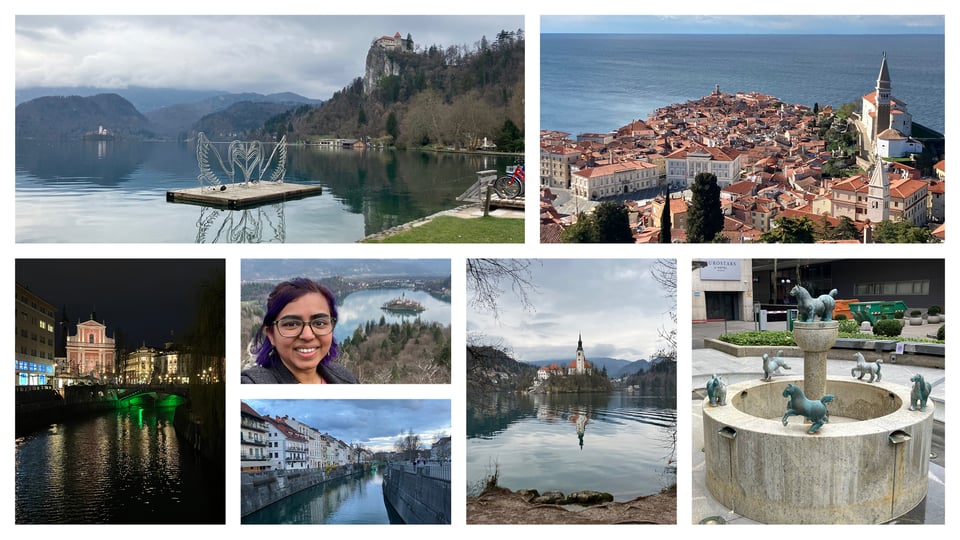
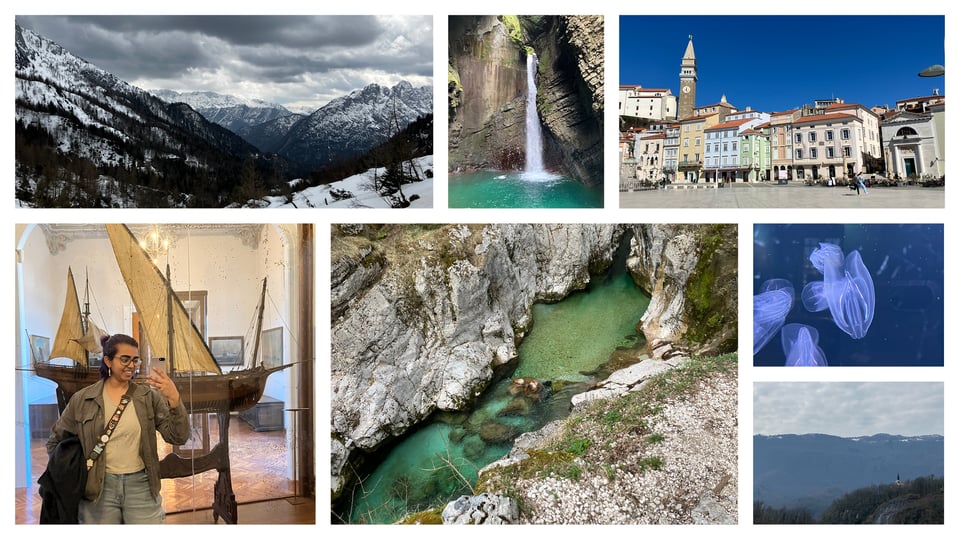
Well, he was onto something. Slovenia is a beautiful country, even at the tail end of winter where the trees are still shivering bare in the wind. Snow-capped mountains wreathe the horizon no matter where you look, and the waters of the lakes and rivers are almost gemlike in their vibrancy and brilliance.
I don’t have any wacky stories about my time in Slovenia. Oh, there’s the perennial manner in which I was mistaken for a university student by every ticket attendant in the country, resulting in a slew of erroneously provided student discounts. And there’s the way my love for lighthouses drew me to the coastal town of Piran on an unexpected free day, where I visited the world’s smallest aquarium. But overall, it was a serene, uneventful vacation; I mostly drank a lot of wine, and read a lot of books by the water, and thought a lot about why I like solo traveling.
When I tell people (and also my mother) that I’m traveling somewhere solo, I often hear in return, “I don’t know how you do it! I could never enjoy traveling on my own.” For my part, that’s a baffling sentiment to me. Solo travel is not inherently dissimilar to group travel. I visit the same attractions, eat and drink at the same restaurants and bars, buy the same souvenirs, as I would with a group. The only true difference is that I do all these things with only myself for company—which means I have to find ways to enjoy my own company.
I think it’s that last element that feels incomprehensible to a lot of people. When you’re always surrounded by other people, be they family or coworkers or roommates or an enmeshed friend group, spending an extended amount of time in your own head can be jarring and unfamiliar. And I get it. It didn’t come easily to me at first, either.1 It’s taken a lot of practice and intentional movement outside my comfort zone to reach a point where I don’t mind hanging out with myself—where, in fact, I crave that solitude on occasion, so I can revel in the person that I am and the life that I have made for myself.
The thing is, if you’re always surrounded by people who enjoy knowing you, then there’s a consensus that you’re an interesting person who is enjoyable to know. Don’t you want to meet that cool person who all your friends like and see what the big deal is? And once you know that person, isn’t it fun to take them to museums they’ll like, and show them art that will resonate with them, and watch them move through life with joy?
I don’t know, maybe I’m stretching the abstraction a little far. I guess my point is that I think learning to enjoy your own company is a worthwhile and necessary endeavor, even when it’s difficult. Not only because it makes it easier to do things like go to Slovenia and catch a bus to see a lighthouse on a whim, but also because you’re a person worth knowing.

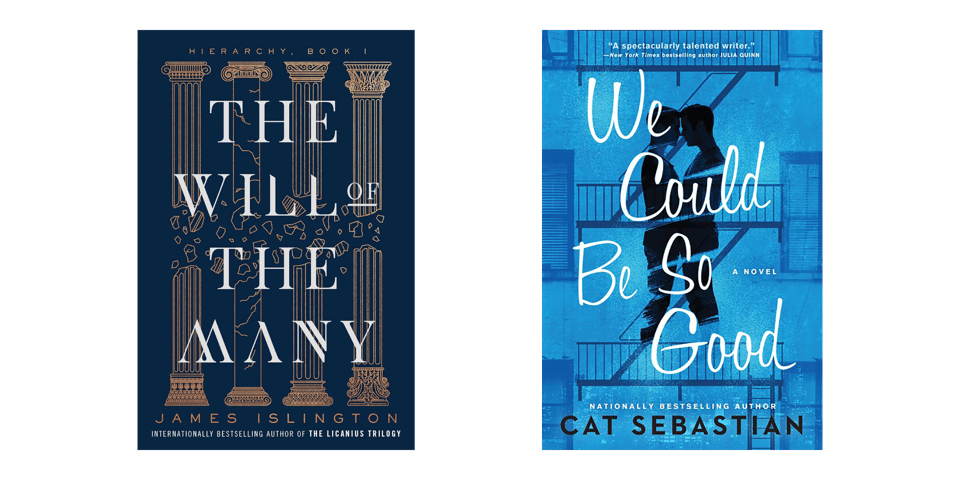
I read two absolute standouts this month, and try as I might, I can’t choose which one to spotlight. So you’re getting reviews of both.
The Will of the Many by James Islington (⭐⭐⭐⭐) is the latest episode of “Sonali finally gets with the program.” This is a 700-page fantasy epic that follows 17-year-old Vis—previously the prince of a small island nation, now an orphan hiding in the slums of the country that colonized his homeland—as he’s plucked from obscurity, installed as a spy at an academy for the progeny of the elite, and exposed to multiple world-shattering revelations in rapid succession.
If you enjoy a competent protagonist, this book is for you: Vis has the brains and the brawn, and it makes him uniquely suited to prevailing against the gauntlet he faces. But his competence never grates or feels unrealistic; his skillset makes sense in the context of his upbringing, and he experiences plenty of setbacks to offset his triumphs. Part political thriller, part dark academia, and wholly riveting from start to finish, this book has me chewing on drywall as I wait for the sequel to arrive at my library.
We Could Be So Good by Cat Sebastian (⭐⭐⭐⭐⭐) is an M/M romance set in 1959 New York City, between Nick, a news reporter, and Andy, the publishing scion who will eventually inherit the paper for which Nick works. I was blown away by how this book achieved the delicate balance of being cozy and gripping at the same time. Along with the core romance, there are subplots about grappling with period-typical homophobia, coming to terms with queer identity, navigating complex relationships with family, and building a home and family on your own terms despite all of the above. Yet you’re never left thinking that the next hurdle might be what finally breaks Nick and Andy. The book establishes a foundational trust and respect between them that means the tension of their story stems not from whether they’ll survive everything the world is throwing at them, but from how.
There’s a moment where Nick says something like, “Even if this doesn’t work out, you’ll still be my best friend,” and that, to me, is the thesis of this story. Yes, it’s a romance, but more than that, it’s a story about being loved right down to your very bones, and allowing yourself to bask in that love.


For a handful of days this month, I was disconcertingly obsessed with a browser-based game called 2025. This is, in essence, an eldritch evolution of Connections: a gargantuan array of 2025 items that can be organized into 45 themed groups of 45. The first 1000 items or so are easy enough to sort. Then the difficulty ramps exponentially.
This is a game made for people who enjoy data entry and cleaning up messes and are prone to hyperfixating. This is a game for people who routinely win first place at weekly bar trivia. This is a game for people who 100%ed A Little to the Left. If any of these descriptions fit you, you should not start this game close to bedtime, because you will lose sleep in favor of Combining Two At A time.
I finished the game with around 3000 errors, hampered as I was by my complete lack of familiarity with at least 6 of the 45 categories. I’d love to know what your final score ends up being!

Junk mail seems to be an inescapable inevitability of the human condition. The postal service had scarcely been invented before it was already being inundated with bags and bags of ads for lotteries and medicines.2
Like my father and his father before him, I’ve grown accustomed to my mailbox being stuffed to the brim with catalogs and credit card offers and coupons for services I’ll never use. As a result, I check my mailbox maybe once a month, and always with low-level annoyance humming in the back of mind.
I’m on an eternal quest to cram ever-increasing amounts of joy into my life, though, and my mailbox is not immune to that mission. So over the past year, I’ve developed a bit of a ritual. Instead of dumping junk mail directly into the recycle bin, I set it aside. And when a respectable pile has built up, I light a candle, pour a glass of wine, and spend the evening writing opt-out emails to every sender that has terrorized my mailbox of late.
Here are a few useful tools I discovered this month in pursuit of deshittifying my mailbox:
The National Do Not Call Registry: Register your phone number here to opt out of receiving telemarketing calls. You can also report any telemarketers that call you once your number has been registered for 31 days.
OptOutPrescreen: This website allows you to opt out of receiving prescreened offers for credit cards and insurance. You can opt out for five years via email, or you can mail in a letter to opt out permanently.
DMAchoice: This tool is run by the Association of National Advertisers and allows you to opt out of receiving prospect promotional mailings. It costs about $8 to opt out for 10 years, at which point you’ll have to renew the service.
It’s a slow process, but these efforts, combined with my aforementioned efforts to start regular correspondence, are beginning to lead to a change in the composition of my mailbox. My next goal is to figure out how to stop receiving campaign mailers, though I fear there may be no escape from these.
I was 23 years old before I felt brave enough to go to a bar alone. I walked past the bar at least 5 times before I could make myself go in, then proceeded to chug a single Long Island Iced Tea over the course of 15 minutes before fleeing expeditiously. ↩
Check out some historical junk mail, dating back as early as 1869, here: https://www.ephemerasociety.org/junk-mail-is-nothing-new/. ↩