#19: Bullheaded confidence and unfettered access to a print shop - January in review
There are some months where I’m too entangled in deadlines and ongoing creative projects to seek adventures and things to talk about. In those months, I always worry that the ensuing newsletter will be lame and boring and everyone who reads it will regret ever having subscribed.
Other months are so replete with exciting adventures and new discoveries that I worry the ensuing newsletter will be way too long, and everyone who reads it will get bored halfway through and regret ever having subscribed.
I much prefer the latter anxiety, all else being equal. I am forever trying to build a life that is fit to bursting with stories and adventures, and a long newsletter means I’ve succeeded, at least for a month.
In other words, January has been fantastic. Let’s get into it.

Minute Cryptic
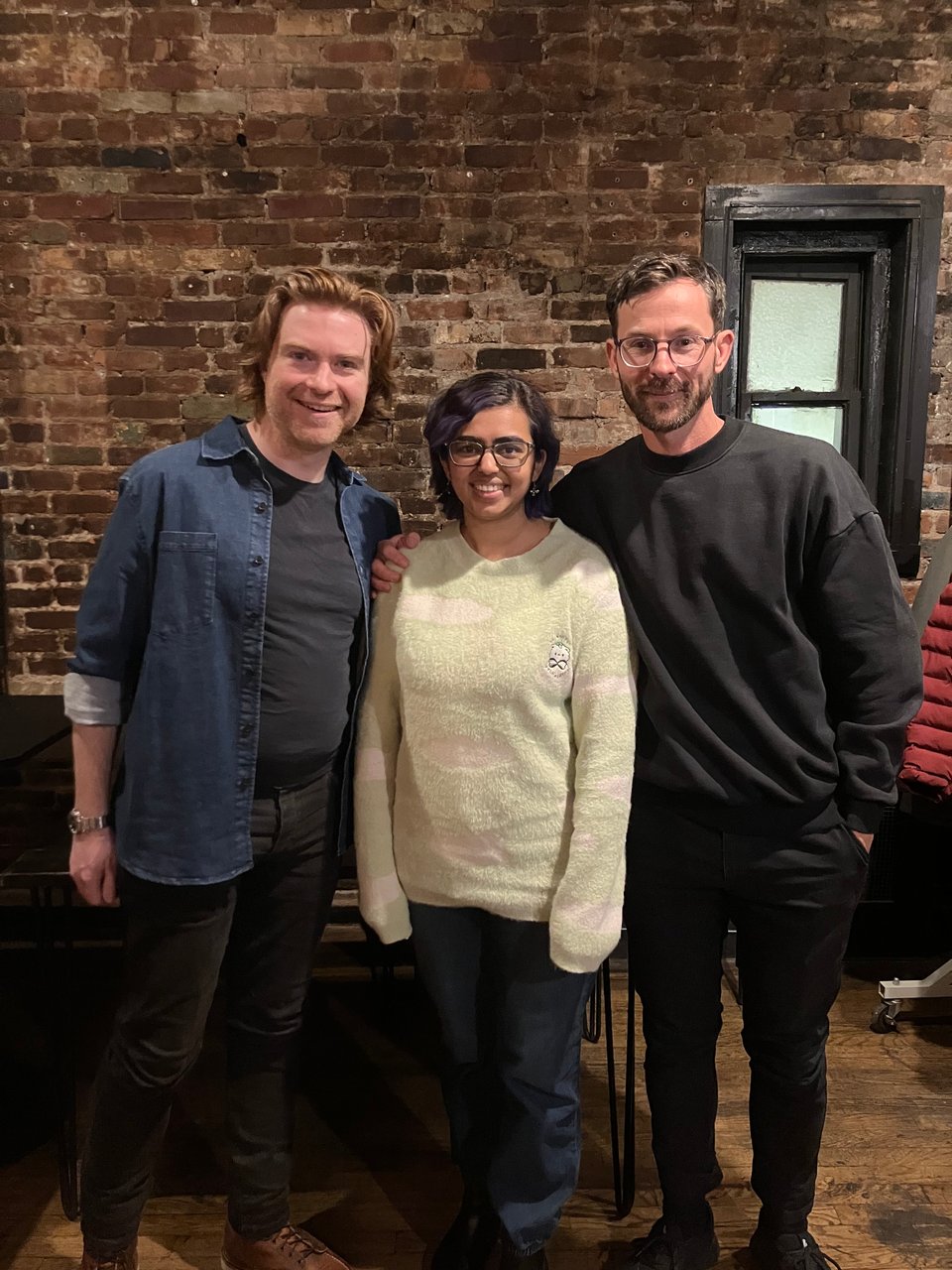
Earlier this month, I woke up from a nap to discover I’d finally gotten off the waitlist for a meet-and-greet with Angas Tiernan and Liam Runnalls. I had just 11 minutes to claim the ticket and 30 minutes after that to make it to the event itself. Luckily, I’d already cleared my evening in the hopes of exactly this miracle occurring, so it was an easy matter to slip on my coat and shoes and race out the door, ecstatic at the prospect of meeting two men who are, to me, celebrities.
You likely do not recognize these names, and that’s because these men are only celebrities to maybe 150,000 people worldwide. Angas and Liam are the team behind Minute Cryptic, a daily cryptic crossword game with an accompanying digital community. Each day, Minute Cryptic posts a cryptic crossword clue to their website, and Angas posts a video to social media explaining the clue’s answer and how to derive it. Since their early days, they’ve grown to have a dedicated app, paid memberships, and now a 3-book deal with Penguin Random House.
At this point, I should probably explain what a cryptic crossword is. Cryptic crosswords are a crossword variant where each clue is a self-contained word puzzle, with a definition at either the start or the end of the clue and the rest of the clue comprising wordplay fodder. To solve a cryptic clue, you have to ignore the surface reading and instead deconstruct and analyze its components.
Take the following clue, for instance:

This clue makes use of anagramming. The phrase “monkey with” evokes the idea of messing with or playing with something, which tells the clue solver that a set of words or letters will need to be messed around with. In this case, those words are “no cigar”. Messing with the letters in “no cigar”—in other words, anagramming them—gives the word “organic”, which can mean “as nature intended.”1
I discovered Minute Cryptic in late 2024. By then, the various daily puzzle games (Wordle, Connections, Semantle) had all become too easy for me, and I’d bounced off them in a big way. I say this not to brag, but to contextualize the level of difficulty I enjoy in word puzzles, almost definitely a product of having spent my formative years on an internet forum dedicated to riddles and brain teasers.
Enter Minute Cryptic, which was baffling and inscrutable and thus an exhilarating novelty. I spent a couple weeks just watching Angas’ videos, trying to wrap my head around how cryptics worked. Then I opened the website and began attempting the daily clues. It took me a month to finally solve a clue without using hints, and another month after that to gain any measurable confidence in my cryptic solving ability. I was hooked, though, and I’ve since amassed a 400-day streak, as well as succumbed to the allure of the paid membership, which offers access to exclusive mini cryptic crosswords.
If you’re not a puzzle solver, cryptics might sound like some abstruse, pedantic form of torture. But I find cryptics force me to practice divergent thinking in a way I haven’t practiced it in years.2 By requiring you to ignore the obvious and look for alternative meanings and associations, cryptics encourage you to disengage from familiar ruts in your reasoning.
And Minute Cryptic, more than any other cryptic crossword resource out there, has perfected the art of crafting clues that are challenging but still solvable. At the meet-and-greet, Angas talked about how the concept of variable reward drives the difficulty of the clues: some days you get an easy win and the quick hit of dopamine, while other days you have to chip away at the clue bit by bit such that the final solve feels like a hard-won victory. This variance, Angas noted, is substantially more effective at encouraging habit formation than instant gratification, as provided by short-form video platforms and, for me, games like Wordle.
So if you’re looking for a new daily game for 2026, or you’re trying to fix your attention span, or you just want to see firsthand what a weirdo I am, consider giving cryptic crosswords a try! Minute Cryptic even has a guide to get you started.3
Solve online || Get their book on Bookshop
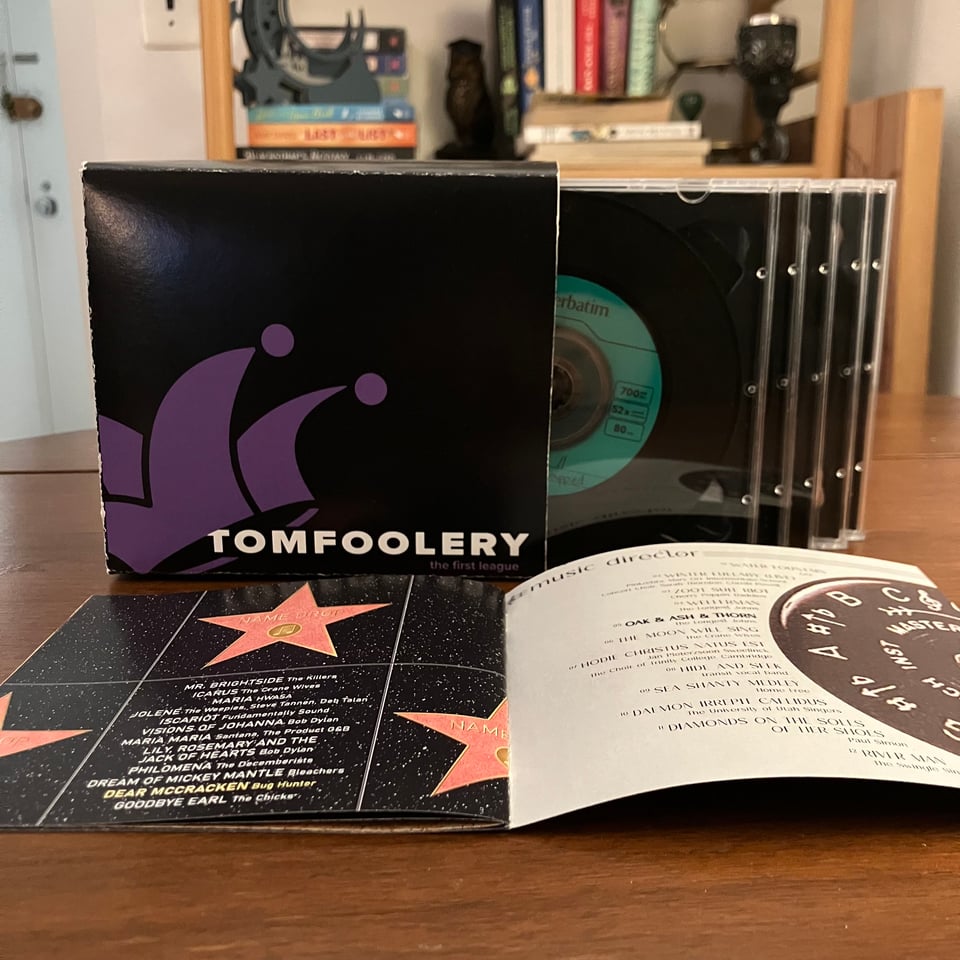
Tomfoolery: The Collected Works
Right at the end of 2025, I finished a creative project 3 years in the making. I’ll try not to ramble too much, but I’m quite proud of the finished product and I have nowhere else to brag about it.
The brief: Turn 10 playlists into a packaged product comprising burned CDs, an album booklet, and housing. Capture the spirit and aesthetic of a 90s mixtape as much as possible. Design each aspect of the product from scratch, because I do not know how to set realistic goals or achieve a Minimum Viable Product to save my life.
The design: I wanted this project to feel vaguely “retro” while maximizing modern functionality. To achieve a retro vibe, I used CDs that look like mini-vinyls and double-sided jewel cases so that I could have an A-side and a B-side in each case. Instead of a lyric booklet, I created a tracklist booklet with a page for each playlist, where the design of each page nods to the playlist’s title and theme. I used a mixture of collaging, typesetting, and basic asset creation to develop the booklet. I also created a digital landing hub, accessible through a QR code, so each playlist can be enjoyed on Spotify as well as on CD. Everything is housed in a slipcase with a somewhat minimalist design, with the intention of creating a visual product that would not look out of place on a bookshelf or CD rack.
The process: I had no idea what I was doing at any point in this project. I started with a dream, bullheaded confidence, and unfettered access to a print shop.
I had originally planned to burn 2 playlists per CD and use slim jewel cases in order to achieve a compact album profile. I had also hoped that I would be able to outsource the production of the box housing to a CD packager, so that I would only need to design the artwork rather than a full template.
This plan quickly fell apart. CD-R storage limits limited me to 1 playlist per CD. This meant I needed thicker jewel cases, which in turn required a bigger box that could no longer be produced using a third-party vendor. So I sucked it up and created a proper slipcase template in InDesign, which underwent multiple iterations in order to get the dimensions right. Then I spent a month sampling different paper types and weights to figure out what would make the sturdiest housing with minimal tearing at the creases.4
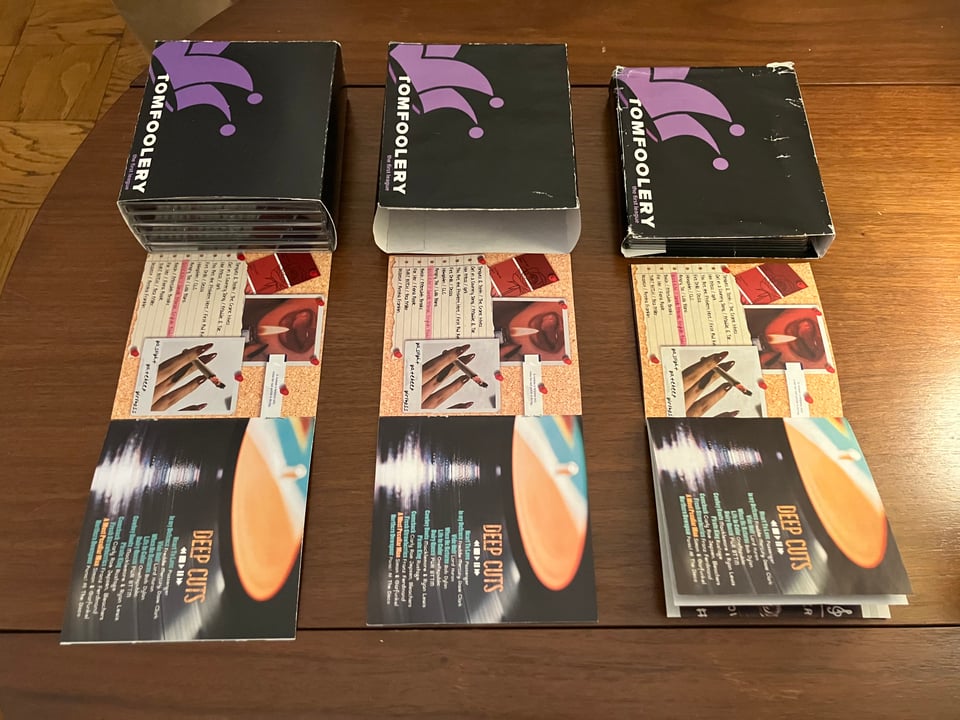
Middle: an intermediary prototype to test dimensions & print quality; printed on photo paper
Right: the very first compact prototype to test product viability; printed on standard printer paper
The album booklet was maybe the easiest part of the project on balance, and certainly the part that I had the most fun with, despite the complexity of designing 10 distinct themed layouts. I had a blast combing through icon libraries and stock photography and lists of fonts to find the perfect elements for each page. (You can kind of tell which pages I had the most fun with based on how much of a page’s design emphasizes typography; the fewer non-type elements on the page, the more challenging I found it.) I learned a lot about setting up printer files and how transparencies work in InDesign.
The finished product: I’m really pleased with how much of my initial vision and intention I was able to translate into reality. Also, I just think it looks really good. All in all, this genuinely might be the coolest creative thing I’ve ever done.

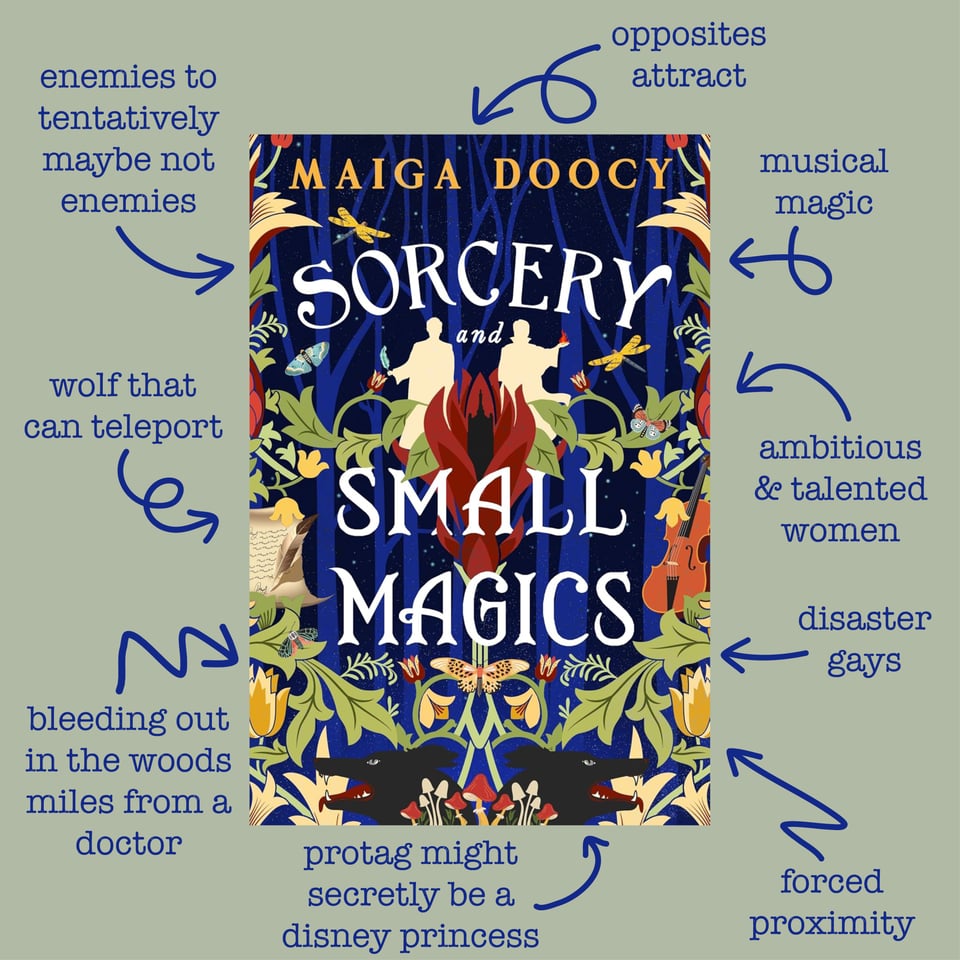
Sorcery and Small Magics
by Maiga Doocy
⭐⭐⭐⭐
Look, sometimes you just want to read a fanfic-coded5 fantasy romance that includes all your favorite tropes, including but not limited to:
a loudmouthed asshole with good intentions who believes himself to be irredeemable because everyone in his life thinks he’s a failure
a quiet, kind of uptight prodigy who is realizing with dawning horror that the asshole’s assholery is a defense mechanism and the person underneath the facade might be lovable after all
rebelling against academic convention to create your own magic (and defying expectations by being good at it)
magically induced forced proximity
only one bed (they do not share it)
taking
bulletsarrows for each otherboth of them think their love is unrequited (both of them are idiots)6
trying to figure out how many of your feelings are truly yours and how many are a product of the curse you’re under
Admittedly, the foreshadowing in the book is a little heavy-handed, and anyone versed in fantasy tropes will have no trouble guessing the protagonist’s dark secret long before he explicitly reveals it. But sometimes you don’t want a perfectly crafted book that could be taught in a literature course. Sometimes you just want a book that tells your favorite kind of story, and tells it well.
Of all the fanfic-coded fantasy romances I’ve read over the years (and boy have I read a few7), this is the only one that has me actively excited for the publication of its sequel. Winter’s Orbit, eat your heart out.

Annabelle Dinda
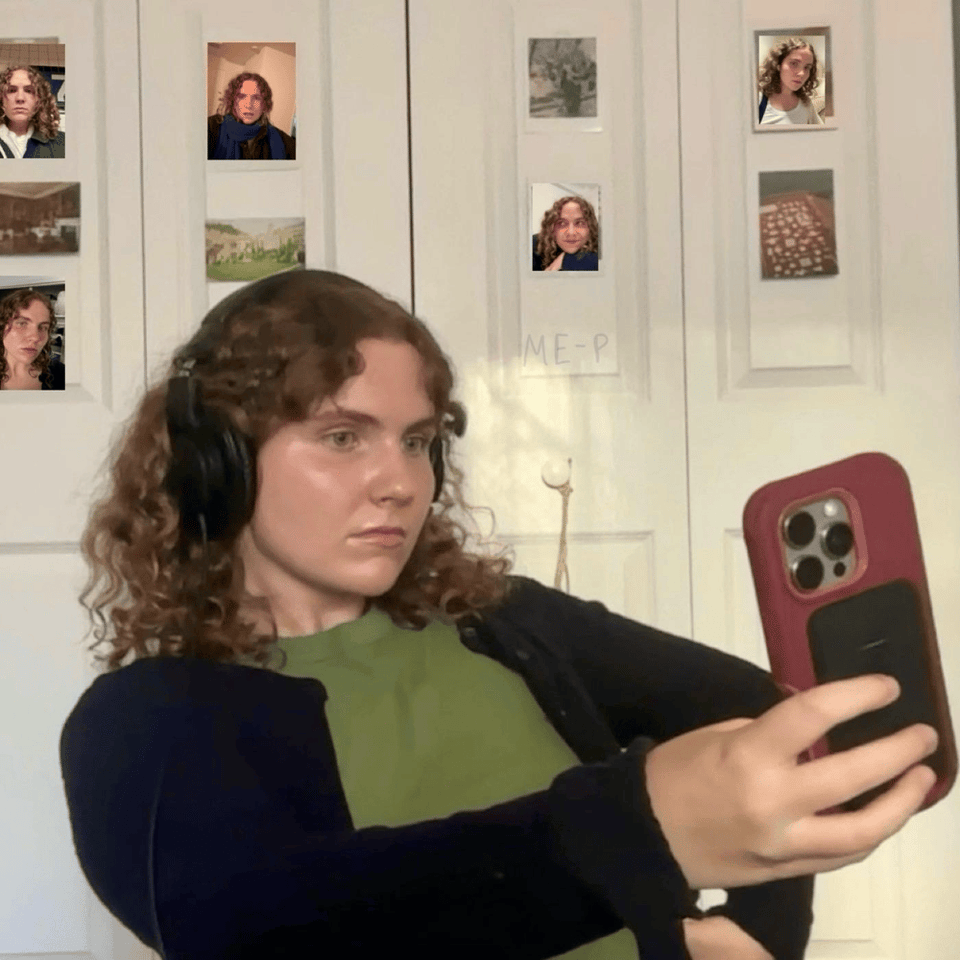
I’m never beating the “living under a rock” allegations, because I only found out about Annabelle Dinda 3 months after she’d already gone viral on TikTok for her song The Hand.
She’s enjoyed a permanent place on my “Now Playing” list ever since, though. Dinda is a folk rock artist whose music carries echoes of a lot of other artists I enjoy: The Crane Wives in her lyricism, The Paper Kites in her production and vocal layering, Joey Batey in the way she rasps and flips her way up and down the musical scale. There’s an almost bardic quality to her songs, which present lilting, loosely structured stories over often-sparse instrumentation. Her repertoire ranges from driving manifestos to introspective elegies that all share a sort of plaintive rawness, as though she’s entreating an uncaring universe for answers she knows she won’t receive. The way she presents
I like The Hand well enough, but I prefer her lesser known songs. Blunt Force and Bomb Dog has really been speaking to me lately, and Egg on Your Head (embedded below) is a delightful little earworm. I think she lives in NYC, so now I’m dreaming about stumbling across her at an open mic or a backroom concert or something; she has the potential to make it big, and I’d love to get in on the ground floor before she does.

Jonathan Strange & Mr Norrell
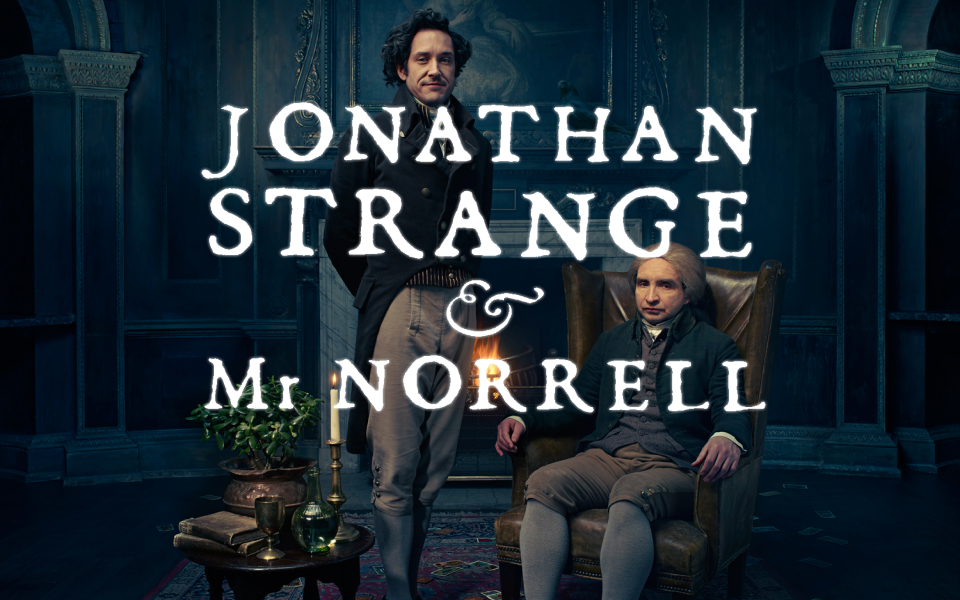
Given how deeply I loved Piranesi, I decided to give Clarke’s debut, Jonathan Strange & Mr Norrell, a try. I must confess, this book humbled me. Replete with footnotes and archaic spellings and formatted as a proper 3-volume novel, it masquerades as an artifact of Victorian fiction, something you might have found next to Austen or Dickens at a circulating library. It’s utterly brilliant: the picture that Clarke paints of a magic-barren England is so rich with detail and invented history that it feels like a true account at times. But the sheer density of information packed into the book means it demands a decent amount of brainpower, which I was sadly lacking when I started reading. It took me 3 solid months to finish the book, with regular breaks throughout to dip into lighter reads.
Even so, the book enthralled me (which I think is clear in the way my diction has started mirroring Clarke’s against my will). I wanted to linger in the world of Jonathan Strange for another year once I’d finished the book. So I immediately pulled up the show, having heard that it was one of the few genuinely good book adaptations out there. And it is, indeed, fantastic. It brings Clarke’s alternate history vividly to life through moody set dressing, phenomenal casting, and clever abridging of the source material.
And the costuming… Oh my word, the costuming! It’s clear that a great deal of care was taken to fit each character’s costume to their personality in addition to the period. Strange’s bold waistcoasts vs Norrell’s dowdy wigs; Arabella’s vivid ensembles vs Lady Pole’s ephemeral gowns; every single thing about the gentleman with the thistledown hair… Don’t even get me started on Childermass’ caped greatcoat, which has rendered me genuinely covetous.

I spoke at length a year ago about how I set New Year themes: a word or intention that broadly shapes my personal endeavors for the next 12 months. The goal is not to establish any kind of permanent change, or to fix a perceived fault in myself, but rather to experience a little more of a specific thing for a little while. In 2024, my theme was dumb joy; in 2025, it was New York. For 2026, I’ve chosen the theme of movement.
Admittedly, I’m cheating a little bit here, because this theme is driven by a desire to reintroduce physical activity to my life after a protracted sedentary period. I wanted to be intentional about the framing of the theme, though. Themes are meant to be value neutral, with no “win condition” with which to define success—and, consequently, failure. Words like “health” and “fitness” feel too charged to me, encompassing spectra where success and failure are all-too-clearly defined. (It is possible to make unhealthy choices or demonstrate a lack of fitness, after all, and I do both quite frequently.)
“Movement,” on the other hand, is much more forgiving. The only way to fail is to not move at all, and I’m reasonably certain I can clear that bar.
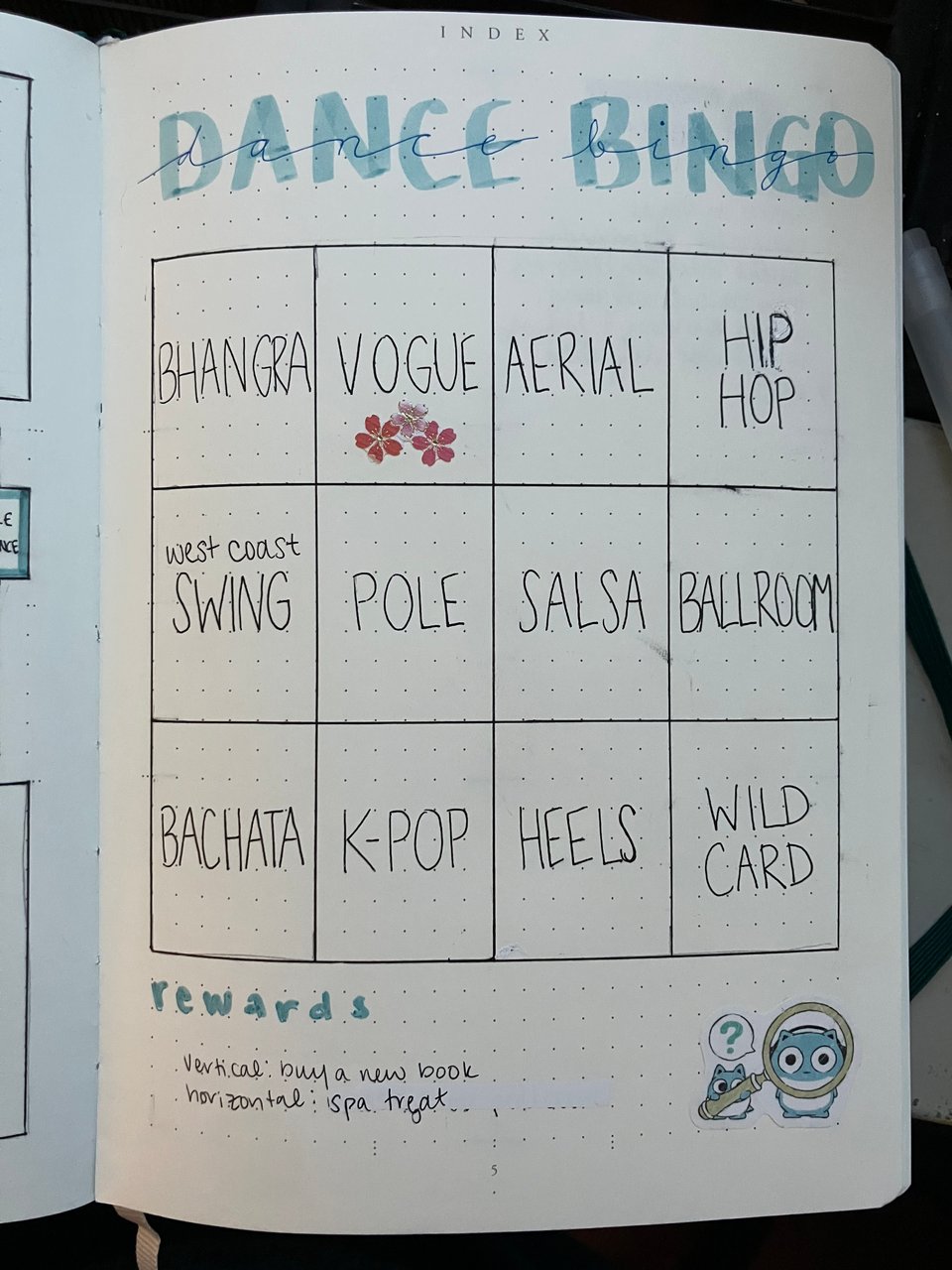
Still, goal-oriented creature that I am, I’ve challenged myself to take a class in a different dance style each month. I started the year with vogue classes at the Alvin Ailey School, as I’ve wanted to learn how to vogue for some time now.8
It will surprise no one to hear that I found these classes exhilarating. Sweat was pouring off me in rivers by the end of each one, but I bounced out the doors with my blood singing and my heart racing. To tell the truth, I’d entirely forgotten how much I enjoy dancing, even though dance was an ever-present part of my life from birth until COVID. Dance has a way of making me feel settled in my body like nothing else. It leaves me proud of what my body can do—the shapes it can fold itself into, the poses it can strike—rather than insecure. Of all the New Year themes I’ve embarked on, this might by the one I’m most looking forward to.
“But how do you know which part is the definition?” you might ask, and it’s a valid question. Sometimes the definition is easy to spot, but sometimes it’s easier to try to identify the wordplay, then use process of elimination to confirm the definition. This clue is an example of the latter process. Both “monkey” and “intended” could feasibly have 7-letter synonyms. However, with practice, a solver will immediately pick up on “monkey with” as a clear anagram indicator, then notice that “no cigar” has the same number of letters as the answer, leaving the remainder of the clue to serve as the definition. ↩
I’m constantly thinking about that experiment where kids and adults alike were asked, “How many ways can you think of to use a paperclip?” Some unnamed threshold was set to quantify “creative genius”. 98% of the children, but only 2% of adults, met this threshold, suggesting we get worse at divergent thinking as we age. Truthfully, if you asked me today how many ways I could think of to use a paperclip, I don’t know that I’d be able to list more than a couple dozen. ↩
A bonus piece of trivia: in 1942, a particularly difficult (at least for the time) cryptic crossword was published in the Telegraph newspaper in the UK as a way to recruit codebreakers to work at Bletchley Park during World War II. You can learn more about my own Bletchley Park hyperfixation in newsletter #13. ↩
My local print shop got to know me pretty well through the trial and error process. All the employees laugh now whenever I walk through the door. :/ ↩
There’s an interesting discussion to be had about using “fanfic-like” as a descriptor for tradpub. So often, “fanfic-like” is used as derogatory shorthand for underdeveloped pacing and overindulgent prose. But sometimes “fanfic-like” can be a good thing: an indication that a story focuses on relationship dynamics and character interiority, or is unabashedly leaning into its chosen tropes. Ultimately, I think it’s probably better to avoid using “fanfic-like” as shorthand altogether and instead list the actual flaws or strengths of the work in question, but on the other hand, this is my newsletter and I do what I want here. ↩
I usually refer to this as “mutually unrequited pining” but I’ve recently discovered there’s discourse about how “mutually unrequited” is a nonsensical oxymoron. I’m not aware of an alternative phrase that captures the essence of this trope, though, so if you know what to call this instead, I’m all ears. ↩
Honorable mentions: A Taste of Gold and Iron (Alexandra Rowland) and A Marvellous Light (Freya Marske). Dishonorable mention: The Irresistible Urge to Fall For Your Enemy (Brigitte Knightley). ↩
I find myself drawn to dance forms that emphasize clean lines and sharp angles. It’s this same fascination that turned me into an avid balletgoer 2 years ago. ↩