
23: Theory of the Möbius
Time becomes a loop.
You are viewing a web archive of an occassional newsletter. If you like anything here, please consider subscribing for free at sometimes.email or at the top of this page.
If you’d prefer, there is an RSS feed too, though email is the easiest way to keep track if anything ever changes.
I went to see Nirvana The Band The Show The Movie downtown in a Cineplex (no longer Odeon) on the corner of John St. a block south of the strip of Queen St. W where the majority of the movie took place. A rare cinematic alignment.
The movie features a trip back to a 2008 version of that strip. The buildings and the streetscape look mostly the same, even if the storefronts are different, but the soul of everything has changed. Even back then it was in cultural decay, the famous Speakers Corner was long closed, CityTV was no longer independent, and MuchMusic was gutted, five years had passed since the last Electric Circus broadcast.
I only ever saw clips of Nirvana The Band The Show so I’ve started rewatching some of their old web episodes. In the first episode they drop the non-fuck F-bomb. In the movie Matt realizes he’s not in 2026 anymore not by changes in storefronts, or newspaper, but by the casual usage of that F-bomb in another movie. Nothing changes, patterns repeat, but culture progresses.
In 2012 we went to watch the movie Trance at the now defunct Marble Arch Odeon, across from Hyde Park in London. At the end of the movie there’s a scene in an underground parking lot from which they exit… at Marble Arch. The film ended directly under where we were sitting, watching the film end. A rare cinematic alignment.
One block south, in the north east corner of Hyde Park, is its famous Speaker’s Corner.
Oculart returned!
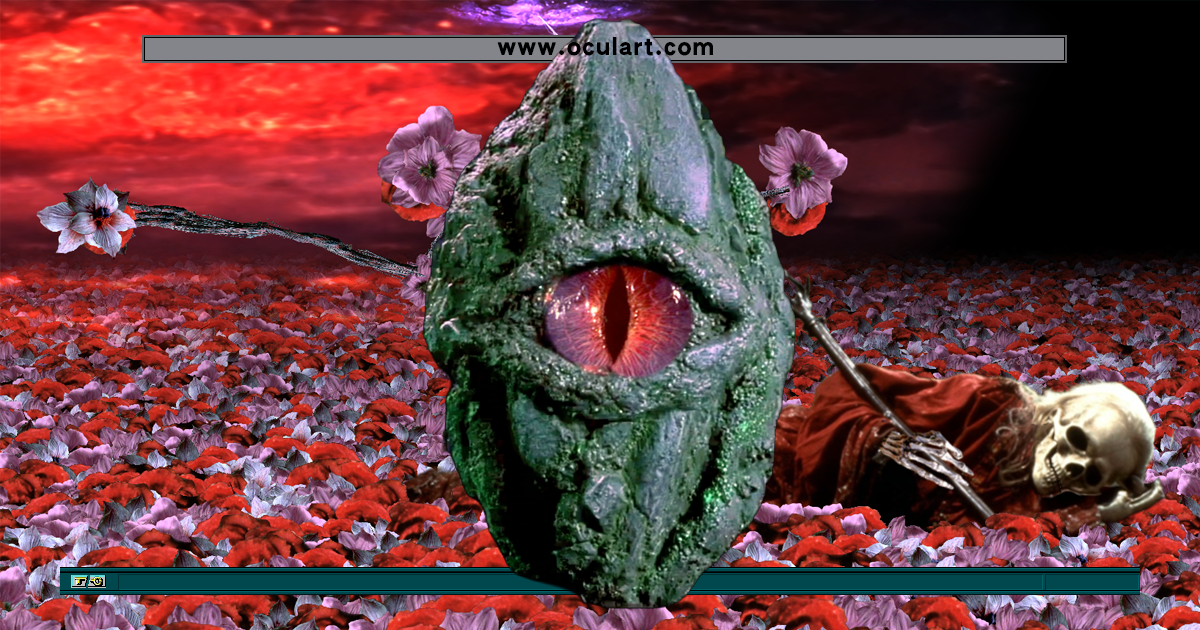
OCULARTV2
by: Geoffrey Lillemon
The early 2000s internet, for me, was overflowing with little interactive little art sites like this. People exploring animation, design, interactivity, on their own, usually with Flash, on their own personal sites. Oculart was one of many. Now it feels unique.
Here’s what the site looked like in 2002: https://web.archive.org/web/20021125214104/http://www.oculart.com/, emulated with ruffle. In its little sidebar it has the advice
click often
read more
One of the lost artifacts of that era of the internet is the splash page. There was a utilitarian purpose to it that’s no longer necessary (browser requirement checks, resolution checks, Flash validation, etc), but it was also a greeting card to visitors, a quick introduction given space and breathing room on low resolution monitors. They would often lead into sites that were dense in information and interface, maximizing the available screen space when 640x480 was still common, and the splash screen would create more creative space that wouldn’t fit anywhere else in the site.
Collaborative design sites, in particular, would feature new artists on their splash screen frequently. I like this one on Canadian design site allmaple, and this one on Japanese design site Shift (not to be confused with Canadian tech and culture magazine Shift.)
Shift, in particular, had a great banner gallery with some known names in design represented (TDR! Hi-Res! Kyle Cooper). They work but there’s some URL work that needs to be done to access them. I should create a gallery of these, easily accessible, he writes as he adds another side-project to his todo list that will never be completed.
Kotaku with a mini-oral history of an EGM Yoshitaka Amano cover in 2001. 19 years later he would do a famous cover for Vogue. I’ve long given up on the idea of ever owning an Amano print, five figures minimum!, though thanks to Lost in Cult I at least have a poster and a signature. Although…
I liked this outsider’s look into the 1990s Japanese video game industry in this interview with Richard Honeywood at Time Extension. It’s fascinating how much the video game industry, and many of its famous and infamous Japanese works, happened only because of the Japanese bubble economy and all the money thrown around. There’s some parallels to the current era and AI, though today’s bubble is all speculation and capital without any of the cultural benefits:
It was the bubble economy; they were super-rich. They also had this thing called fuzzy logic, which is basically what the AI bubble is right now. They were putting fuzzy logic into washing machines, rice cookers, microwave ovens, whatever you could think of, and it was going to take over the world.
At Hosei University, I took classes on artificial intelligence, including fuzzy logic and OCR (optical character recognition) for reading people's hand-written Japanese text. But I soon realized that the fuzzy logic thing was just all smoke and mirrors; there wasn't actually anything there, which is like shock horror, the whole AI thing today. That's why I'm very anti-AI right now. I lived through the whole fuzzy logic bubble, and I realized just how much of it was marketing hype versus reality.
An interesting look at The marketing of Sega in Italy (1984 – 2001). As someone that was raised in Canada on, primarily, Japanese games, the big gap in my gaming knowledge is what was local and popular in non-Japanese, non-English, markets. The dominance of western game history online has averaged out other gaming cultures:
Still, to this day, it is relatively easy to come across articles – written by Italians of all people – that keep on mentioning the “console wars” in the 90s or the “great video game crash of 1983”, and yet, did not seem to have any particular effects on Europe.
This one’s a few years old: A Floppy Disk MIDI Boombox: The Yamaha MDP-10, and as much as I love the idea of a floppy disk powered MIDI boombox, what really stands out for me is that there was an official Final Fantasy IV soundtrack for the Yamaha Electone organ from 1991. Unfortunately Nicole Express couldn’t read the floppy.
A 1997 look into Reboot at Wired (original link), everyone’s favourite 1990s Canadian CGI animated saturday morning cartoon. One thing I learned from this is they couldn’t use “the word hockey on the grounds that it's apparently slang for a mixture of semen, urine, and feces.”
I watched a lot of Saturday morning cartoons in the 1990s, oblivious to the regulatory and commercial forces that shaped them in the Reagan era. An article from that era, 1987 to be exact, gives a great overview of those forces: HOW IMAGE MAKERS SHAPE KIDS' TV : Q5 Firm Advises ABC on the Look and Style of Cartoon Shows; Some Writers Call It Intrusion - Los Angeles Times
“There is no sense of honor, of anger, of deep emotion, of love. They’re bland-izers; they try to hammer out all of the high and low points of being a human being. I can see we’re not doing Dostoevsky on Saturday morning, but there has to be some leeway to create characters who are free to express themselves.”
J. Michael Straczynski, who later created Babylon 5, features prominently. Maybe prophetically knowing his future struggles with TV studios. A couple weeks back something called ClipZone: Beyond Infinity, which seems to have a deal with Warner Bros., temporarily, and probably accidentally, uploaded a bunch of full episodes of Babylon 5. I rewatched the pilot episode – the re-cut and re-scored one that is listed as the zeroth episode of S1, not the original TV movie version – for the first time in many years. I still like it. The show had its issue though the journey was, mostly, rewarding.
Farscape recently put full episodes on YouTube. On purpose. Farscape came out at the very end of the decade, in 1999, and acted as the epilogue to what I think consider the golden age of televised sci-fi.
One could reasonably argue that this decade has been a golden age. Indeed, a lot of prestige shows across all the streaming services are sci-fi. And there are good ones! Yet I look at all the money and talent thrown at things like Foundation and Alien: Earth and Stranger Things and I’m left bored. I’ve somehow watched all of Foundation and it’s such a mess. A very beautiful, well produced mess, with the most nonsensical plot.
Alien: Earth was the same. One episode late in the season ended with a nonsense revelation and then in the fade to black credits roll “Cherub Rock” from The Smashing Pumpkins played. Every episode of the series ended with some of the most 90s alt rock or metal, but there is something particular about “Cherub Rock” that took me out of the year 2120 and into 1993, watching The Smashing Pumpkins videos on MuchMusic and episodes of Star Trek: The Next Generation on CityTV.
That’s the thing with time travel, you’re already doing it. You and the culture you’re in is progressing. The common theme in many of these stories is the time traveller realizing their own evolution. If I were to travel back to 1993, I don’t know what I’d change or how I’d change but for sure I would no longer fuck with The Smashing Pumpkins. Retroactively that era for me is early Autechre, Future Sound of London, SL2, Nookie, LFO, and on and on and on. They were my future all along.