
🕰️ jumping through time
on ushering in your dreams
Hello dear friends,
“We don’t experience time the same way,” a mentor of mine told me recently. Sometimes that’s because of how we’re raced in this society ( I definitely feel that Black women move through time in a distinct way). Sometimes it’s because of your job, your gender, your sexuality, and everything that’s specific to your environment, your history, and the people you belong to. But time doesn’t just happen to us. We also move and touch and change time. And I’ve been learning how to jump through time for the past two months, and in doing so, how to shape it.
When writing the novel got to be too much with all my other commitments I was juggling, I used September to take a break from writing and to re-embark on The Artist’s Way by Julia Cameron. The Artist’s Way is a book and 12-week program for anyone who wants to reshape their relationship to creativity. The defining belief of the book is that all life is fundamentally creative, and by extension all humans naturally want and need to create.
Each week, you move through a different chapter of the book, focusing on themes like creative blocks, jealousy, self-belief, spirituality, while committing to daily morning pages, weekly artist dates, and a series of written prompts you use to reflect on and change some of the damaging beliefs about your own creativity. There’s a lot of information and content on this book(it’s been around since the 90s and has captured the hearts and minds of a lot of humans across the generations) so I won’t go too deep into the book itself but I did want to share something that was coming up for me in relation to this idea about time-jumping.
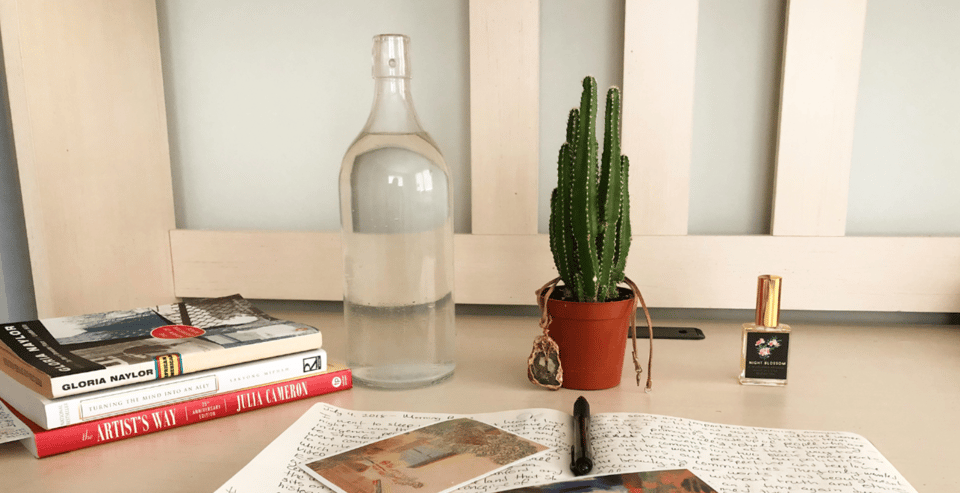
During Week 4 of The Artist’s Way chapter entitled “Recovering A Sense Of Integrity”, one of the prompts asks you to describe yourself at eighty and think about what you may have enjoyed by this stage of life. And then you’re asked to write your current self a letter from this 80-year-old version of yourself. And over the course of a morning, I found myself sitting across the table from this elderly Sojourner. She has a certainty of self that can’t be rattled. She is a generous listener who can make most anyone in her path feel held. She has a sense of humor that cuts through the challenges of life. She is constantly creating something – whether that’s a quilt for a loved one, a meal, or growing a flower. She has organized all her journals into a neat archive and has left instructions for the next generation on how to care and engage with them. She owns a home by the ocean in the Ivory Coast. She’s made it to every continent on earth. She gets everything she needs, in the end.
As I wrote from the eyes and heart of this version of self, I felt both of us climbing through time to reach each other. My desire for what my life might be like catapulted through the future and settled into a frenzying clarity, a physical truth. And I touched this truth, meaning I held the future and made it the present. Julia Cameron writes, “people frequently believe the creative life is grounded in fantasy. The more difficult truth is that creativity is grounded in reality, in the particular, the focused, the well observed or specifically imagined. As we lose our vagueness about our self, our values, our life situation, we become available to the moment. It is there in the particular, that we contact the creative self. We become original because we become something specific.”
The following week, through a prompt offered from Cameron’s chapter on “Recovering A Sense Of Possibility”, I began collecting a file of images related to postponed pleasures, imaginary lives I want to live, desires, dreams, adventures I want to go on, items I want to own etc. I got really specific about the things on these lists, and whenever I saw something that reminded me of my list out in the world, I would take a picture of it and file it away into a folder in my Notes app. And the more I collected images, the more my internal dreams seemed to pop out at me on morning walks or during late night TV binges. Cameron calls this practice “imaging”. She writes, “this is a very potent tool. I now live in a house I imaged for ten years.” Whatever the name we give it, for me it’s like a deep devotion to collapsing time. Every time I intentionally file away an image that’s connected to a dream I have already named for myself, it’s like I touch a version of the dream that has already materialized. The more specific I am about the desire or the adventure or the item, there seems to be less space between me and the object of my imagination – less time between us. Through that clarity, I welcome the reality of my dreams into my life. And in being in constant contact with the things dreamed of, I animate my dreams into the present.
“As we eliminate ambiguity, we lose illusion.”

- Julia Cameron
💡 i just had an epiphany (creative breakthroughs)
creative arcs of return: I recently took a class with writer and artist Cody Cook-Parrott called The Long Arc. The class focused on guiding creatives towards their own definition of consistency. The end outcome was a plan of sorts we created through guided prompts, with the intended purpose of bringing one or a few creative projects into sustained, forward motion. One of the biggest takeaways for me was Cody’s definition of consistency, which they said is “the process of return. It’s a pattern that builds trust and continuity. It’s the reliability of an action. It’s the thread that runs through your days, even when the threads knot or fray.” After feeling really overwhelmed about continuing my novel draft (and not writing anything for a month!), this definition pushed me to think about what kind of writing practice could nurture this version of consistency. For the past three weeks, I’ve been doing micro-writing sessions for my draft (anywhere between 10 minutes to 30 minutes) and that’s been cutting right through the noise of anxiety and “not good enough”. Here’s a series of questions from Cody that helped me work through my current relationship with consistency:
What has consistency meant to you in the past?
Does the definition still work for you?
If you could move towards a version of consistency that works with your body, life, and energy, what would THAT consistency look like?
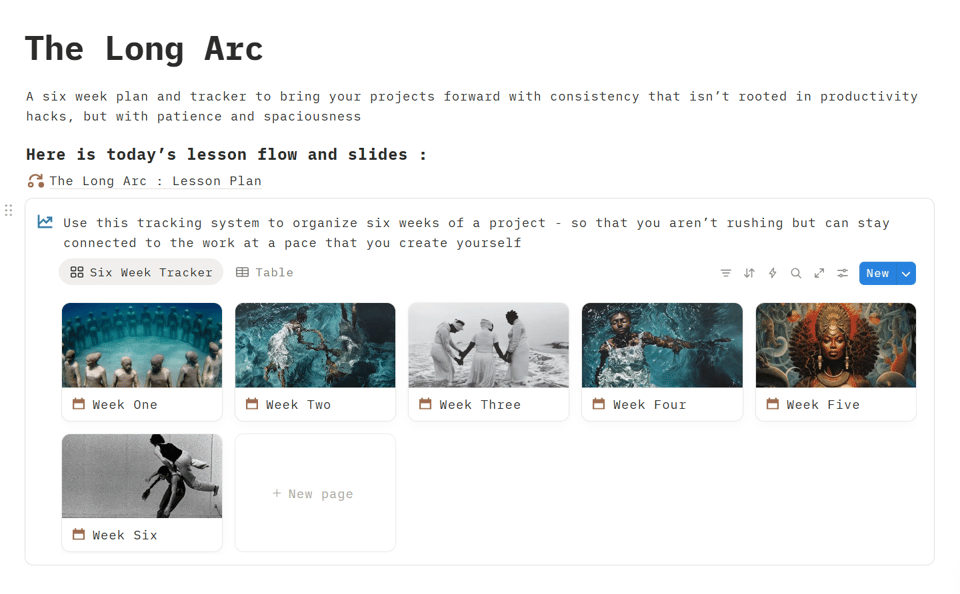
a snapshot of the 6 week plan I built on Notion in Cody’s class to move my novel forward. Let me know if you’d want to see a template to support your own creative project/s. dropping down the well: A lot of the anxiety I deal with as a writer comes from this belief that the entire burden of creation is on me. It’s this feeling that with every sentence I write, I need to strain in order to meet the constant demands of invention. And that really keeps me from wanting to return to writing/creating sometimes. I was struggling with that feeling in big ways all of September and then during week 7 of The Artist’s Way, I came across the following quote:
“Art is not about thinking something up. It is about getting something down. The directions are important here … Art is an act of tuning in and dropping down the well. It is as though all the stories, paintings, music, performances in the world…are like an underground river. They flow through us as a stream of ideas that we can tap down into. We hear what’s down there and we act on it – more like taking dictation than anything fancy having to do with art.”
Julia reminds me that we’re not really here to invent from complete scratch. That’s not our job. Our job is to listen. I can listen. WHEW.
Where can you let go of the need to be the inventor in your creative practice and be more of an observer or devoted listener?
How do you think you would feel if you made the transition?

☔ what’s pouring in (sojourner’s inspo)
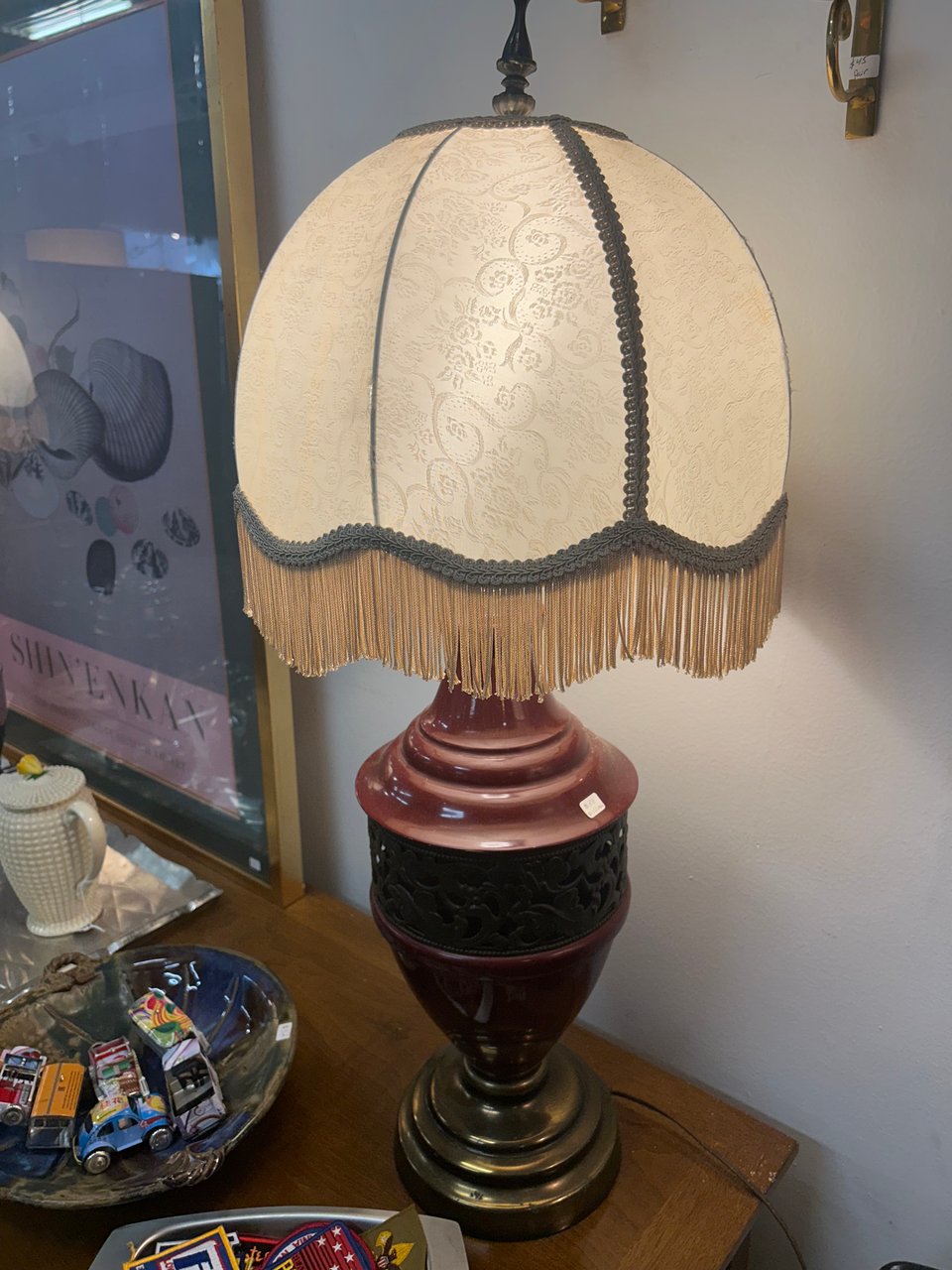
new orleans gothic: Spooky season is one of my favorite times of year, and I typically have one or two tv shows that ground me in the season. This year, I was glued to my seat all of October watching Interview with the Vampire. Adapted from the 1976 novel by Anne Rice, it follows the life of Louis de Pointe du Lac, a gay, affluent Black man in 1910s New Orleans who is romanced and then later transformed into a vampire by the charming, French vampire Lestat de Lioncourt. It took me a few episodes to feel connected to the characters, but I immediately fell for the world. Since it’s a vampire series, most of the show takes place at night, and New Orleans’ elegant yet grimy glamour of the Progressive Era really shines through. I’ve been obsessed with art deco and art nouveau interior design styles lately, and this show has been quite the feast for the eyes when it comes to set design. I can't get enough of the fringed lamps, the emerald greens, and ALL. THAT. VELVET.
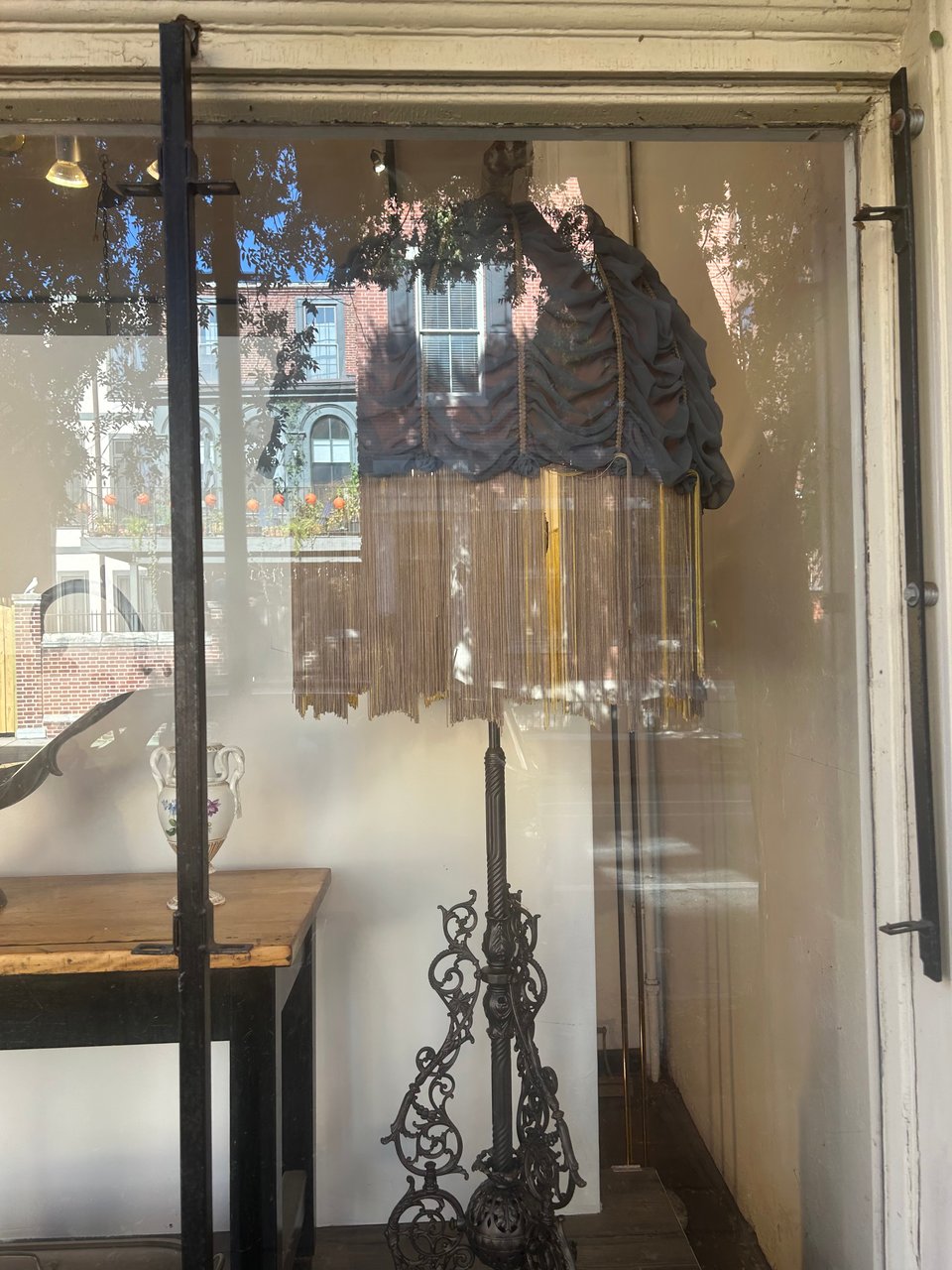
high fantasy audio: I’ve been looking for a new podcast to get into and recently discovered a few podcast production companies that produce something called audio fiction, which is basically a hybrid genre that bridges together narrative fiction with audio. It’s different from an audio book because the stories don’t always include narration…sometimes it feels like you’re just listening to a play or a conversation between characters. And some of them have really fancy sound design, almost like a TV show or a film. The other key distinction is that audio fiction has a real cast of voices, not just one narrator acting out all of the voices from a particular book scene. I’ve been getting into one in particular called Levian.
It’s very Game of Thrones- coded, so if that’s your thing, you'll be into this. It follows this Lord named Vallentin Tellari who is forced into exile by his sister and must make a deadly journey across the sea. I think the thing I’m most impressed by is the writing, especially the writing about the ocean. These are characters that have been shaped by their built and natural environments, and the setting has been shaped by them as well.

Levian is a high fantasy audio drama by the creator of Hug House Productions.
🌊 the bottom of the sea (novel writing updates)
lifting the veil: “It’s tea time and the dolls are at the table. Listen”. I’ve been both haunted and energized by that line from Anne Lamott’s Bird by Bird, a nonfiction book on writing fiction and what it takes to be alive and attentive to life in all the ways. In this quote, there’s a message about surrendering to your characters. At the outset of any novel writing process, you don’t know your characters. They come from you, but they’re also hiding a lot from you, too. One of the ways I decided to spend time with my teenage protagonist, Ahou, was to write first person point of view scenes from the POV of other characters in her life. I wrote about her parent’s love story from the POV of her mother, June, who is a Black-American expat living in Cote d’Ivoire. I wrote a scene from the POV of the mermaid Ahou will encounter in the ocean, and used that space to explore the mermaid’s lore and her creation story which were adapted from the folklores I grew up hearing about my father’s ethnic group, the Boulé, and Mamy Wata, a mystical African mermaid who frequented all my bedtime stories…
Upgrade to a paid tier of starshine & clay to read the rest of my novel updates.
Become a paying subscriber of the newsletter to get access to this post and other premium content.
a subscription gets you:
📖 behind-the-scenes novel updates + creative writing resources for your own projects
🍲a recipe/food essay
🙋🏾♀️ Q&A thread : ask me anything about writing, freelancing, or creative process
early access to coaching + workshops.
As I write this letter to you, I’m laying deep under layers of blankets and a new, burnt orange comforter. The humidifier’s steady hum and glow has stopped now, and there is warmth in the air that’s fighting back against the dryness of the season. I am nursing the end of a cold, which means I am learning how to move slowly again. May this season be warm and slow. “I am trying to get a little orange into this poem” a writer once told me. May you call “a little orange” into your season. Happy Autumn!
from the footsteps of my desires to yours,
🦉sojourner