
Choose Your Chair Wisely
Surviving AI's job disruption through strategic signals, subtractions, leadership and ownership.
One strategic signal 🔭
One (human) prompt 🧠
One subtraction opportunity ➖
Created by Sam Rogers · Powered by Snap Synapse
Freely available on Substack, LinkedIn, and our mailing list.
New issue every Monday.
🔭 Signal: "Not My Job" is Predictive
When I present about AI or teach skills to people who are warm to the idea, I keep hearing the same pushback: "That's not my job."
And they're right. It isn't. But that's a bigger problem than it sounds.
Until recently, my standard response was the old security-culture line: "It's everyone's job. We all have something to share." That landed fine. Polite nods. Not much change.
Last month, I started trying a different response: "You're right, it isn't. But don't you want it to be? Because otherwise, you're about to run out of work."
Every job that exists today was built to move at human speeds for human needs. AI has introduced inhuman speeds for inhuman needs. The nature of what jobs are is shifting underneath us. This hasn't happened quite like this before, but it has happened before. Ask a generation or two older than yours and they'll be glad to tell you about their version.
So now it's our turn. Not to panic, but to step up and shape what happens next. Because here's the part most "not my job" responses miss: employers aren't going to keep paying people complete task lists anymore. They're paying for something AI genuinely can't do: take a stake in the result. AI can help design the workflow and execute the checklist, but it cannot own the problem. That's our human edge. And accountability is the only part of the job description that's getting more valuable, not less.
So what do you think leadership hears when someone says "not my job"?
Worst case? They agree with you.
🧠 Strategic (Human) Prompt: Whose Job Is It Then?
Instead of asking: "What training do we need for AI?"
Ask: "Where is accountability for AI outcomes actually living in our org right now?"
If nobody owns the result, the result owns everybody.
And a special prompt for all my Learning & Development professionals in the audience:
"What would it look like to measure AI capability in real work, not just in training?"
The organizational label may shift and the scope may change, it's happened before. But the skills you've built over careers in L&D remain deeply relevant: helping people adapt to change, stay safe, and amplify business impact. This is the moment to get closer to the capabilities themselves, not just the courses about them.
➖ Subtraction Opportunity: Busy ≠ Safe
Stop measuring business value by how many tasks are completed.
"Busy" is now a software feature. It takes a hundredth of the time, scales on demand, and can be purchased with a token budget at the moment of need. Then, most importantly, scaled back down to zero overhead (unlike people).
If relevance depends on task volume, people already lost to the tools. Subtract the task count as proof of value. Replace it with one honest question: What part of this work can't be templated?
This week, identify just one responsibility you no longer need to "own" and experiment with redesigning the rest of your role around what remains. The part that's hardest to explain is usually the part that's hardest to replace.
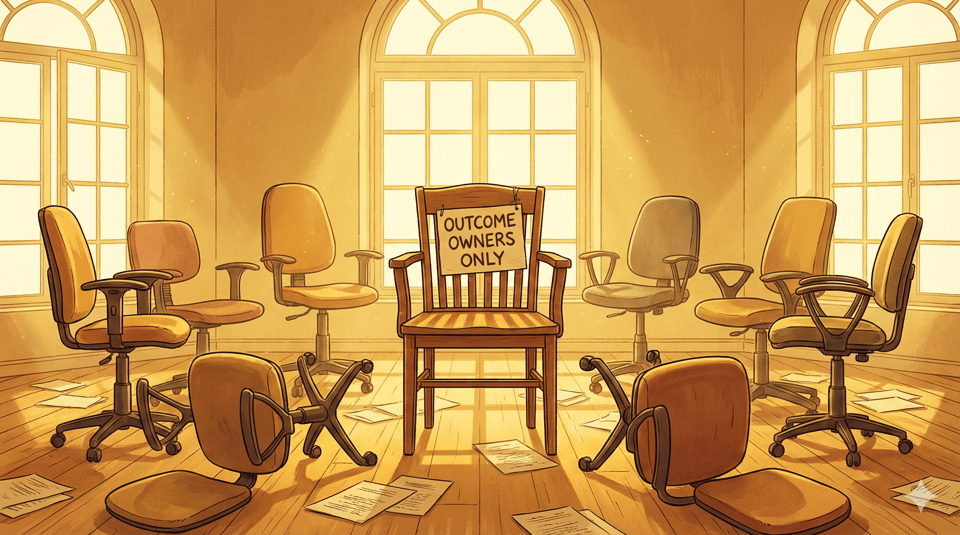
🪑 Analogy of the Week: Musical Chairs
Remember musical chairs?
Everyone walks in circles while the music plays. One chair gets removed each round. When the music stops, somebody's out. It's random, it's stressful, and the only strategy is to stay close to a seat and hope.
That's how most people experience AI disruption today: circling, anxious, hoping the music doesn't stop while they're between chairs.
But here's the twist nobody talks about: in real organizations, the chairs aren't removed at random. They're removed based on what the chair does. Task chairs vanish first. Accountability chairs? Those are not going anywhere.
The people still in the game aren't the fastest. They're the ones who stopped circling and sat down in a chair nobody else wanted, the ones labeled "Outcome Owners Only"
Don't compete for the shrinking seats. Claim the one that was always available and that AI doesn't fill.
♬ Closing Notes
You can be robbed of a job, but accountability always counts. Now more than ever. My heart goes out to those who find themselves suddenly and involuntarily self-employed. Next week we'll talk about what to build.
For this issue, the takeaway is that the most dangerous belief in any organization right now isn't "AI will take my job." It's "AI isn't my problem." Because the second belief is what makes the first one come true.
Don't bring a belief to a science fight. Bring proof that you own something that matters.
Until next time,
Sam Rogers
Chief Accountability Officer
Snap Synapse – from AI promise to AI practice
If "not my job" is the most common AI pushback in your org, that's a signal worth measuring. See where your team's AI collaboration behaviors actually stand with PAICE.work.
