
The Handoff Gap
Ownership at AI Scales and Speeds
One strategic signal 🔭
One (human) prompt 🧠
One subtraction opportunity ➖
Created by Sam Rogers · Powered by Snap Synapse
Freely available on Substack, LinkedIn, and our mailing list. New issue every Monday.
🔭 Signal: Ownership at AI Scales and Speeds
Q1 planning is in full swing. How many artifacts from Q4 just got copy-pasted forward without anyone checking if they're still valid?
AI generates it. Humans edit/approve it. But who owns what happens to it next?

The creation moment feels complete. The output automatically looks finished. Someone clicks approve or ship and moves on. But then these artifacts take on lives of their own in the world. They get referenced, forwarded, updated, inherited. And when they do, the context that made them "good enough" at birth doesn't travel with them like a passport.
What I'm seeing: Documents with no version history because the AI conversation is long gone. Analyses that can't be reproduced because the prompt wasn't saved. Deliverables that outlive their creators' tenure. "Who made this?" answered with shrugs.
Every AI-assisted artifact is a future maintenance burden, a future audit question, a future "why did we decide this?" with no trail. The generation cost dropped to nearly zero, but the ownership cost didn't change at all.
To be clear, this is not a new problem, this is a scaled problem. Meaning we have solutions that kind of work at human speed, but break at the inhuman speed of AI.
Nobody planned for AI-generated artifacts to accumulate this fast. Now shared drives, knowledge bases, and project folders are filling with orphaned content that looks authoritative but has no steward. The person who created it moved on. The context that justified it evaporated.
The next person to find it has no way to know whether it's still valid, or if it ever was. So what will they do? Chances are they'll just make more.
🧠 Strategic (Human) Prompt: Provenance Check
Before celebrating the output, ask:
Who owns this artifact six months from now?
Not who generated it. Not who approved it. Not who requested it. Who updates it when the context inevitably changes? Who defends it when someone asks why? And most importantly, who deletes it when it's time? Because we're not so quick to trust AI to do that part for us.
If the answer is "whoever needs it next" that's not ownership. That's abandonment with some extra steps.
➖ Subtraction: Orphan Artifacts
Stop generating AI-assisted content without a named owner assigned at creation. Not a department or job role, an individual human whose name stays attached when the creator moves on.
This week: Audit one shared folder or workspace. How many AI-assisted artifacts have no clear ownership? No update history? No expiration date? If you can't even tell which ones were AI-assisted in the first place, that's its own answer.
For this one folder at least, no governance theater. Answers for the basic who, when, where, why, and what happens when this goes stale are obvious.
If generation is cheap and ownership is expensive, the bottleneck just moved. Plan accordingly. And before we can scale, we have to start.
📦 Analogy of the Week: Warehouse Slop
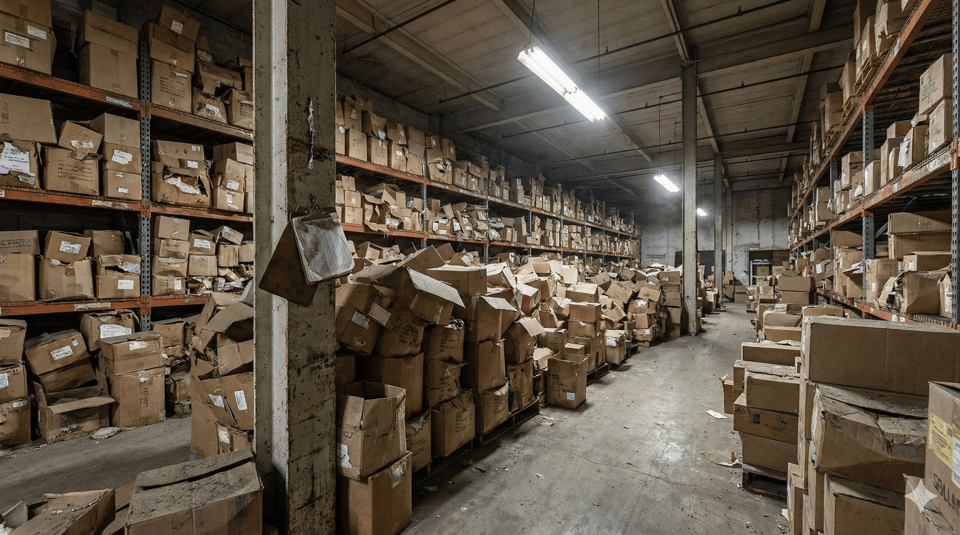
Boxes keep arriving. Labels are vague or missing. Nobody knows what's in most of them, when they arrived, or whether they're still needed.
The warehouse looks productive, just look at all that inventory! But try to find something specific and you'll spend hours digging through musty boxes that should have been discarded months ago, and dusty ones from who knows when. Worse, some boxes contain decisions that shaped downstream work. Others are duplicates. A few are actually dangerous: outdated specs, superseded policies, analyses built on assumptions that stopped being true two quarters ago. And do try not to trip or tip anything over.
That's what AI-generated artifact accumulation looks like. Fast in, never out. When you finally need to trace a decision back to its source, good luck. The box is in there...somewhere. But the person who packed it and put it there is long gone. The label says "Q3 Strategy" but curiously doesn't say which year, which version, or whether anyone ever validated it.
The problem isn't the boxes. It's that nobody's handling the inventory.
♬ Closing Notes
Last week's issue explored validation mismatches, judging AI outputs at the wrong resolution. This week's is the downstream consequence: what happens when those outputs escape into the wild without ownership attached.
The pattern compounds. Fast generation plus absent ownership plus time equals an organization that can't trust its own artifacts. Not because the content is wrong, but because no one can verify whether it's right.
The fix isn't complicated, it's unfamiliar. Assign an owner at creation. Stamp a best by date. Predefine the update trigger. Make "who maintains this?" as mandatory as "who approved this?"
Make full-lifecycle design so ubiquitous that people can go back to not thinking about it.
Until next week,
Sam Rogers
Provenance Auditor
Snap Synapse – from AI promise to AI practice
📅 Book a meeting
🎯 Collaboration effectiveness includes artifact accountability: PAICE.work
🎇 Bonus: What artifact accountability looks like in practice
Last week I vibecoded the AI Feature Tracker in 24 hours. It monitors 70 features by pricing tiers across 7+ AI providers, all with verified dates, links, summaries, version history, and a clear update path.
Every entry has a freshness date. Every change goes through Git. Anyone can file an issue or submit a PR. There is no database on the backend, it's simple (markdown) text that requires zero expertise to change, and a human reviews it before it goes live. The ownership structure is baked into the artifact itself. Feel free to use freely, suggestions and contributors welcome!
