The One-Hour Year
When individuals outrun institutions, the ground shifts for everyone
One strategic signal 🔭
One (human) prompt 🧠
One subtraction opportunity ➖
Created by Sam Rogers · Powered by Snap Synapse
Freely available on Substack, LinkedIn, and our mailing list.
New issue every Monday.
🔭 Signal: Velocity Inversions
I'm not big on Twitter/X, but these two tweets with combined 22 million views tell a compelling story about where we are as 2026 kicks off.
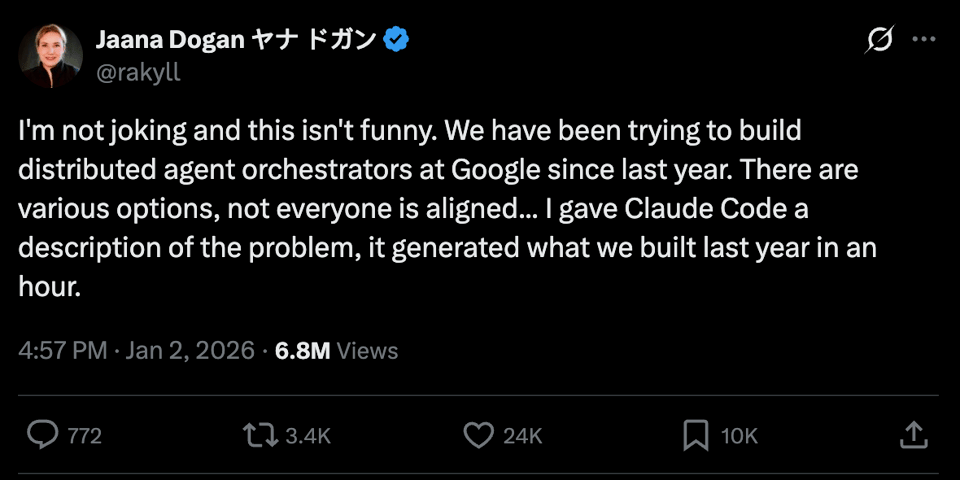
Like Gemini? Me too. This just in from a Principal Engineer working on it at Google:
Like ChatGPT? Me too. Last week OpenAI cofounder Andrej Karpathy (who coined the term "vibe coding") had this to say:
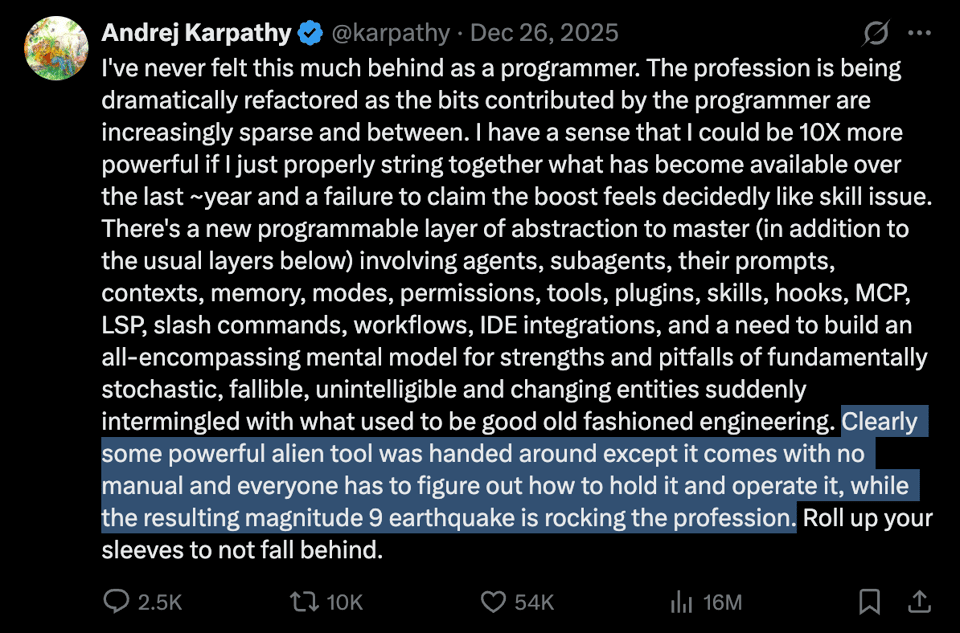
What do you see here?
I'd sum it up as: Individual + AI outruns Institution + Process.
A year of alignment debates, options analysis, and team coordination collapsed into sixty minutes. Not because the team was slow, they're some of the best in the business. Because coordination itself was the bottleneck.
This breaks everything downstream:
Governance assumes human-speed delivery
Accountability assumes people-based teams doing the work
Documentation assumes someone understood what was built
Maintenance assumes somebody will be there to fix what eventually breaks
This earthquake isn't coming. Feel things shaking? It's here now.
🧠 Strategic (Human) Prompt: What Breaks When Someone Ships Alone?
If someone on your team delivered your Q2 roadmap this week, what fails first?
Not hypothetically. Walk through it:
Who owns what they built?
Who maintains it after they move on?
What approvals were skipped? And did it matter?
Which coordination overhead turned out to be merely friction, instead of protection?
The answers reveal where your org is still optimized for a reasonable human pace that no longer exists. Some things are very unreasonably inhuman-paced now.
➖ Strategic Subtraction: "Necessary" Complexity
Stop treating all coordination overhead as automatically necessary.
Some alignment processes are protective. They catch risks, surface blind spots, distribute knowledge. Keep those.
But much of what passes for necessary is just friction that used to be invisible because no one could figure out how to bypass it. Well, now they can. The bypass exposes what was always optional.
The earthquake didn't create new fault lines. It revealed the ones that were always there.
This week, audit one multi-step approval process:
What would actually break if it disappeared?
What would improve?
Which steps in the flow exist because of documented past failures vs. habits?
Find the faults before they find you.
🌋 Analogy of the Week: Earthquake
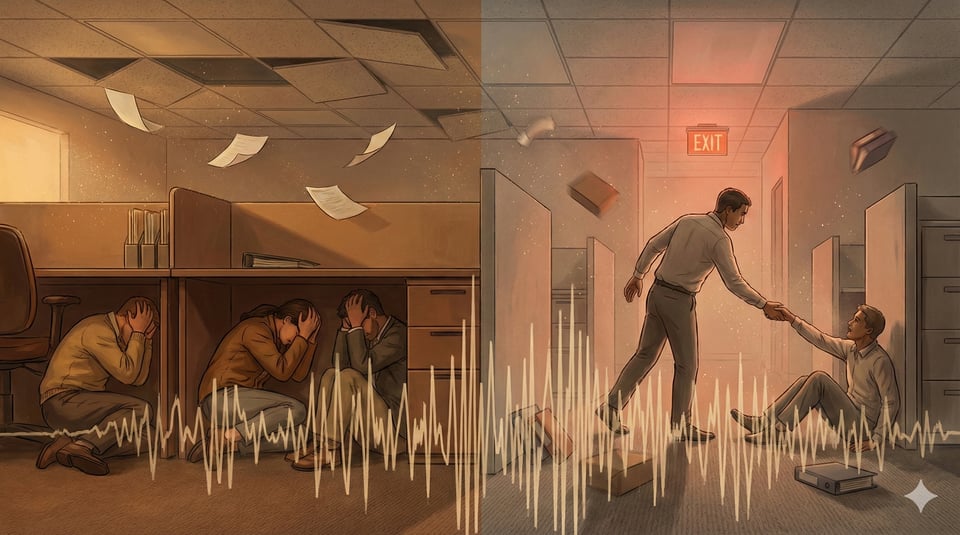
In a powerful earthquake, most people freeze or try to flee. The shaking is too violent, too unfamiliar, too fast to process. Instinct says hold still and hope it stops (bad idea), or run like hell until something stops you (worse idea).
But the people who've trained for it, who've learned how to move through chaos rather than waiting for it to end or adding to it, they're the ones who get themselves and others to safety.
The training isn't complicated. Look up, not down. Find a secure position and a path to it. Stay calm enough to be of service to those in need. Try not to be the one in need, but if you are, then say what you need. Communicate clearly and directly. Organize and adapt collectively.
The earthquake doesn't get any less powerful because you trained. But you stop freezing/fleeing anytime the ground shakes.
♬ Closing Notes
I spent most of my life in the San Francisco Bay Area. I've been through some big ones, and earthquakes used to terrify me. But no more.
What changed wasn't the seismic risk. It was learning the fundamentals: how to secure an area, how to assist first responders, how to communicate with strangers in an emergency to organize and adapt together. Once I understood how to respond and spent some time practicing the skills, the fear dissolved.
I still feel the ground shake. I wouldn't say I like earthquakes, but I don't freeze anymore.
That's the 2026 work. It's not predicting tremors, and not praying they stop. It's learning to move through them, and to work together.
The individual velocity is real. Dogan's one-hour year is reproducible. But individuals don't rebuild cities alone. And it's the collective response that gets people out of rubble.
If your org is still frozen, waiting for the shaking to stop? Consider that maybe...it won't.
Maybe it's time to roll up your sleeves and learn what to do.
Until next time,
Sam Rogers
Seismic Response Coordinator
Snap Synapse – from AI promise to AI practice
📅 Book a meeting
🎯 Ready to measure how your team actually collaborates with AI? PAICE.work
