squire me: or, knighthood & municipal politics
New thoughts on old favorites.
Note: I started writing this last autumn. Brain fog got in the way of editing it, and I’d completely forgotten it existed until now. Whoops!
Recently, I started driving myself to and from the day job. This has been a big deal, not just because I got my driver's license more than ten years later than many of my peers, but because I currently have at least an hour to fill with the Precisely Right Level of Boredom. Can't do anything too distracting, because, y'know, distracted driving. But I know that if I sit in complete monastic silence, I'll be prone to get lost in thought and get distracted anyway.
(Or become an expert in mindfulness. I've done walking meditations, but driving meditations would be new to me.)
In short: I got an audiobook to listen to in the car. It's a book I've read many times before, so if I miss a line or two because the GPS is giving me directions, it's okay. But it's my favorite comfort read, and lately, like many people stressed out by current events, I've been needing something comforting.
(Friends may be able to guess already which author I'm talking about. Pause for dramatic effect…)
If you guessed Tamora Pierce, ding ding ding! We have a winner!
In particular, I've been listening to Squire, my favorite of her books. It's book three of the Protector of the Small quartet, and it's a bit of an odd favorite; it's not the series that introduced me to her works (The Immortals), it's not her most popular series (The Song of the Lioness), nor is it set in my personal favorite of her two major settings (Emelan, of the Circle of Magic books, which were the first fantasy books I read that reflected the variety of cultures I encountered in my own life.) As a matter of fact, I stopped reading The Protector of the Small after the first book or two, the first time I tried them as a kid. I can't remember why. Maybe the bookstore didn't carry the rest, or maybe I'd moved on to a different obsession for a while.
Still, Squire is something of an odd book, in terms of your classic fantasy plots. Set in the medieval, western European-ish kingdom of Tortall, it follows Keladry of Mindelan, known to friends as Kel: the first woman to try openly for knighthood in Tortall in some [mumble] hundred years. Unlike Alanna and Daine, the first and second Tortallan protagonists, Kel doesn’t have gods watching over her or magic of her own.
What Kel has instead is stubbornness and a strong belief in fairness.
The first two books follow Kel as she goes through a probationary year (to “prove” an ordinary girl can handle the rigors of knight training) and her years as a page in the Tortallan capital. Squire picks up when she's apprenticed to a knight-master, Raoul of Goldenlake (best fictional man of all time), and follows her through her squire training until she becomes a knight herself.
The plot structure is, at a glance, largely slice-of-life. Kel isn't faced with a single, overarching antagonist—no dukes plotting to steal the throne, no emperors planning a war, not even a ringleader of bullies. A war will take center stage in the following book, but it only arrives in the final quarter of Squire; before that, it only looms on the horizon. Instead, Kel fights bandits, struggles to care for an unpleasant baby griffin, and is confronted with the limitations of Tortallan law when one of her chief bullies is taken to court.
The antagonist of Squire isn't one particular person so much as it is the prejudices and injustices baked into Tortallan society: the captain who’s wary to believe a girl can fight, the rumors of impropriety she's forced to deal with as a female squire to a male knight, the laws which treat common folk as lesser to nobility. After a tense courtroom scene where an antagonist is found guilty of kidnapping Kel’s friend & servant Lalasa, but is only made to pay a fine to Kel for the inconvenience of lost work, Kel asks for a private audience with the king.
“It was wrong, sire. […] If Joren had kidnapped me instead of my maid, the legal penalties would have been much worse.”
“Because if a member of the old nobility kidnapped one of the new nobility, it would cause a civil war,” replied the king. “I like to discourage that sort of thing.”
“But by law it’s right that I be paid for the inconvenience of my maid being frightened to death? Not even that she gets the money, but I do? That’s not right. It’s like saying common folk are slaves. Their rights are measured in coin, not justice.”
The king - who was, after all, a protagonist in a previous series, who the audience is inclined to think of as a good king if not always a good man - admits that she’s right. He’s reluctant to get into another legal battle to change the law, but every other adult in the room backs Kel up. It’s a bad law. Changing it may take time and difficult negotiations, but it must be changed.
It reminds me, to some degree, of Victoria Goddard’s The Hand of the Emperor, which follows a career bureaucrat in a fantasy empire as he attempts to implement a universal basic income, help the emperor (who doesn't want to be emperor) make a retirement plan that distributes imperial power back to the colonies, and maintain a functioning post office so he can write to his family back home in said colonies. It's not a court intrigue, exactly; that genre always implies, to me, a degree of backstabbing, assassination attempts, and reluctant alliances with self-serving characters. Instead, one of the central tensions is that of being a self-aware idealist trying to do the best you can within a flawed system.
Which is to say that it reminds me a lot of municipal politics.
One of the things which always comes to mind for me, when reading stories about revolution, is what comes next? When the revolution is over, who picks up the trash and makes sure the water stays clean? I could blame my day job (which involves working with local governments & the people who maintain infrastructures) for this. Or I could blame my upbringing; I grew up visiting family in South Africa frequently, getting most of my education in its recent history from newspaper comic strip compilations, which both celebrated the end of apartheid and satirized government responses to the crises that came in the following thirty years (AIDS, droughts, a failing power grid…)
Apartheid was ended without an outright civil war.
And, also, the end of legalized apartheid didn't fix everything.
Now, I'll try to keep this from spinning out into several dozen tangents in a row. Friends may know my love of Pete Seeger’s parable of the teaspoon brigade, which in essence boils down to “peace activism may seem impractical, like all the powers of the world are stacked against us, but if we keep showing up and doing the little bit we can do, one day there will be change.”
This is why I love Kel, and why Squire is such a comfort to me. She doesn't have a god on her side; she's kept away from anybody who could help her with magic, because she has to prove that an ordinary girl (albeit from a noble house) could become a knight without magic. She spends the whole book doing things which suck, like slogging in mud to rebuild a town, or feeding a feral baby griffin, or jousting crotchety knights who want her dead for her insolence, or attending a court which is fair under the law but not just; and she does it because somebody has to.
“When people tell me a knight’s job is all glory, I laugh, and laugh, and laugh,” Lord Raoul had once told Kel. “Sometimes I can stop laughing before they edge away and talk about soothing drinks.”
In the following book, newly-minted knight Kel is given her first command in war: not in the glory of the front lines like she’d hoped, but building and protecting a refugee camp.
In the time it's taken me to write a first draft of this essay, I finished the audiobook. I'll admit, the final chapter made me tear up; I cry easily over stories these days.
The knights in Tortall must face a final test, before going from squire to knight. They must face the Chamber of the Ordeal: a magical, semi-divine room where a presence older than the gods tests their greatest weaknesses to see if they'll crack under the pressure. Before their Ordeal, they must take a ritual bath, receive instruction in the traditions of knighthood from their knight-master, and spend a night in silent vigil on the cold chapel floor.
This vigil is usually taken alone, but in Kel’s case, another knight accompanies her to make sure that nobody interferes with her vigil. After all, bigoted squires tried to sabotage her tests in a previous book. The knight accompanying her isn't Raoul, or Alanna (the only living lady knight), or any of the other knights Kel’s befriended. The knight who insists on keeping vigil alongside her isn’t there to offer personal support.
The knight who keeps vigil with Kel is the lord magistrate, the same man who oversaw the kidnappers’ punishment and meted out consequences in precisely the measure of the law, no further, regardless of his personal opinions of said law. He’s a seventy-year-old conservative who doesn't like anybody, but knows that nobody would accuse him of aiding her unfairly or allowing others to do so.
In her vigil, Kel reflects silently on her duty to the realm and wonders how to define the realm: the plains and forests she's been traveling through as a squire? The king who rules it? The people she's defended on the way? The mix of cultures and traditions that make it up?
It's the culmination of a book concerned with questions of heroism, duty, and leadership. Duty, Kel understands, is not as simple as following the orders of authority; nor is it the glory of battle, dulce et decorum est pro patria mori. Duty is the magistrate snoring quietly behind her in a cold, uncomfortable room. Duty is doing your best to treat others fairly, even if you don't like them, and doing your best to make the world fair too.
Kel is an idealist, in a way I can relate to. The injustice, unfairness, cruelty, and flat out bullying in her world infuriates her. She knows she can never stop all of it. But that won't stop her from trying.
At the end of her Ordeal, the Chamber gives her another vision. I won't spoil it, but it's a horror she's charged with facing and ending. But the Chamber won't tell her where it is or what she can do to stop it. Her task, it says, will find her.
This struck me differently, on this read. The feeling of seeing, from afar, something horrific without knowing what to do or how to stop it is a feeling I'm familiar with. It is, perhaps, a near-universal condition of the 21st century - except, of course, for the people experiencing horrific things firsthand. The vision continues to plague Kel through the next book, getting under her skin until the moment comes where she can do something.
There's a spate of excellent lady knight books coming out this autumn, and I'm very excited to read all of them. Several, like Alix E. Harrow’s The Everlasting, deal with the role the mythology of the knight plays in national consciousness; how nations and empires are made from myths, from stories we tell ourselves about how we're different from our neighbors, how the land on this side of the river is different from the land on that side of the river. Knights, as Harrow points out in her excellent essay on the subject, were brutal enforcers of their liege lords’ reigns. Knights, at the end of the day, were soldiers. Ye olde marines. The reality of knighthood wasn't nearly so romantic as the myth.
I've been rolling around ideas for a lady knight book of my own for several years now, and always struggled with it. It comes out too sad, too dark, too much history in the fantasy. Rereading Squire, I realized that my love of Kel and her ilk isn't because of the shiny armor or swords (though those are fun); it's because of the fantasy of knighthood, because it appeals to my idealist heart, because it looks at a child setting her shoulders against an unjust world and goes you're right, we can do better, keep trying, you may not fix everything but that doesn't make the trying worthless.
And at the end of the day that, I suspect, is the thesis statement for everything I write.
Subscribe!(writing from the present again)
Thanks to my Thursday night gaming group for reminding me it had been a while since I’d put out a newsletter, and to Iain, who once said something like “I try to focus on what I can practically do to change the world, because it helps me remember that changing the world is actually possible.”
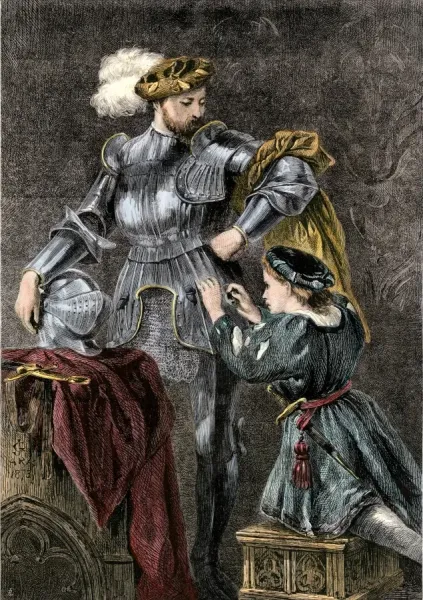
Thanks to my old HEMA friends, who would help me put on the gear I struggled with alone, if I walked up with an armguard and went “Squire me?”
Other life updates:
between moving & continuing to sort out medical things, it’s been a busy start to the year - I’m hoping for a less eventful spring
playing: Kids with Capes, a superhero version of the TTRPG Kids on Bikes. absolutely delightful. plus Werewolf: The Apocalypse, so expect a newsletter on World of Darkness sometime. also, on the video games front, some Suika, a cute puzzle game where you combine little fruit to make bigger fruit while jaunty music plays in the background.
listening: “turn me around” by Mavis Staples. heard another version in the National Museum of African-American History & Culture when I visited D.C. last weekend, and Staples’ comes the closest to the one from the museum, of the versions I’ve heard so far.
watching: I finally watched The Boy & the Heron; it was just as good and weird and emotional as I was hoping it would be. also watched Billy & Dom Eat the World, which I’d recommend for anyone who enjoys Somebody Feed Phil or watching two very silly friends have a lovely time traveling and making food together. also includes the best representation of a Scottish ceilidh I’ve seen so far (the others I’ve seen in travel shows are all very bougie.)
writing: still editing the novel! the thing about having edited a book so many times is you forget some of the boxes you put yourself in are boxes and can, actually, change. thanks to my friend Garrett for brainstorming with me and helping me get un-stuck with this chapter.
reading: the aforementioned friend’s book. I’m so mad I can’t talk about it more. this is the tragedy of having writer friends, and the joy of having writer friends. wish I could tell you to pick it up at your local bookstore, but alas, not yet. but don’t worry: the next edition of this newsletter will probably be an Oops, All Book Recommendations!
Until next time, stay warm and eat something nice.
Love,
Siobhan


Add a comment: