
Still Thinking About Perfidia Beverly Hills
Spoilers ahead, so you should probably read this after seeing One Battle After Another.
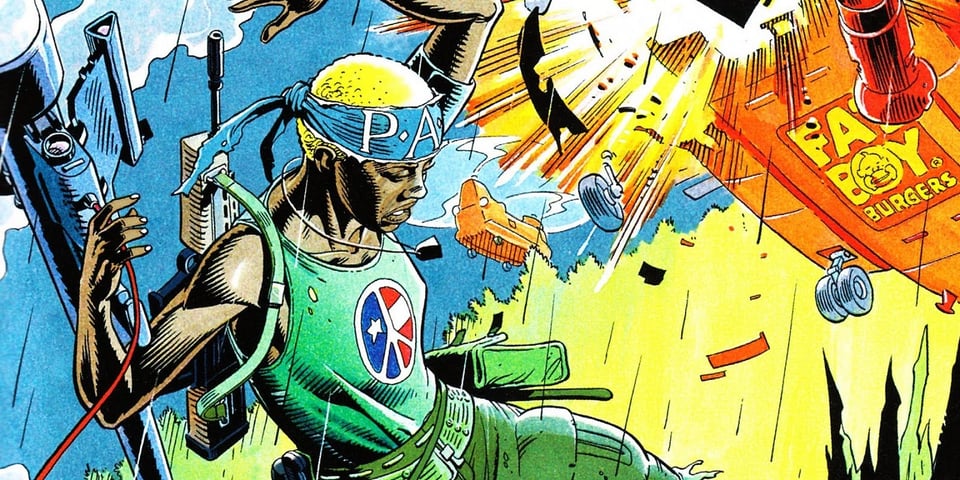
In 1990, Dark Horse Comics published Give Me Liberty, the first of their two creator-owned titles from unlovable trailblazer Frank Miller. It’s not a great comic, but it has its charms, as do even the most minor work from Miller. Give Me Liberty sold so well that it was just the first Miller-written series starring Martha Washington, a young black woman who seems to be the real face of America, according to puckish Frank Miller. Martha was born in a moribund housing project (Cabrini Green, of course), and her father died advocating for their home and their neighbors. She becomes a decorated and demonized war hero who must repeatedly save the country from its fanatic white leaders.
I have a soft spot for Give Me Liberty because there’s no real way to misread what Miller’s saying there, beyond tweaking the noses of his preesumed white male readership: this is the face of a real American hero. At the heart of that righteous challenge is a maybe easy to forgive preference for suffering as a test of character. Martha and her family give more than most white heroes would be expected to. I don’t love that, but I can appreciate that outlook coming from Miller, a pop art genius whose work continues to influence the mainstream in both obvious (Snyder) and less obvious (Gunn) ways.
Anyway, I’m thinking about Martha Washington and what Miller got away with in Give Me Liberty as I think about Perfidia Beverly Hills, Teyana Taylor’s horny American guerrilla fighter in One Battle After Another. This black antihero, along with her outspoken colleague Junglepussy (Shayna McHayle) and her mother Jennie (Starlette DuPois)…and her daughter Willa (Chase Infiniti)…and her other colleague Deandra (Regina Hall)…are both sensible and also dissatisfying if you judge the movie as a political satire.
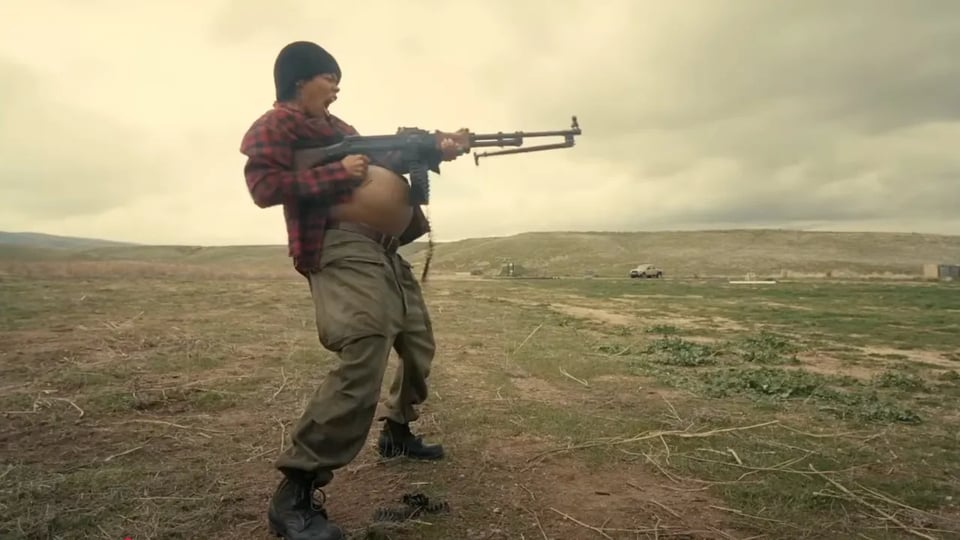
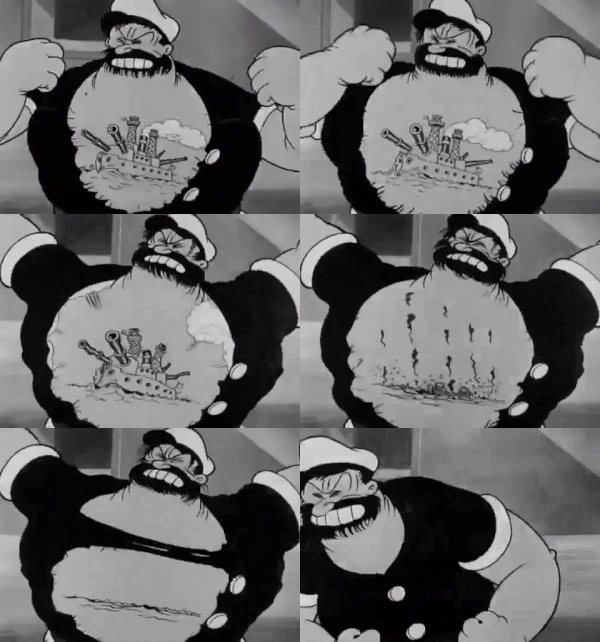
As a thriller with politics on its mind, One Battle After Another is tense fun. I was less into the movie whenever it suggests that the sturm und drang of political theatrics is instantly undermined once you know that it’s all personal and small at heart. That may be satisfying as far as Sean Penn’s story goes, with his Popeye strut and what Andrew Pope smartly calls a bad stab at looksmaxxing. But what about Ms. Beverly Hills, a conflicted character who slips away before we can get a better handle on her more strident, hyper-sexual, and sometimes empty sloganeering? Is the joke on her or us for expecting more from the character, who’s arguably most important for the hole that she leaves in both her child and partner’s lives?
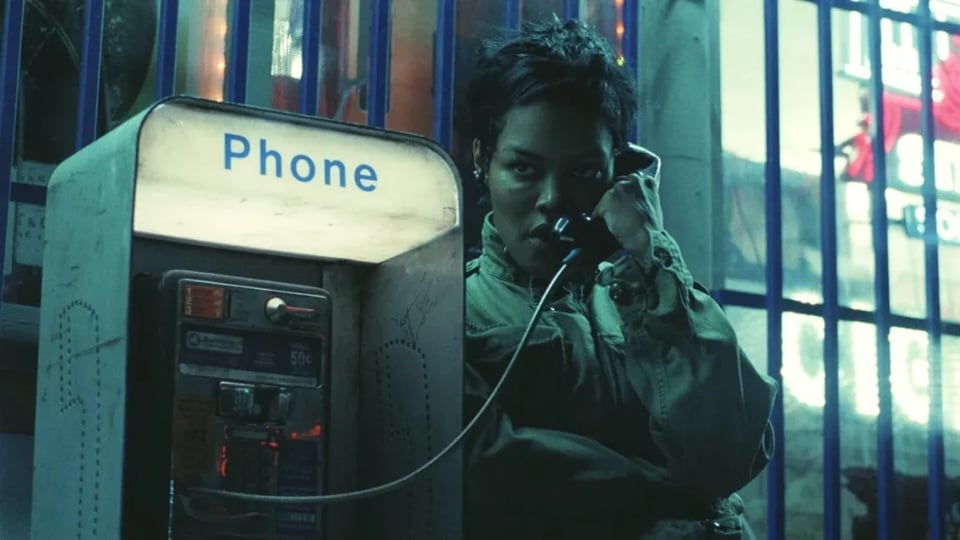
There’s something off-putting about the glib tone of Perfidia’s handful of scenes, especially when you compare the way she taunts Penn’s character with the way that Junglepussy’s character declares war at the bank…right before Perfidia has to kill a security guard who’s too stubborn to just stop moving. Both NPR’s Aisha Harris and HuffPo’s Candice Frederick point out that the black characters not only seem to have little to no interiority, but also don’t really make up for it with blaxploitation-style bluster. That’s partly intentional, I think, but it’s an ungenerously expressed point, at best.
What’s funny about a clanger like “this pussy doesn’t pop for you” is ostensibly the distance between amped-up feeling and low-down expression. I still can’t stop thinking about how miscalculated that line feels and how this might actually be the best proof of what Matt Lynch calls the movie’s hybrid nature as a loose merger of PTA’s “weed dad” and “coke kid” sensibilities. I unfortunately think that “this pussy doesn’t pop for you” is more coke kid humor than I need, and so is Perfidia’s provocative challenge, for both Bob and Steven J. Lockjaw (Penn): “Do you like black girls?”
For starters, Regina Hall’s character gives me pause, mostly because I find her teary-eyed final scene, at the back of a squad car, suggests that there’s some truth to her interrogator’s nettling accusation that it must hurt to know that she can’t protect Willa. That suggests a sharp contrast with Perfidia, who leaves Bob with the responsibility of raising and caring for Willa. The idea seems to be, as my buddy Steve Carlson suggests, that even though Deandra does everything by the revolutionary text’s letter, she still fails to keep Willa safe almost entirely because Willa, like her mom, is too stubborn to think of anyone but herself. There are lines drawn here and throughout the movie that I find distractingly unyielding and for reasons that have little to do with what makes the rest of the movie so satisfying.
Like, what’s the deal with Comrade Josh (Dan Chariton) and his strict adherence to the revolutionary text? Is it that he sounds like a young pedant but is actually older than he sounds? (I like this theory and have swiped it from Steve Carlson) I have a variation of the same question about Bobo (Colton Gantt) and Bluto (Carlos McFarland) and Willa’s other high school friends. What’s the joke behind naming that one kid Bluto if he never even comes into direct contact with Penn’s bicep-forward strongman? And why is Bobo the one who gives up Willa’s phone number, unless the punchline is that it doesn’t matter what we look like, even the most well-meaning and innocent among us—the pressure and the strain of political action inevitably reduces us to human, messy reactivity.
I dunno, I found the passing of the baton to Willa at movie’s end to be dissatisfying, and not just because I think using “American Girl” at the end is a bit much (I don’t care about the Demme connection though, sorry). Because to my stingy eye, Hall’s character ultimately exists to cover the filmmakers’ asses and really only hints at a depth of feeling that most of the other black characters never get to express (Jennie comes closest and in the least amount of time). That’s not just distracting, it’s hard to overlook when your movie ends with Willa running out to meet the day’s problems while Tom Fucking Petty hails her as a real American Girl. She’s part of a tradition and a background that’s so often reduced to dramatic and generic short-hand that it makes that much harder to appreciate Taylor and Hall’s genuinely affecting performances.
I prefer Martha Washington to Willa Ferguson, honestly, but not by much. Miller was clearly trying to provoke readers, but even his cynicism stems from a compelling, genuine, and obviously idiosyncratic place. I’m a less comfortable when a movie advertised as a Leonardo Dicaprio picture makes a big show of giving flowers to a young black character after struggling to find a way to make her mom’s character-defining bluster seem both human and also ridiculous. Which is it, and why does this type of conciliatory relativism matter? I guess Tom Petty’s pussy doesn’t pop that easily either…