Curating as a Shared Inquiry
2026-03-02

Curating was never a stop on the path I envisioned for my artistic journey. When I joined Critical Stuff Collective, I was thinking of ways I could contribute. Around this time, this practice was realigning under what I had identified as a core exploration. My longstanding interest in how humans perceive, for whatever reason, became clear. It served as a canvas on which I could weave the different aspects of my work.
This gave me momentum at a time when I had just finished a new series. Knowing I was entering a season of admin/resourcing, I still felt the desire to pull at these threads. Simultaneously, I felt compelled to address the current sociopolitical landscape in the United States. There was a sense of urgency I had been waiting to address.
In relation to the exhibition, I began to reflect on how artists can understand their role on a societal level. At a time when art faces the threat of censorship, as with most media channels, it seems vital to reflect on this question. I believe many artists can feel the power of agency within their practices. This being is in the way one is allowed to show up as themselves and forge narratives of meaning that are uniquely their own.
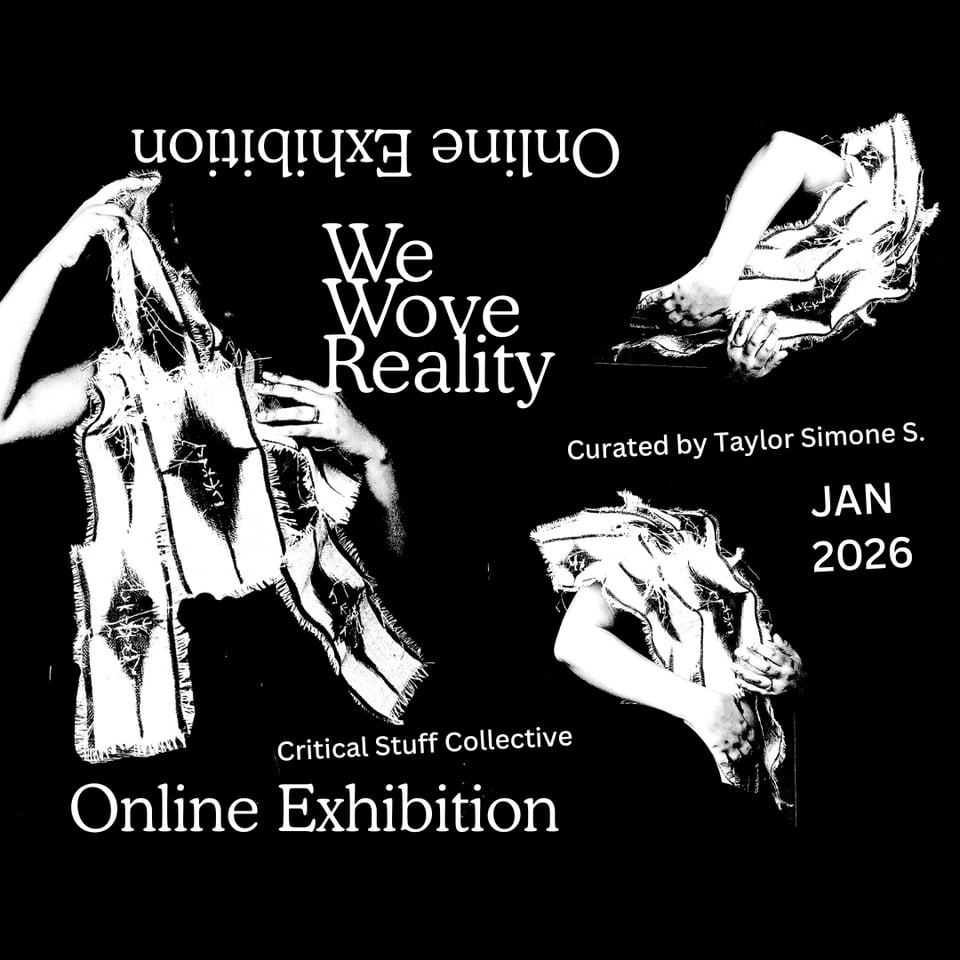
The prompt given to the exhibiting artists in We Wove Reality was rooted at the intersection of those interests.
Together, we will be guided by the work of biologist and theorist Jakob von Uexküll—a Western forefather in the study of purpose, perception, and meaning. Uexküll’s work presents a cellular model in which every organism possesses a unique perceptual vantage point. For him, we navigate a deeply individual world of meaning—one that arises through the relationship between an organism and its environment. This reinforces the idea that we experience the world through similar filters, yet from unique vantage points.
A Shared Prompt:
I invite you to work loosely under shared prompts:Frame this exploration as visual alchemism (including expression of language and symbols). Both exploring and wielding perception—through surrealism, abstraction, juxtaposition, the uncanny, or an exaggeration of the sublime.
To reflect on the importance of artists during moments like this. What is our role in mediating the process between finding meaning and being prompted into action?What excited me about an exhibition was the idea of uplifting artists who have inspired me, opening up a discussion, and framing this as a departure from research. One that starts with bringing others in after exploring some sources that I had been reading in my personal practice. The start of a much longer bibliography.
The idea of centering the curation around a shared prompt was inspired by the artist and curator Mahari Chabwera. We Made Armour is a group exhibition that featured the work of artists Christa Pratt, Ricky Weaver, Nastassja E. Swift, myself, and Chabwera. Unlike other group exhibitions I had experienced, we were invited to come together in conversation around the source that inspired the show. Each of us was gifted a copy of In Search of Our Mothers’ Gardens by Alice Walker. The book prompted discussion and a sense of a shared bond or community, while also allowing our unique dispositions as African American women to shine through.
From a curatorial perspective, I was interested in the idea of a collective truth defined by individual explorations. My hope was that this prompt would serve as a grounding mechanism that would allow the work to unfold in a dynamic conversation. I was also interested in the idea of the exhibition being a survey a qualitive research when it comes to this time in the United States.
In hindsight, I can say the goal of collective truth and individual perspective is present in the We Wove Reality. The idea of surveying this time with a poignant response to our current sociopolitical state was not met. I am still reflecting on how the invitation shaped what manifested, but I have grounded this in two questions.
What quantitative measures need to be taken for an exhibition to be presented as art-based research?
How can language position those exhibiting as co-collaborators versus participants, giving agency to individual vantage points while setting parameters that allow for shared scope?
Without the immediate answers to this, I am sure of the need for both simplicity and specificity.
The Offering:
One of the things I offered participating artists was a view into my personal practice by sharing the inquiries and theoretical lineages informing the prompt.
A formative moment in shaping the future trajectory of this research emerged through dialogue with one of the artists. After receiving the offering, they reached out to share that my use of the word orientalist made it difficult for them to settle into the inspiration behind the exhibition and, in turn, the prompt itself. I sat with that reflection carefully. Noting for the first time how vulnerable it can be to share research but, also how vulnerable it is for someone to speak up about discomfort.
The term had been chosen deliberately, particularly in relation to the applied fetishization that can frame readings of Augustin Berque’s work. Naming this dynamic felt necessary to me. The presence of the word 'orientalist' was not incidental; it was a window into the intellectual and ethical journey that brought this exhibition into being. The impact of how it was used is something I had to hold.
The exchange underscored the responsibility embedded in language. Even within an offering—perhaps especially within one—clarity around implication matters. Berque’s theoretical framework, without a doubt, required discernment. In naming his field of study, I assumed it would be understood without explicitly naming it. It's something I apologized for, as I strongly believe intention doesn’t change the impact.
There was also a sense of surprise at the western lense of my research. This did not surprise me, as I did agree. It's something that I had already noted, but, in honesty, do not grapple with as a point of tension. For myself, I understand that I am situated within a reality. As an African American woman, I have been educated within institutions that predominantly elevate Western perspectives. Culturally, I have navigated and been shaped by a Western environment. At the same time, there is something inherent in my cultural identity that aligns with a lineage rooted in the African diaspora.
I believe I clearly expressed that I hold the view that the journey of decolonizing what must be decolonized in my worldview is ongoing. In that, I also don’t reject the reality of all the intersections shaping how I perceive my environment and the sources I work with. In that acceptance, I believe there is a discernment I must hold to my own reflection. In many ways, I believe this is why I am able to disarm ego and listen when I have caused harm.
I share this moment not as a correction, but as an extension of the exhibition’s ethos: research is relational, language carries histories, and how we understand the process of deriving meaning matters.
That said, the conversation continued with care and respect. I made an offer to continue working on the offering, while honoring my capacity at the time. In the end I am happy for what could be called a moment of tension because I did learn. I took time to look at sources that better illuminate the deep fetisization and dehumanization that can not be made seperate from those who aligned with orientlist sentitments. The artists called to attention that ways Western ideology can shape how we organize the world and our enviorment. In this was it allowed me to open up to a more nuanced understanding of how of what it means to hold the term western. It is an ideological and cultural framework based entrenched in binary mindsets and colonial ways of viewing our enviorment.
Moving forward I know have a better understanding of what I am looking for when I question how and why I dervived specific meaning.
One of the biggest lesson learned in this process is that idea that there is an aspect of community that must be held within curating and the beauty of dialogue doesnt have to be contained to the gallery walls.
Below you will find the adapted curatorial offering. A short writing that gives insight to the foundational sources that are shaping a longer path of research in my personal practice.
Curatorial Offering:
For so long, the arts have been grounded in what is vital to recognize culturally—the complex nature of perception and the subjective role in deriving meaning. The study of meaning and perception spans disciplines such as psychology, semiotics, geography, architecture, kinematics, and more. While science captures the quantitative, the arts capture the qualitative, functioning as a vast survey of meaning. Artists contribute to a tapestry of truth—one that embraces diverse thought and the nuanced contradictions within it.
In my own practice, there has always been a kind of longing—a pull to understand how perception shapes experience, how meaning moves between the felt and the seen. That longing often leads me toward questions of sensory processing, the unseen labor of understanding, and the tension between how I sense the world and how it is framed.
The idea for this exhibition illuminates that contribution—artists coming together as mediators of meaning. It was inspired by a desire to visualize the world as I perceive it: an environment that, in its concept, holds nuanced contradiction—individual, collective, seen, unseen—and framed sensory processing disorder. During that time, the term Umwelt, coined by Jakob von Uexküll (1957), came into orbit. The book Divergent Mind by Jenara Nerenberg introduced it as a way of naming and exploring one’s sensory environment. (Nerenberg, Our Private Worlds 2019) This was instrumental in inspiring a deeper study of perception.
It led me to Augustin Berque’s (2000) paper The Perception of Space or a Perceptive Milieu?, which brought new language and understanding. Berque—a geographer, orientalist, and philosopher—surveyed others’ writings as he developed a theory of meaning. Building toward an ecological premise of perception, he explores the relationships between organisms and their environments, and the unseen ecologies of processing. In the paper, he describes perception as the “passage from the physical to the phenomenal” (Berque, 2000). To perceive is not simply to interpret or comprehend, but to engage in a relational exchange—a process in which data is transformed largely based on what Uexküll (1957) calls our affordance.
It is important to note that Orientalism functions as an ideology that, in many ways, gives shape to the ideology of the West itself. The term signals the need for careful discernment when approaching Berque’s work. In The Framed Arab/Muslim: Mediated Orientalism, author Silke Schmidt argues that defining Orientalism requires acknowledging its deep entanglement with binary thought and the value judgments that follow. He both critiques and builds on Edward Said’s foundational claims, noting how his analysis links Orientalism to hierarchical binaries—particularly inferiority and superiority (Schmidt, 2019). When Berque analyzes the work of his peers and Japanese theorists, his interpretations remain framed by the broader field’s investment in Western superiority.
Through these readings, Uexküll’s foundational role in the Western study of meaning became clear. My interest in how this conversation can and has developed across the diversity of the arts grew into the prompt for this exhibition.
In A Foray into the Worlds of Animals and Humans: With a Theory of Meaning, Dorion Sagan (2010) opens with an introduction that revisits Uexküll’s work. In it, Sagan brings his theory into a modern context, raises fair critiques, and shows how Uexküll’s ideas have influenced a vast range of fields across the sciences. They also offer an important frame: organisms exist in a continuous relational exchange of stimuli with their environments—a reality of constant sense-making. (Sagan, D., 2010).
In this, there is a continuous desire for perception to inform action. Which is why this conversation feels so pressing. Many of us are fighting an overwhelm that stops action. With an influx of environmental stimulus—arriving at a rapid pace through mainstream media, global events, economic instability, and sociopolitical shifts—it feels harder than ever to perceive: to organize the flood of information into meaning that feels concrete, grounding, or that leads to action.
To the artists taking time to sit with this invitation—thank you. Your attention and care in considering this offering are deeply felt. This exhibition exists as a shared inquiry into perception, relation, and the meaning we build between one another. Those confirmed to participate will receive a follow-up offering—a document that dives further into the key terms, texts, and sources that ground this prompt, serving as both an offering.
The idea of the prompt is to ground us in a shared environment so that the exhibition functions as a survey of qualitative research—a way of asserting the importance of diversity, which runs as a consistent thread through the sources above. There is a continuous and clear assertion, from the biological to the cultural, that perception is shaped by a constellation of variables. These variables generate differences in meaning that ultimately become the truths through which we each navigate reality. In this way, it becomes essential to acknowledge both the objective nature of our world’s materiality and our role in alchemizing that data.
In the pedagogy I began developing before encountering these sources, I explored this through the idea of individual vantage points—how artists, in particular, hold space for the contradictions inherent in our collective search for truth. Truth, in many ways, is inherently complex, resisting society’s reliance on frameworks of absolute thought. Yet we often operate within structures that attempt to flatten this complexity into a black-and-white world, moving us toward a singular, restrictive mode of perception.
With this in mind, I selected artists and writers whose practices engage deeply with our ecologies of perception—through process, design, aesthetic, or theme. They serve as mediators of meaning, each adding another layer to this evolving tapestry, this survey of how we come to know, sense, and interpret the world.
Note About Sources:
The sources that brought on the inspiration for this show are rooted in a Western lens of ideology and collective subjectivity. This largely reflects the intuitive ways I initially encountered them, as well as this being the starting point for a larger bibliography. It feels important to acknowledge that you may have your own sources or cultural understandings of perception. I invite you to add to this conversation not by replicating the ideals of these sources, but by engaging them in dialogue. While my understanding of perceptual ecology is informed by sensory processing, science, and spirituality, yours may be grounded in spirituality, science, or personal and cultural frameworks.
In many ways, even the study of meaning—or the ecologies of perception—presents a lexicon of subjective truths. For example, Jakob von Uexküll’s assertions were entangled in fierce critiques of evolutionary theory, a debate that was unfolding at the time. His work also draws on evidence shaped by the now-debunked notion of racial separatism in biology (Berque, 2000). Although much of this has been abandoned within the modern sciences he helped influence, it remains important to name and critique these foundations.
Augustin Berque, a scholar of Eastern studies, pulls from both Western and Eastern ideologies. Yet to be an orientalist is, in many ways, to project a Western lens onto Eastern environments and cultures. Berque is heavily inspired by the Japanese concept of environment, similar to the umwelt, known as milieu, which he discusses in his work (Berque, 2000). What he and others often share, however, is not the direct language of Japanese theorists, but their own synthesis through Western academic traditions.
What is especially compelling in Berque’s analysis is the way he acknowledges the limits of his own positionality—the lack of affordance available to him when attempting to find meaning in an environment that is not native to his tools of interpretation. This raises a distinction between translating and deriving.
Berque explains:
“With time, I concluded that though the generally accepted translation of ma (間) is ‘interval,’ it is not an interval in and of itself (the idea of ‘interval’), but always an interval in concrete space and time, which supposes a situation, an atmosphere, and more generally a Japanese milieu” (Berque, 2000).
References (APA 7th Edition)
Berque, A. (2016). The perception of space or a perceptive milieu? L’Espace Géographique (English Edition), 45(2), 1–14. http://www.jstor.org/stable/26213781
Nerenberg, J. (2019). Our Private Worlds. In Divergent Minds: Thriving in a World that Wasn’t Designed for You (First edition, pp. 147–148). essay, HarperOne.
Sagan, D. (2010). Introduction. In J. von Uexküll, A foray into the worlds of animals and humans: With a theory of meaning (J. D. O’Neil, Trans.). University of Minnesota Press.
Schmidt, S. (2019). The framed Arab/Muslim: Mediated Orientalism. In (Re-)Framing the Arab/Muslim: Mediating Orientalism in Contemporary Arab American Life Writing. Transcript Verlag. https://www.jstor.org/stable/j.ctv1xxs1s.6
Don't miss what's next. Subscribe to 'Studio View' by Simone Studio's: