
SHORT STORY REX Nov 2025
SHORT STORY REX Nov 2025
1. Jonothan Pickering, "Hunigsuge"
For those in need of something to tide them over until the next issue of Seize the Press comes out, STP editor Jonothan Pickering's story in Cosmic Horror Monthly #65 should do the trick. Like in his story "The Time I Watch the Foxes Drink" which appeared in The Deadlands a few years back, Pickering goes in for a markedly pronounced narrative voice—if that that older story created estrangement via the constant, willful breaking of grammatical tense, here the sharp dialectal flavor serves to focus the observations, reminiscences, and tangential thoughts that pass through our protagonist’s head as he and his uncle wait out the “goblinoid shadow” that’s got them penned up inside the house. I love a good “wolf-at-the-door” story but the wolf is not a wolf, and wait a second, which side of the door is the monster on, anyway?
2. Joe Koch, “Jar of Arms”
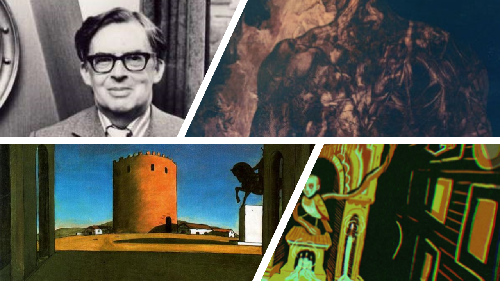
We Shall Speak Again of The Red Tower, a recent anthology of short stories inspired by or written in tribute to Thomas Ligotti’s classic “The Red Tower”, is a project that feels like it was undertaken on a dare. Like a gang of kids egging each other on to go knock on the door of the haunted house, but no one wants to go it alone, i’ll go if you go, no you first, and pretty soon they’re all inside the haunted house together. Of course, in this analogy, the house is some other kind of construction…
Each kid emerges with a different takeaway on what happened to them inside: clinical (Joelle Killian) confessional (Carson Winter), satirical(C.J. Subko), monomaniacal (Jack Klausner), hysterical (TJ Price), metafictional/metaphysical (RSL), but all of them (and srsly they cannot stress this enough) definitely encrimsoned.
Joe Koch, however, gets the Blue Ribbon for my money, both for how “Jar of Arms” most fully internalizes the inside of the Tower and for how uncannily it mimics the surface of its source text. Something to do with the eerie communal narcosis that colors the first-person-plural POV, the persistent undoing and doing of perception and existence and meaning.
Of course, that’s a perfectly subjective judgment on my part. Rest assured there’s a favorite shade of crimson for every taste on this color palette. It reminds me of those old tribute albums that used to come out, where you’d get a weird variety of artists doing the most unexpected covers (I’m thinking specifically of Kramer from Bongwater doing “Insight” by the Dead Kennedys, for example). Suffice it to say that this anthology is the kind of collective DIY passion project I want more of.
Art finds tunnels out of loneliness, RSL writes near the outset of the hybrid text ‘Draft of Ligotti’s Children: An Exploration of the Fictional Realities ‘The Red Tower’ Creates”. They all love “The Red Tower”, and that’s all that matters. Community through a desire to build. Yes, out of loneliness but into what? A desire to build what, exactly? Need you ask? Grab your copy here and get encrimsoned
3. “The Inner Room”, Robert Aickman
Speaking of, Thomas Ligotti is on record as not being an admirer of the work of Robert Aickman. I know others who feel a similar way, including writer friends who would seem a priori sympathetic (much as Ligotti would, you might argue) to the vibe of the Aickmanesque. And people are entitled to their opinions, that’s fair. But also, I dunno, odd if you ask me. Strange, even.
The subject of Aickman, Ligotti says in an interview, “is not one I warm up to”. Obviously (given the nature of this newsletter), I’m the exact opposite. I “warm up” to Aickman most immediately on the basis of style: the archaic flourishes, the pointed idiosyncracy of structure and word choice. The texture that results is a sometimes-subtle sometimes-not impression of temporal and perceptual out-of-jointedness, and that stylistic impression is key to the overall effect of strangeness in stories like his classic “The Inner Room”.
The first person narrator of “The Inner Room” relates several episodes about a dollhouse that was briefly in her possession as a child, as well as some autobiographical notes and an anecdote about a misadventure in the woods, also related to her brief “landlordism” of the aforementioned dollhouse. It tells a tale about the passage from childhood to adulthood, about spaces hidden and neglected, a story which suggests that the vicissitudes of our biographies constitute a kind of entropy, a stepwise falling away from an essence, a decay of the self. Now tell me, who couldn’t “warm up” to that? Like I said, odd. Strange, even.
NOT-SHORT STORY REC: Feast of the Pale Leviathan, John Chrostek
From the beginning, my temptation was to read this not as a novel, but as a “romance”. Now, by “romance” I mean not in the modern, HEA sense but in the Gothic sense, which was taken to mean simply an extended fictional narrative of marvellous or unlikely incidents. And by “from the beginning”, I mean the table of contents. Something about opening a book and being greeted by that lengthy list of chapter titles preceded by Roman numerals called to mind HTML versions of, like, Anne Radcliffe or Horace Walpole on Project Gutenberg, and certain passages here I could totally imagine an early 19th century reader getting super titillated over…but then again, it is at the same time a book which starts with some dude named Owen who takes some shrooms and goes tubing.
It then occurred to me I might also call this “metamodern”, which is a term the YouTube algorithm has insisted I familiarize myself with recently. In a book about being swallowed by a sea monster, it’s no surprise to find some elements of pastiche: a certain old-fashioned solemnity, deliberate echoes of Melville, of Jonah and the whale. But then we wildly oscillate from mythic-adventure pastiche at sea into present-day satire on land, all radio ads and Powerpoint presentations and stale continental breakfasts and yes, eventually, a YouTube video (not about metamodernity but rather ‘You’ll Never Believe What Happened Next: 7 Impossible Survivors’). Meanwhile, inside the belly of the beast we discover a society of victims from different historical moments with their signifiers and values all coexisting at once, their backstories a mosaic of nautical epics and aristocratic drama and Cold War intrigues, overlapping dichotomies of good and evil, darkness and light, oppressors and oppressed, haves and have-nots. The cultural logic of cultural logics, embodied in a subacqueous humanoid giant.
But as the story takes on its true dimensions, there is one thing which becomes perfectly clear, and that is: Feast of the Pale Leviathan is ultimately and unabashedly a Genre Novel, and it does not shirk its duties on that score. Vibrant cast, artful pacing, plot twists and escalations, eyeball kicks and mindfucks, moments of operatic pathos, it’s all here. It’s a “fish-out-of-water” story (ironic, maybe, i guess), a portal story of sorts, certainly a cosmic horror story, and for all its outré imagery, its evocations and provocations (post-/metamodern or otherwise), Chrostek never loses sight of his central characters, the relatability of their struggles, and the novel is so much the better for it. Available wherever rad books are sold!