
SHORT STORY REX Jan 2026
SHORT STORY REX Jan 2026
[Before we begin: it does feel hopelessly trivial to be nattering on about short fiction just now, so let my first recommendation this year be to check out initiatives such as Stand With Minnesota, donate to UNIDOSMN (an immigrant-run organization doing work on the ground), Immigrant Law Center of MN, who provide assistance to people with families detained by ICE, or the Immigrant Rapid Response Fund, assembled by a coalition of Twin Cities Foundations, and lend your support to the people on the front lines of the fight against the fascist thugs running rampant in America’s cities. Thanks.]
1. Namita Krishnamurthy, "Morning Shed”
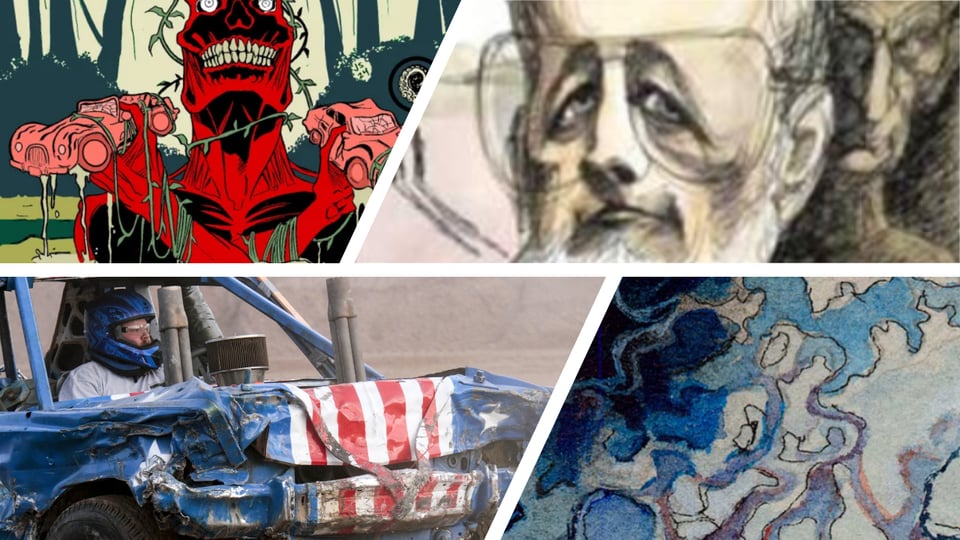
Namita Krishnamurthy's bio states that she is a writer and actor from Chennai, India, and that "Morning Shed" is "her first foray into fiction". To which all I can say is, nice foray! This little story from December in Strange Horizons has it all: eyeball acne, a snake god, sentences like: "The smooth eggs of my cousins shatter in yellow applause"…seriously, what more do you want from a first foray (and a first short story rec of the year, for that matter)? Also I was not previously aware of the term morning shed, or the whole “go to sleep ugly, wake up beautiful” philosophy behind it, so there’s a fun little image search for you to do
2. Kay Vaindal, “Jared Chapel's The First Car Ballet” and Tyler Barton, “Once Nothing, Twice Shatter”
I’ve been thinking about these two stories in conjunction for a while, though its only just recently Ive had any time to halfway sort out those thoughts, specifically about how they both interpret the most tragic and depressing moments of life through the aesthetic prism of smashing up cars (and not, or not only, in the sexy(?) Ballardian eros-and-thanatos way).
In Vaindal's story, our title character is a war hero obsessed with the idea of telling his story in the form of a 'car ballet'. He is also involved in kind of a romantic throuple situation with his comrades Durban and Chickoree, the latter of whom is both a corpse and a ghost. (He likes to watch.) Makes sense, right? Also it makes perfect sense that this story—a capital-G 'Genre' story complete with outer-space setting and necromancer and such—should so explicitly specify the genre of the car-smashing at hand, the titular 'car ballet’, such that we have a genre story inventing another genre inside and beyond itself. Just like it makes sense that the dynamic between the characters, and the way Vaindal maneuvers them, should be so spry and effervescent, so dang balletic in its way, and so open-hearted at its core. When the story's over you want the narrator and Durb and Chick to come and do a curtain call so you can shower them all with roses.
Barton's story, while also about how 'hurt people hurt people cars’, is a different animal. If Jared Chapel gives us art, "Once Nothing, Twice Shatter" gives us religion. Not dance, but oratory. Our narrator—who now calls himself Todd but was once a radio shock-jock known as ‘Brad the Broadcast Bandit’—has hit rock bottom. When his car is totaled in an accident, he sells it to local car dealer Luther, who incorporates the ruined Buick into his fledgling demolition-derby cult and takes Brad on as the PA announcer/cultic voice from on high.
"Will I ever escape a microphone?" Brad/Todd later wonders. His narration, meanwhile, is irrepressibly nimble and motor-mouthed, and his color-commentary never lets itself lapse into "quirky writing"—you might think it's about to1 but it slams on brakes right there at the edge.
Set in the aftermath of the 2008 financial crisis, the story is broadly about just that: aftermaths, plural. Don't look back, though, reader; keep your eyes on the road and look where you’re going. It might feel like running in place but that thing you're about to crash into is the future. It’s just one damn thing after another, isn't it
3. Donald Barthelme, “A Shower of Gold”, “The Photographs”, “The Joker's Greatest Triumph”
Speaking of art and smashing up cars, here’s a bit from “A Shower of Gold” by Donald Barthelme:
He was working in the loft. The piece in hand was to be called Season’s Greetings and combined three auto radiators, one from a Chevrolet Tudor, one from a Ford pickup, one from a 1932 Essex, with part of a former telephone switchboard and other items. The arrangement seemed right and he began welding. After a time the mass was freestanding. A couple of hours had passed.[…] He stood looking at the work, moving from time to time so as to view it from a new angle. Then the door to the loft burst open and the President ran in, trailing a sixteen-pound sledge. His first blow cracked the principal weld in Season’s Greetings, the two halves parting like lovers, clinging for a moment then rushing off in opposite directions. […] The President’s second and third blows smashed the Essex radiator and the Chevrolet radiator. […] “But Mr. President!” Peterson shouted. “I thought we were friends!”
My go-to comfort-watch to fall asleep to whilst staying home sick from work was, for a solid couple of years, episodes of Monty Python's Flying Circus (and in terms of therapeutic effect, the more obscure and obtuse the sketch ie the more references to forgotten Reginalds like Bosanquet and Mauldling, the better). Netflix no longer streams the series in my part of the world, but luckily I discovered last month that a bevy of Barthelme stories read by the man himself on YouTube, when listened to with feverish eyes closed and headphones in, will scratch a similar itch. “A Shower of Gold”, with its parade of ever-heightening, non-sensical interactions, takes that warm, familiar mid-century absurdity not just as its MO but as its object of inquiry. “Let me answer your question with another question,” Miss Arbor asks our protagonist in the first scene:
“Mr. Peterson, are you absurd?” Her enormous lips were smeared with a glowing white cream. “I beg your pardon?” “I mean,” Miss Arbor said earnestly, “do you encounter your own existence as gratuitous? Do you feel de trop? Is there nausea?” “I have an enlarged liver,” Peterson offered. “That’s excellent!” Miss Arbor exclaimed.
And several decades later, our screens are smaller, but Peterson's desperate exhortation to the audience still resonates: “Don't be reconciled. Turn off your television sets.”
This recent rekindling of my relationship with ol’ Don B is owed in no small part to an episode the podcast A Meal of Thorns (see below) did about his collection Sixty Stories (which I mentioned very briefly here a couple years back). Host Jake Casella Brookins mentions his interest in Barthelme in the context of “surrealism, postmodernism, absurdism, […] broadly speaking irrealist literature in a way that has some interesting resonances and parallels with […] speculative fiction, although this would almost never be categorized as speculative fiction”. And you know something, he’s right about that last bit, probably. But then again what, I ask you, could fall more squarely within the bounds of science fiction than a story like “The Photographs” in which two scientists discover photos taken from the Pioneer 10 probe which show the human soul ascending to heaven? (A lot of things, probably but hey)
And while it is not discussed on the podcast, and is apparently unavailable in audio format, someone should write an essay about how his story “The Joker's Greatest Triumph” prefigures2 and pre-emptively puts to rest so much of the discourse around fanfiction as it exists today and its relation to postmodernity, but honestly whoever writes said essay probably ought to be someone with more familiarity with, and, er, let's call it affinity towards, fanfic in general than I have. Or not? I dunno. Speaking of, at least one person on livejournal was apparently aware of the story and felt a certain type of way about it, lol
PODCAST/NON-FICTION RECS: A Meal of Thorns / Ancillary Review of Books
These days I seem to enjoy podcasts that make me acutely aware of how slow a reader I am and how not-well-read I am. A Meal of Thorns is that kind of podcast, which means I have yet to listen to the vast majority of episodes. I can, however, vouch for the aforementioned Barthelme episode, as well as the ones on Ian M Banks's Excession and William Gibson's Pattern Recognition, and i’m sure my more widely-read readers will find plenty more eps to enjoy in their catalogue.
A Meal of Thorns is, I hasten to mention, the podcasting arm of the Ancillary Review of Books, an excellent publication which if you’re unfamiliar and need a place to start, i can recommend essays like Casella’s “An Anti-defense of Science Fiction” and Zach Gillan’s “Reading Weird Fiction in an Age of Fascism” just to name a couple
NOT-A-STORY REC: The Red Krayola, God Bless the Red Krayola and All Who Sail with Her
Being a drummer myself, I would be remiss not to include this photograph of Donald Barthelme at his drum kit, taken by his father Donald Barthelme, Sr. Truly a dude after my own heart:
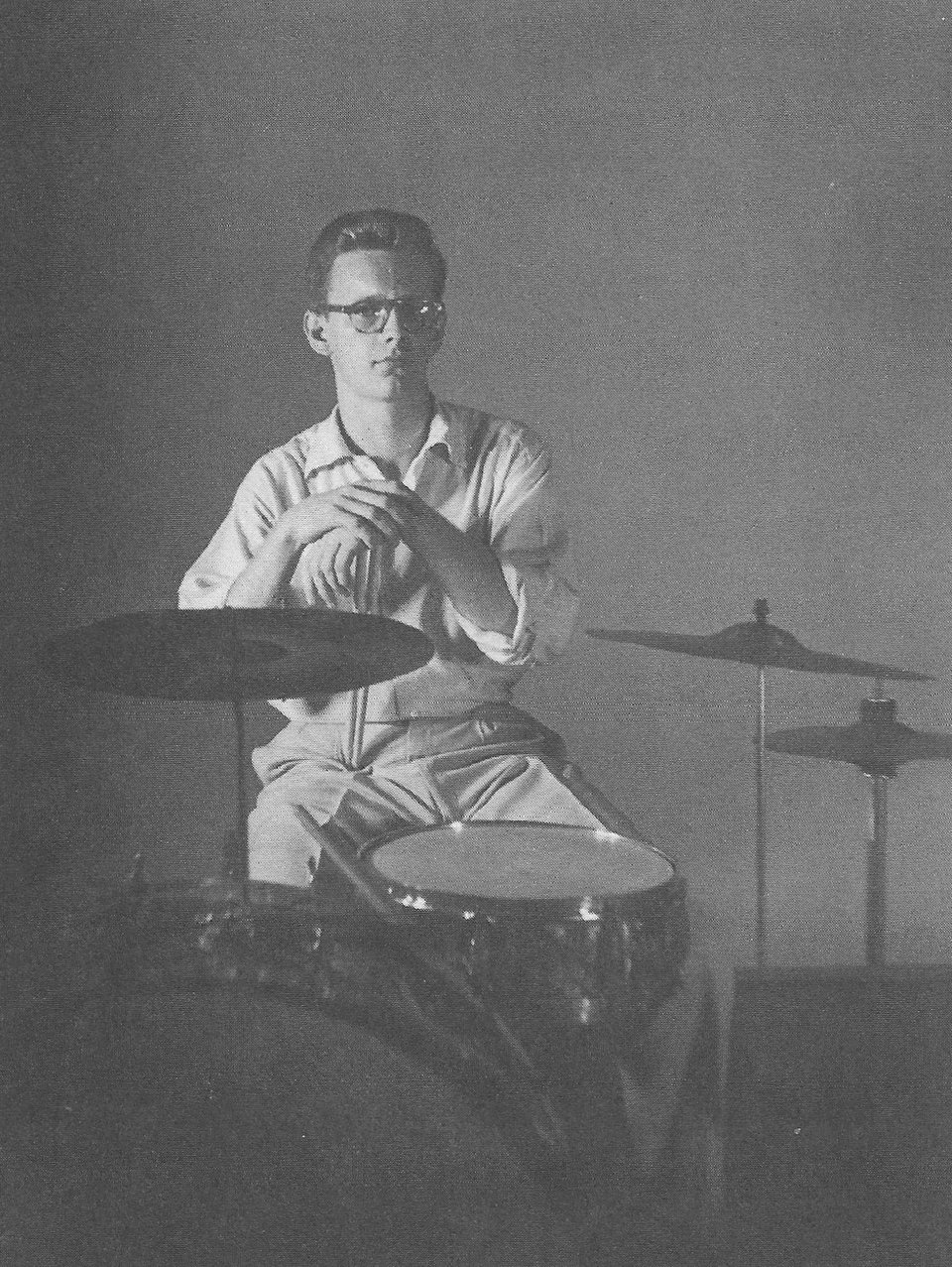
And as a final bit of trivia, Barthelme’s brother Frederick (see footnote 2) was not only also a writer but also a drummer, most notably appearing on the first Red Krayola album. Now that first one is a classic for sure, but I am immoderately fond of the second one, with its minimalist Dada-ish chamber-music vibe, and in light of the previous discussion re the non-canonical usage of crimefighter characters in popular culture, this trick seems most apropos:
Hell, even the titular line kinda does the thing Joe Sacksteder complains about in his infamous "Against Quirky Writing" essay, the quirky writer's "basically one maneuver: wrenching a word from one part of speech into another." ↩
This blogpost from back in 2009 sheds some light here, pointing out that Barthelme’s Batman story saw print “before the Batman TV show […] or the rise of fanfiction as a hobby of thousands. Barthelme played in the Batman sandbox shortly after Roy Lichtenstein started adapting comic-book panels into his fine art, when such appropriation was so novel and brazen that it had to be originality rather than the opposite.” And it goes on to ask: “What should we make of Fredric, the faceless observer who's nonetheless privy to Bruce Wayne's secret identity and liquor cabinet? […] Is he a "Mary Sue"? No, Fredric's not interesting enough to be wish-fulfillment for the author. But I note that Barthelme wrote this tale when his younger brother Frederick was still in his teens.” ↩