
Septology 4-2: How The Pieces Fit Together

Hello and welcome. This newsletter is 2148 words (~10 minute read).
ProgressI have been reading books and magazines published by the financial services company Stripe. I know how that sounds. I work in marketing, and I think I understand it okay, and everything about this whole situation trips the marketing alarms in my head: any kind of messaging produced by a corporation, anything they want to convince me of, is automatically something I’m skeptical about. That’s true even when the content itself is good. I mean, that's what I do at Lightcast, I write blogs and reports so that people can see what's possible with our data so they buy Lightcast data. It's a commodity: I am giving you good ideas and useful insights, and the hope is that eventually you buy my product.But that's also the business model for any media company: The New Yorker wants to write good articles so that you buy a subscription to The New Yorker. So when it's a non-media company producing something, you still have to be on your guard, but that's no different than any other media you consume. Who benefits from this message? Who's paying for it? What do they want out of me? In this case, Stripe is paying for it, but they are not convincing me to use Stripe for my internet commerce: their goal is “progress.” Their publishing arm, Stripe Press, has the slogan “Ideas For Progress.” Their magazine, likewise, is called Works In Progress, billed as “A magazine for new and underrated ideas to improve the world.” The magazine includes articles on how mosquitos can and should be eradicated, or a forgotten way to lay out public squares so people enjoy them more. The book I have is The Art of Doing Science and Engineering by Richard W. Hamming, who was instrumental in the invention of the computer, and he talks about how to have better ideas. (This PDF, based on a lecture he gave called "You And Your Research," hits many of the main points.) In 2019, Patrick Collison, who co-founded Stripe, co-wrote an essay in The Atlantic about the need for "Progress Studies." He and co-author Tyler Cowen write: "We haven’t yet cured all diseases; we don’t yet know how to solve climate change; we’re still a very long way from enabling most of the world’s population to live as comfortably as the wealthiest people do today; we don’t yet understand how best to predict or mitigate all kinds of natural disasters; we aren’t yet able to travel as cheaply and quickly as we’d like; we could be far better than we are at educating young people. The list of opportunities for improvement is still extremely long." That's why the books and the magazine exist. And they’re beautiful, meticulously designed and charmingly illustrated. It’s a treat to scroll through the Stripe Press site. Instead of getting me to buy their product, Stripe wants me to improve the world, and support those who already are. This has more in common with patronage, or old-fashioned Gilded Age philanthropy, than it does with marketing. They have all this money, and they're putting it to use by funding art, and interesting ideas. There's some image-building, sure, but there's also progress. Andrew Carnegie built all those libraries so that people would like Andrew Carnegie, but a lot of people have read books there. Stripe is well-known, in certain circles, for working its employees very hard. Before even engaging with its publications, I was reading posts like “What Working At Stripe Has Been Like” and “Operating Well: What I Learned At Stripe” and being impressed at the work ethic its employees describe. I couldn’t survive there (especially with a child just weeks away), but it’s still an inspiring image. I’ve seen evidence that this company is very smart and very ambitious. I used to get ads for Works In Progress magazine that read “You used to underline things. You will again.” There is an effort implied in reading these ideas, which is correlated to the image of the Stripe culture that I already had in my mind. In this way, the company laid the marketing groundwork for the content, rather than the other way around. I’m writing about Stripe not because they’re breaking new ground with content marketing or philanthropy. What’s interesting, to me, is that these ideas have captured my attention now. I started this essay saying that I know it sounds lame to be reading books published by a fintech company, but they have earned it. I’m going in with my guard up against any marketing stunts, but I come away still convinced by the ideas, and wanting to work harder, and improve the lives of others, and that’s good, no matter who’s signing the checks. |
Tricks And Treats The question on everyone’s mind practically goes without saying: Tim, how many trick-or-treaters came to your door this year? I thought you’d never ask. I prepared slides.  This year Becky and I handed out treats to 60 trick-or-treaters (ToTs), the lowest number on record. That’s down 35% year-over-year and down 25% from our previous average (87.3). 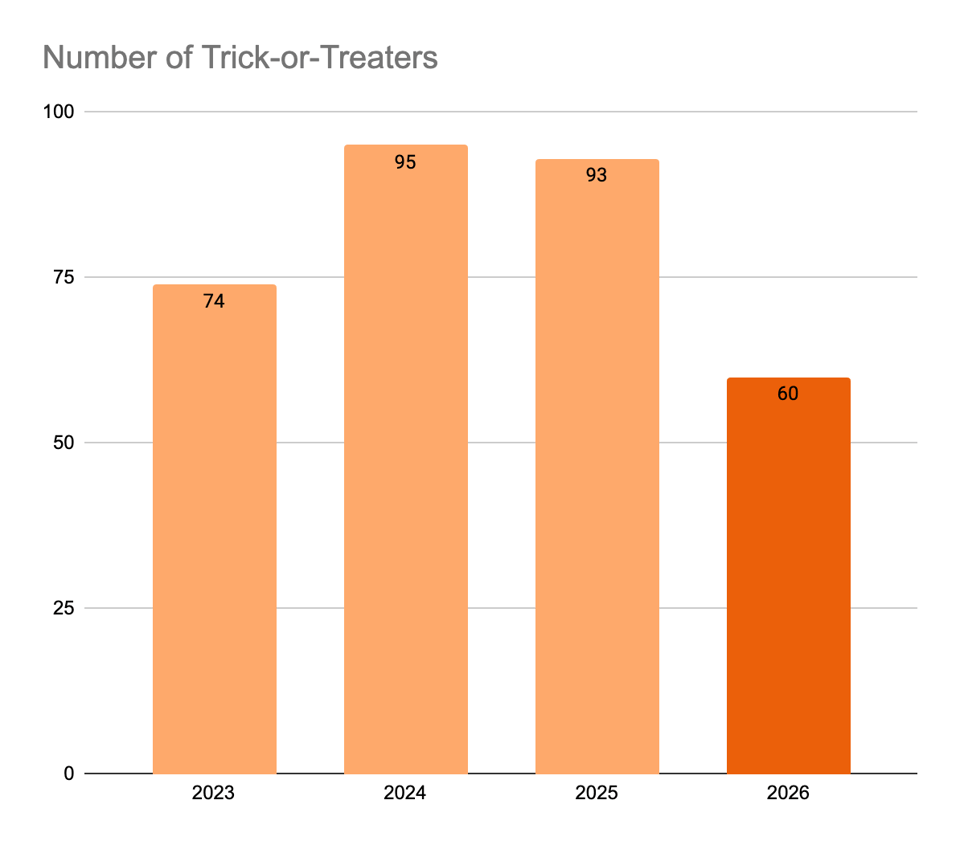 We also kept track of when those ToTs came, and you can see that the biggest spike was around 7:15 pm. 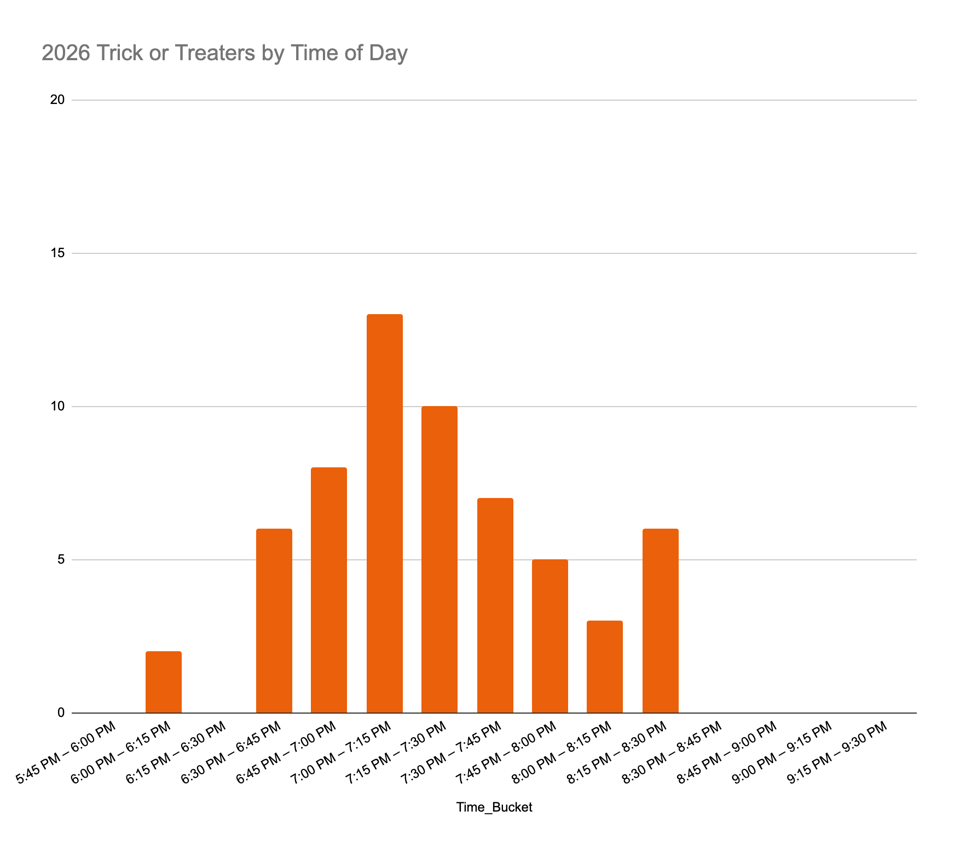 That’s different from what we saw in years past; usually our biggest spikes are between 7:15 and 8:15. So why did we have fewer, and why did they come at different times? 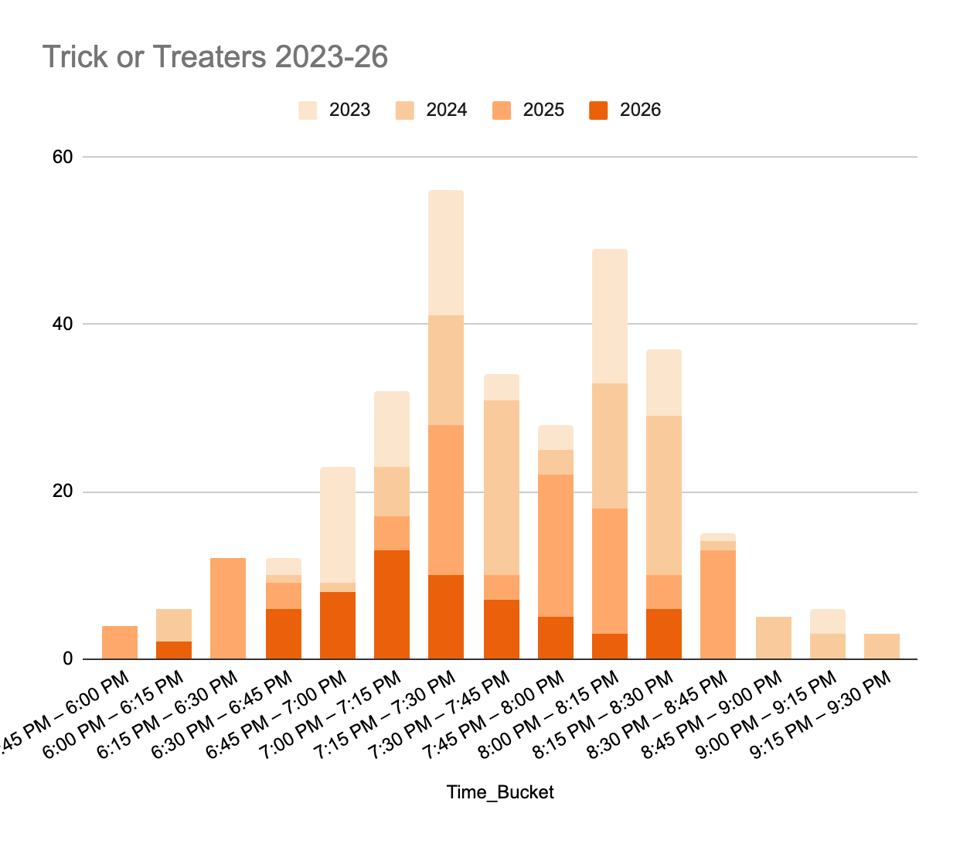 One friend suggested that having Halloween on Saturday might have caused the early spike, because kids were more eager to get on the road than usual. I’m not completely sold, but it’s possible. Whatever the reason, you can see that before 7:15 this year, we were running clearly ahead of schedule, when you compare the average concentration vs. 2026 actual. I was worried we had not bought enough candy, to be entirely honest with you. 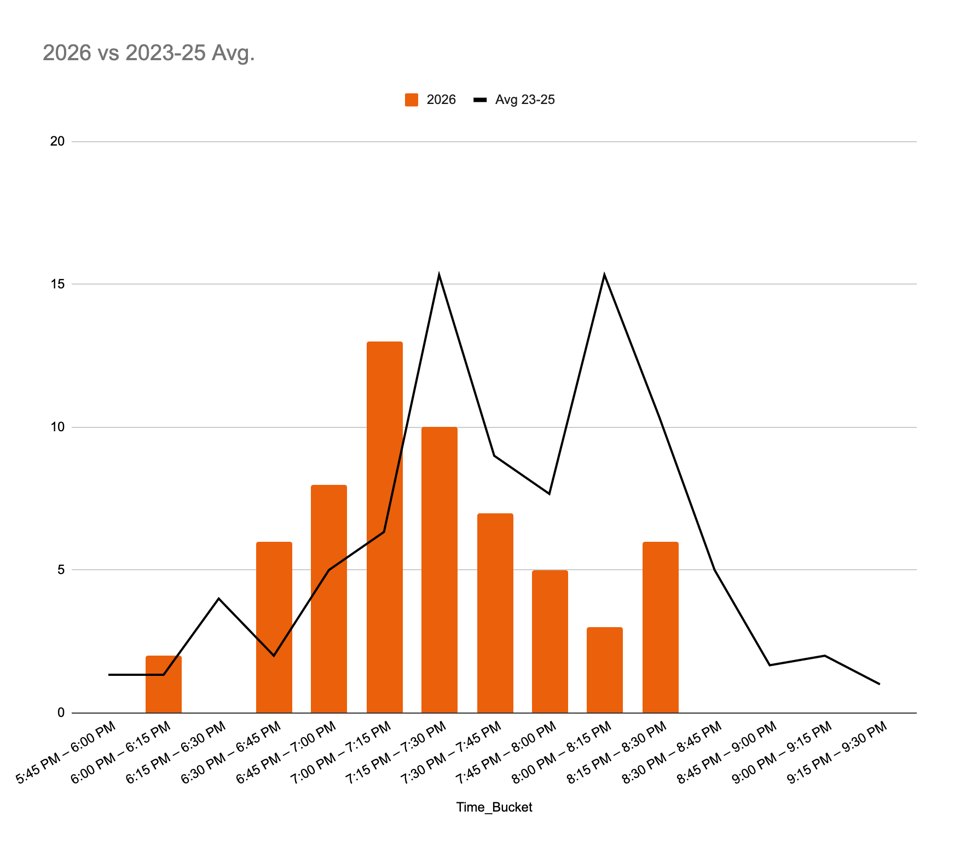 Soon afterward, my fears were put to rest. The night turned pretty quiet, and (as I said) we ended up with far fewer ToTs than usual. Why? Well, it was raining in Tulsa, which would be the most obvious explanation—but it doesn’t hold up. The sky cleared up by 7:00. That means we experienced above-average candy demand while it was still raining, and lower demand when it stopped. 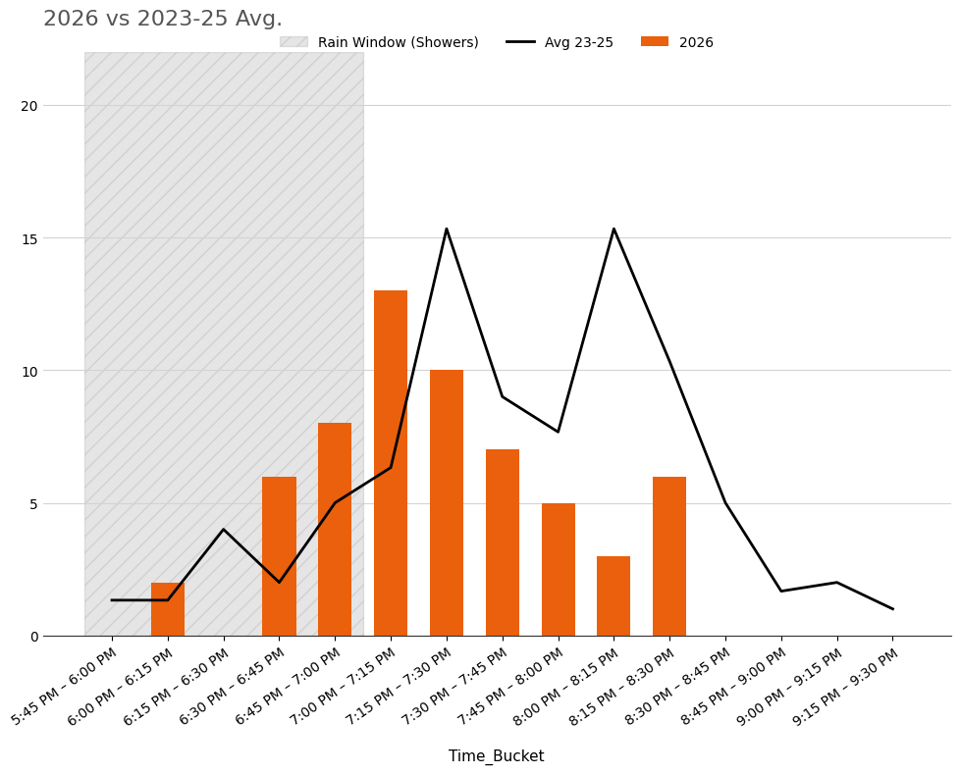 Could it be possible that rainfall is actually correlated to more ToTs? No. There’s no relationship. We had more rain in ‘24 than we did in ‘26, and that was our record high. Temperature also shows no obvious relationship to ToT numbers. (Temperature is an average of the readings during the 5:45-9:30 pm observation window and rainfall is cumulative.) 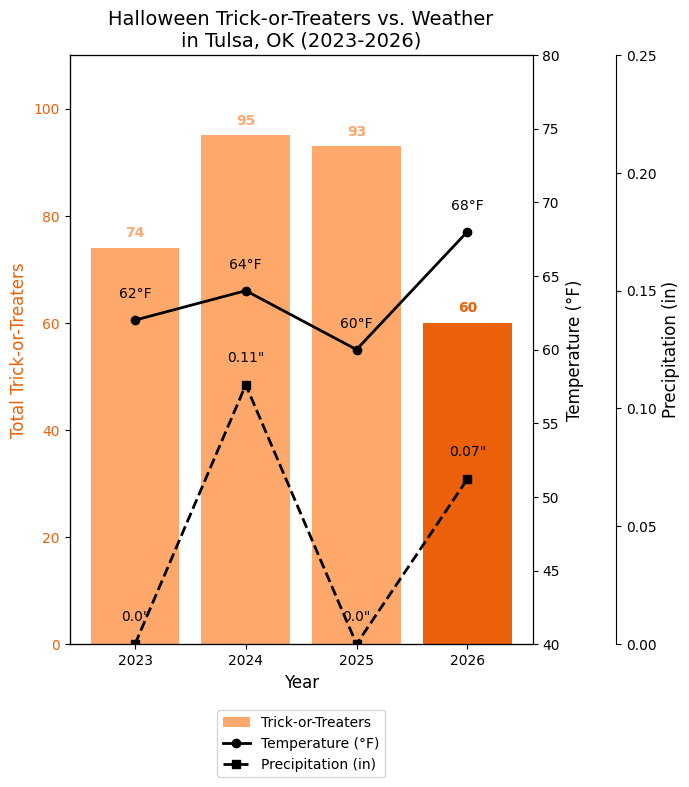 What conclusions can we draw from this?
 |
Arc, RIP On October 22, The Browser Company of New York announced that it would shut down Arc at the end of this year. Arc was its first browser, and I have used it since January 13, 2023. It has a dozen tiny features that made it nicer to go on the computer: vertical tabs that were easy to read, a preview window when you hovered over links, profiles you could swipe between, tabs that closed automatically at the end of the day so they didn't pile up, tabs that were synced across windows. Written out, it sounds so small to say I had a keyboard shortcut for copying a url, but I do that dozens of times a day. At work, it would cause a little ripple of surprise whenever I shared my screen, because my browser looked different from everyone else’s. It was one little thing I was known for. One time, I presented on something to my team, and afterward a coworker said "You seem to know your computer really well, that looked really efficient." That meant a lot to me! I get on here eight hours a day, so it's worth my while to do it well. Then last year, IT said I had to stop using Arc. Only approved browsers allowed on my work computer. I asked around, talking to Chrome and Safari users: do you like using your browser? And they said they don't really think about it. I guess that's not a bad outcome, but I had a browser that delighted me. It wouldn't have occurred to me that a browser could do that, so I'm grateful Arc taught me. I use Firefox now, and it doesn't. 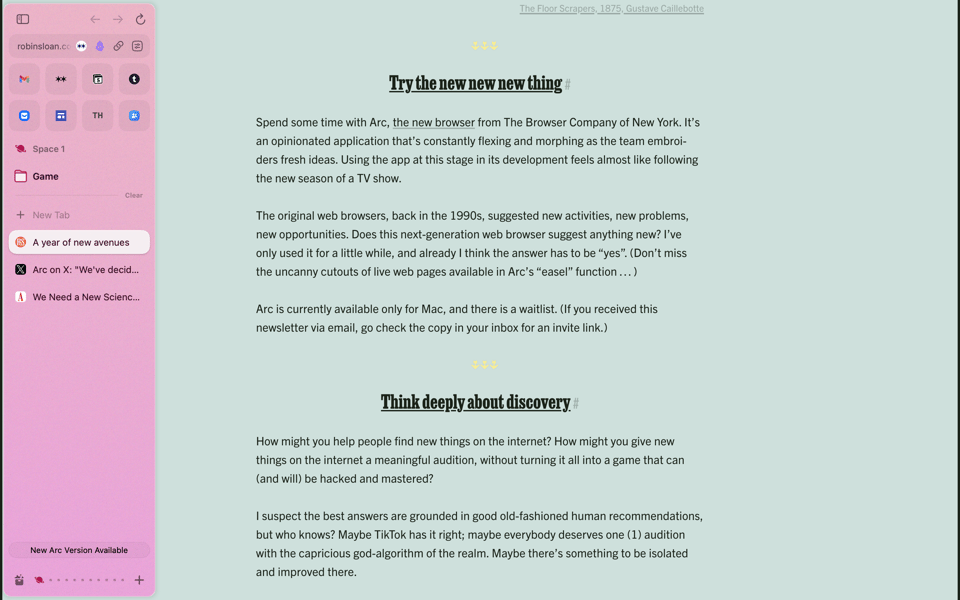 |
The Hardest Test In The World is offered by All Souls College at Oxford University in order to determine who will be awarded its selective and prestigious seven-year research fellowships. Applicants choose their specialty (Classical Studies, Economics, English Literature, History, Law, Philosophy, or Politics) and answer gruelling essay questions, split into two sections. One is related to their specialty: the college asks “Why was medieval Lithuania so resistant to Christianity?” and they expect an answer. “Does the use of economic instruments to achieve geopolitical objectives require a fundamental revision of traditional economic theory, or merely a reinterpretation of its tools?” “‘The Wife of Bath is the first ordinary woman in English literature.’ Discuss.” It’s amusing to read these questions, because I’m so clearly not supposed to. This is not meant for me. It’s an illicit thrill, I’m behind the curtain, it’s the opposite of impostor syndrome. The second part of the test consists of essays about “General” questions. “What is the point of zoos?” “Does architecture affect the thoughts of the people within it?” “How would you explain the internet to a dinosaur?” And these are not easier, but they are more accessible. You can bring a few on a road trip, or on a night out with the guys. Becky and I went to CiCi’s Pizza on Wednesday and got to the bottom of a few things:
Already, I’m imagining eight years from now when I’ll exasperate my daughter with these over the dinner table. No dessert until we decide if civilization has ever died. All the questions for 2024, 2025, and 2026 are available on the All Souls website. |
7 Things I’ve Consumed
|
That’s all for this month. See you again December 7, which is a Monday. My daughter’s due date is December 17, so who knows what that issue is going to look like. Probably won’t be 2,148 words and six charts, but we’ll see! From Tulsa, Tim |