
Septology 2-3: We Must Stop Smoking And Give Our Lives To Jesus Christ
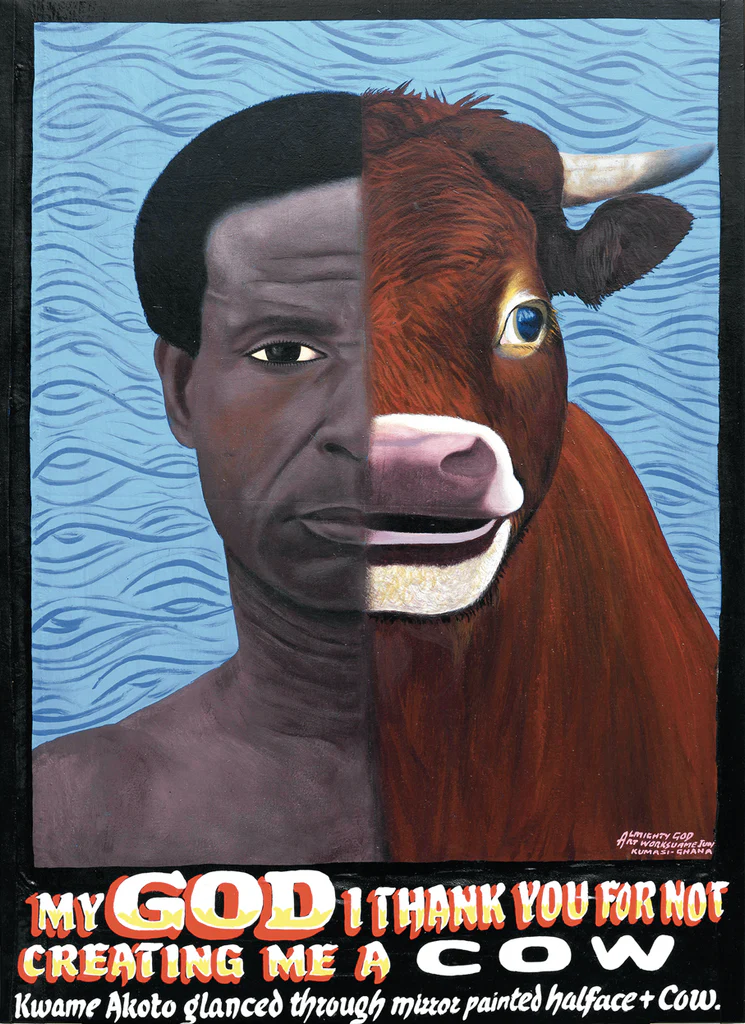
My God I Thank You For Not Creating Me A Cow
Good afternoon; first, let's look at these paintings together. I love them.
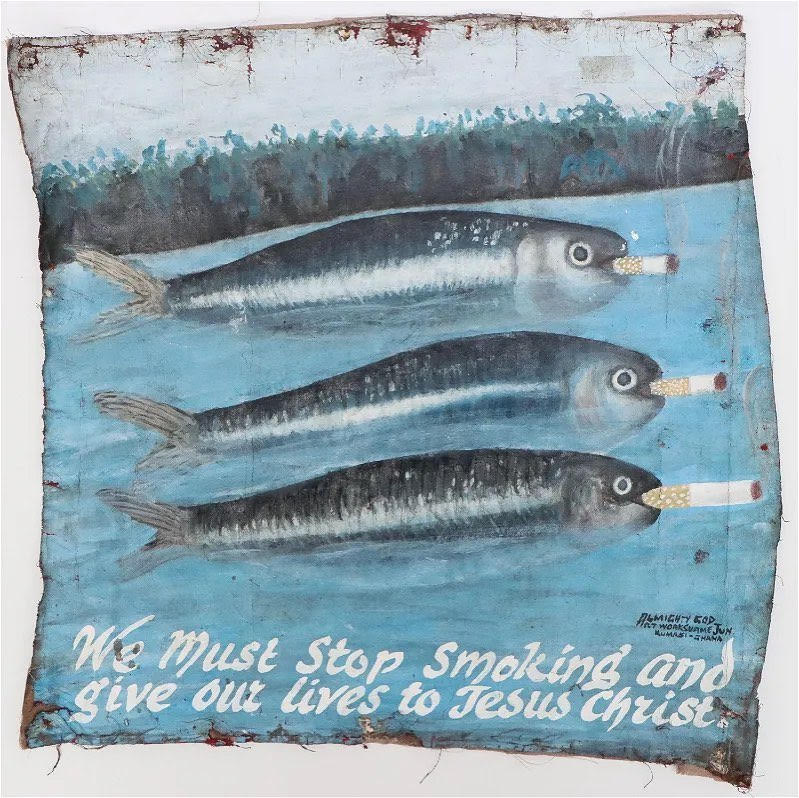
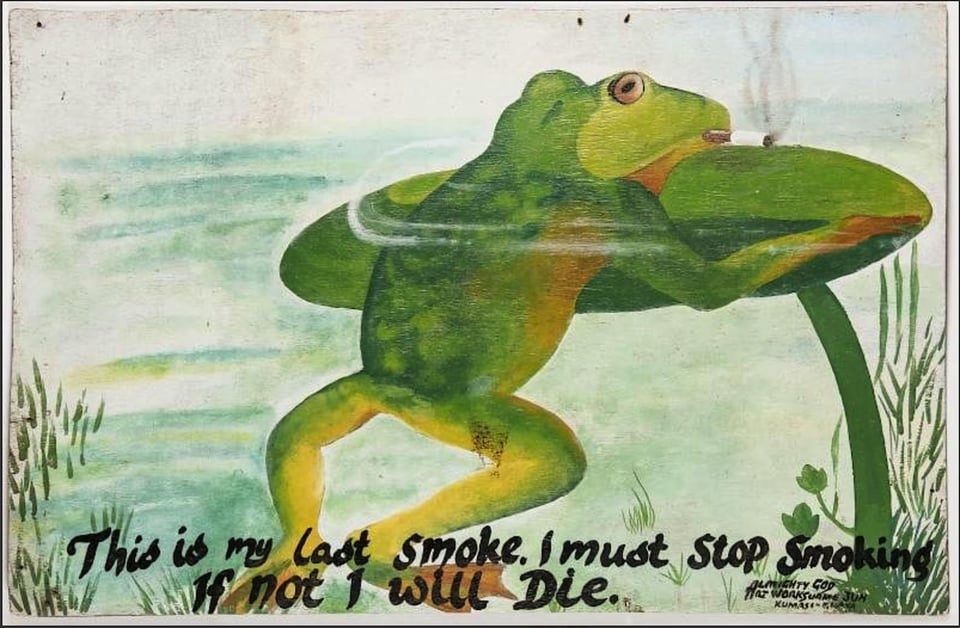
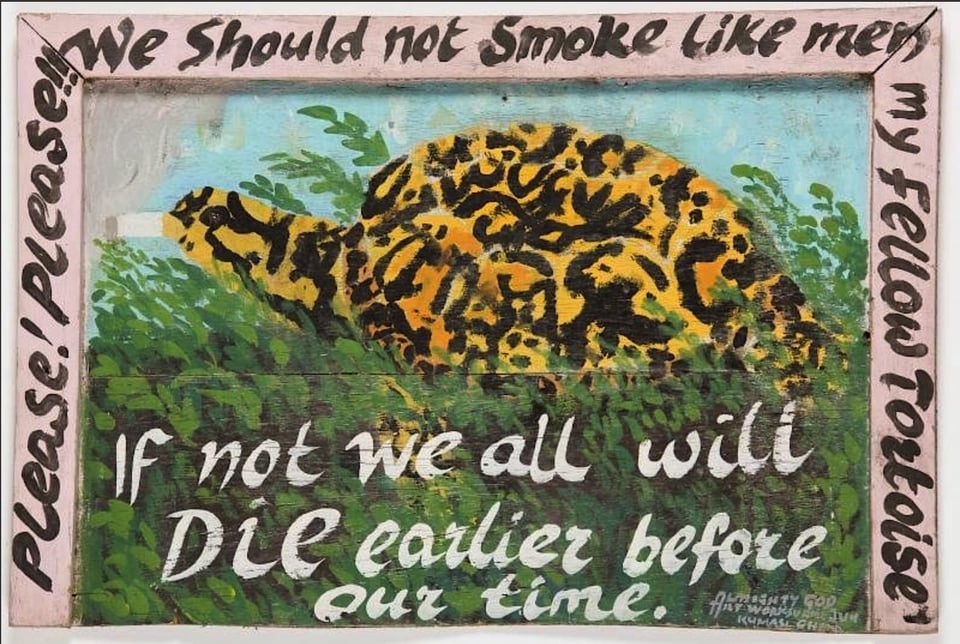
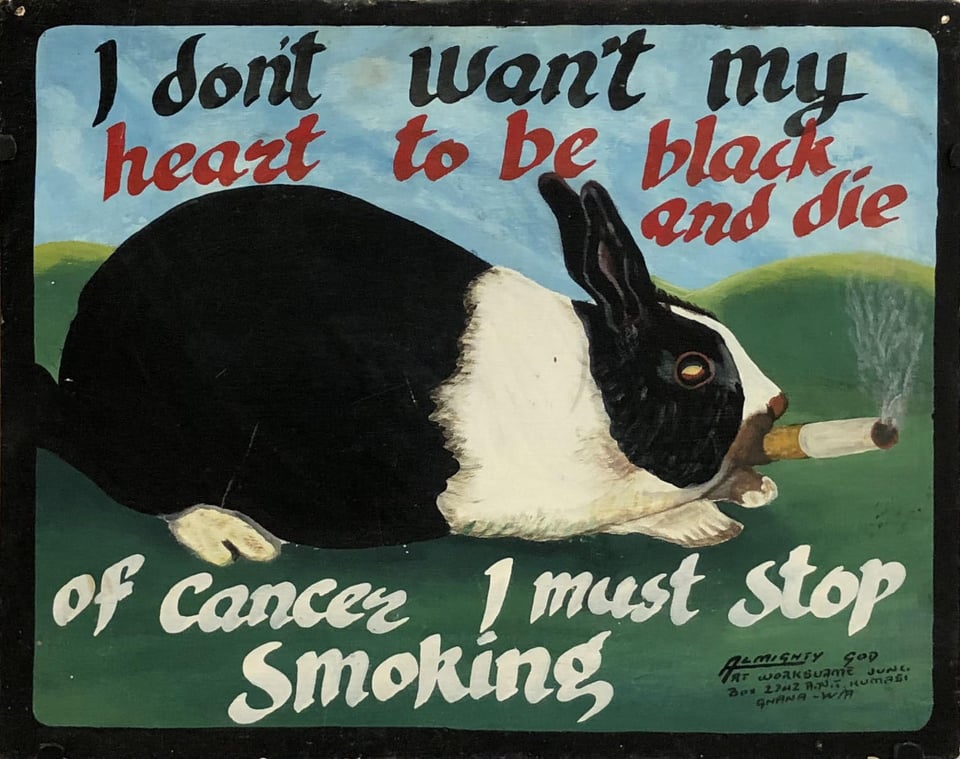
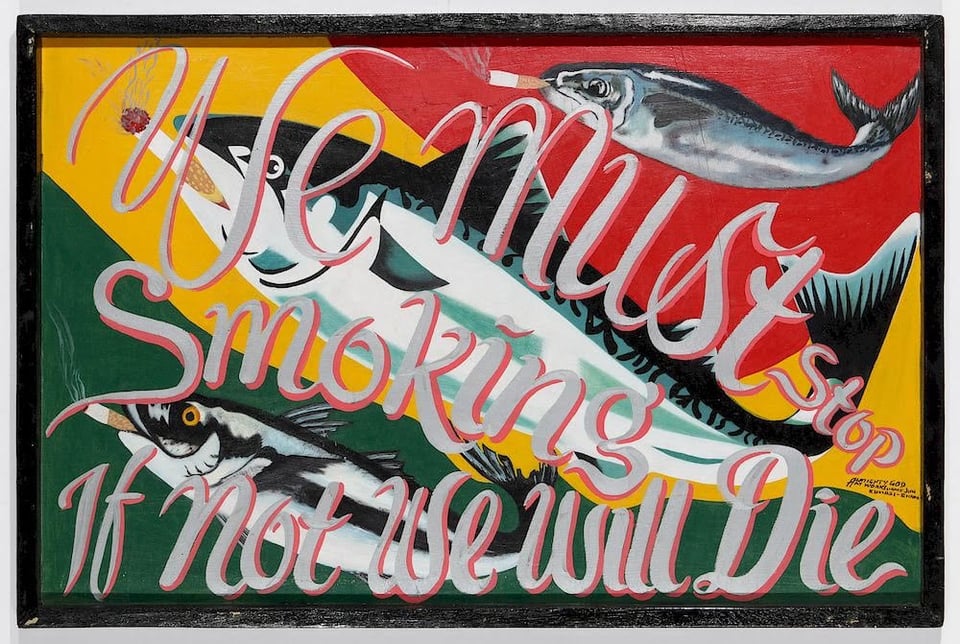
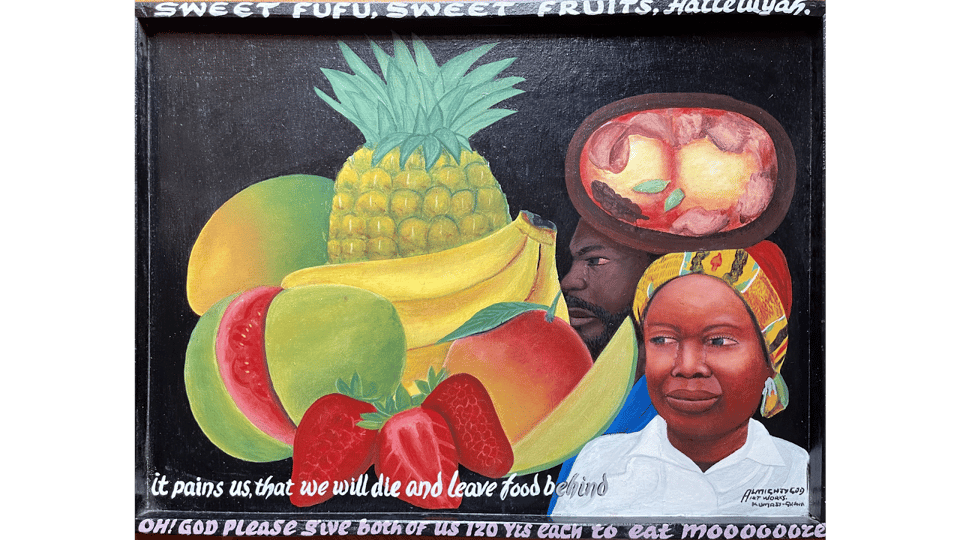
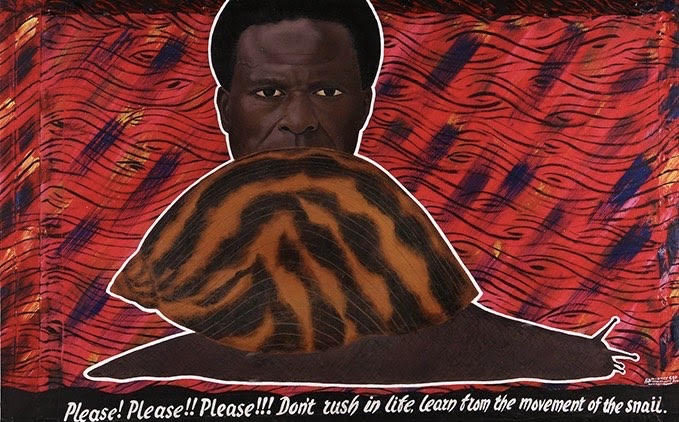
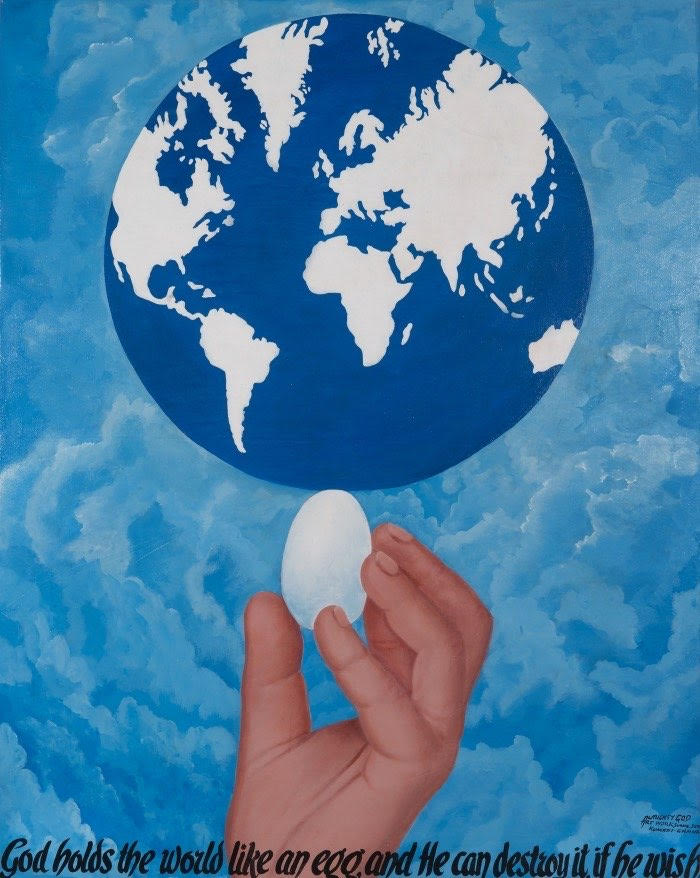
Kwame Akoto (1950-2020) was a Ghanaian artist who used to smoke cigarettes but then he quit because he was convicted by the Holy Spirit, I guess, and then he used his art to inspire others along a similar path of clean living. He went by the name "Almighty God," in part perhaps to distinguish him from another (very good!) Ghanaian artist named Kwame Akoto, who creates works in memory of enslaved people. Almighty God painted about, well, other stuff. His art fills me with delight.
Formatting Note
I (originally) decided to write this month's Septology just right here in Gmail instead of formatting it in Buttondown or designing my own webpage, because I have gotten tired of designing my e-mails just so. It was taking too long! And I have things to say! For the past two months I've wanted to discuss more than just the essays about books, but after writing them, editing them, and putting them together into something that looks nice, it was already the 7th and the newsletter was out the door. So I'm skipping the third step in that process in order to write about more than just books—paintings, for example. I'm getting better at the HTML and I'll do something pretty again in September. But first I'll talk about a book.
The Fanatic
I picture it like this: every time a character is published, the new version has been drawn on top of all of the previously published versions. When a character is introduced for the first time, it's easy, because it's a blank page—one author controls the narrative, and what that author introduces is what that character is like.
When the movie Superman came out last month, one of the main discussion points that I heard was whether the version of Superman that director James Gunn put in this movie was a good depiction of Superman; specifically, whether it was an accurate version of Superman, whether the Superman we saw onscreen rang true compared with the idea of Superman that people had in their heads. Superhero movies have an especially difficult time with this because the characters in those movies have been in a lot of different comic books, and many of them have been in a lot of different movies, too. When Amazing Spider-Man came out in 2011, I remember saying to people that this is a great movie, I had a great time, but Andrew Garfield's version of Peter Parker doesn't act like any Peter Parker I know.
When a character has been written over many, many times, it's easy to accept and understand that no one version perfectly encapsulates the whole, and no one version tells the complete story. But every time a new author is entrusted with an existing character, they are doing so in a way that necessarily diverges from the versions of the character that have existed before. It gets trickier for the second author to try their hand, because their portrait is going to be a little bit different, and you can see where they diverge (this is where many "the book is better than the movie" conversations begin).
In July, I read a book called Karla's Choice. Karla's Choice is "A John le Carré Novel," it says so on the front cover, but John le Carré didn't write it. His son Nick Harkaway did (John le Carré died in 2020). Heir to his father's literary legacy, Harkaway has written a new novel about his father's most famous character, George Smiley, in a new story that takes place in between the events of le Carré's two best and best-known novels. Based on those facts, it should not be good, but it is.
Le Carré served in the British Intelligence in real life, and that's why he couldn't publish under his real name (David Cornwell). The Spy Who Came In From The Cold was his first novel to achieve widespread success and it came out in 1963, the year after Dr. No, the year before Goldfinger, and the same year as From Russia With Love. Starting then, and continuing until his death 58 years later, le Carré wrote about a British Intelligence—"the Circus"—that was shabby, tired, and somewhere between hypocritical and deluded. James Bond may be at the Casino Royale, but George Smiley is at work.
Unlike Superman or Spider-Man, George Smiley has not been written by a multitude of different authors at different times. Up until now, there were only le Carre's books, written mainly in the 1960s and 1970s, and then two BBC miniseries starring Alec Guinness (Tinker Tailor in 1979 and its sequel Smiley's People in '81) and then Tomas Alfredson's 2011 movie Tinker Tailor Soldier Spy 2011, starring Gary Oldman. (George Smiley also appears very briefly in The Spy Who Came In From The Cold, 1965, dir. Martin Ritt and starring Richard Burton and that's great but not a Smiley story. I have the Criterion edition on Blu-Ray if you want to come over and watch.)
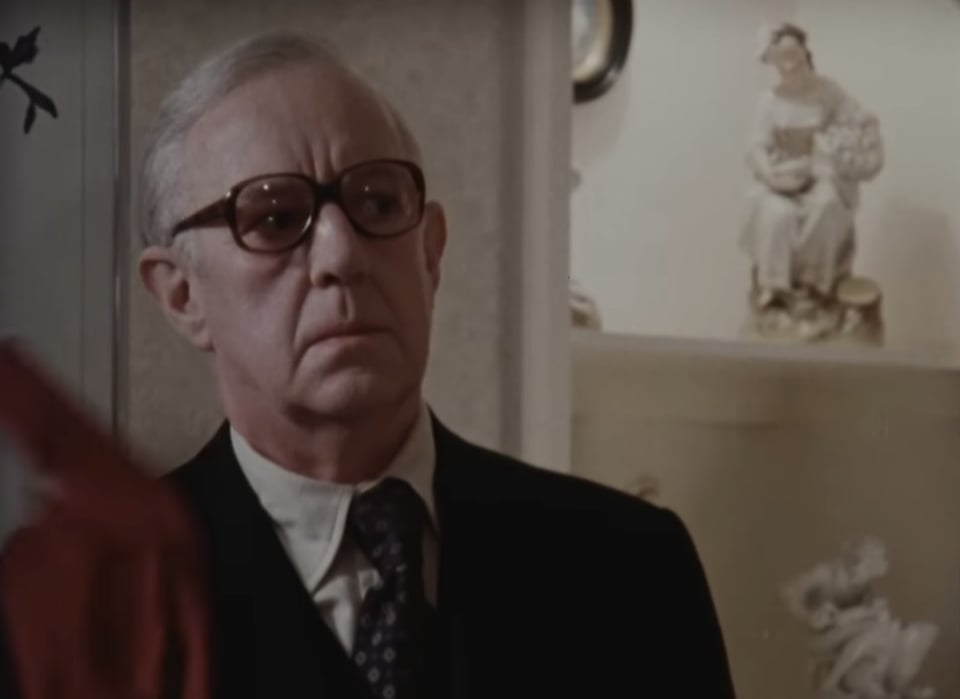

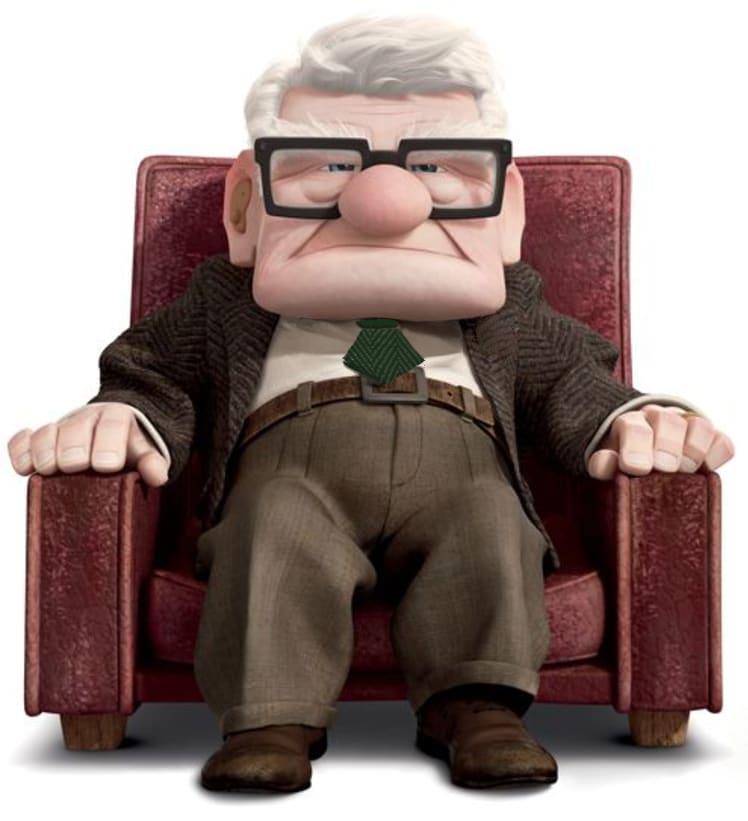
I love the 2011 movie but I prefer Guinness' Smiley because I think Oldman was a little too elegant. George Smiley is supposed to look, uh, stupid and fat? In Tinker, Tailor, Le Carré introduces him as "one of London’s meek who do not inherit the earth. His legs were short, his gait anything but agile, his dress costly, ill-fitting, and extremely wet." He's retired. He's not happy. He's constantly polishing his glasses on the fat end of his tie, and "when he did this his eyes had a soaked, naked look that was embarrassing to those who caught him at it." When I picture George Smiley, I picture Carl from Up.
If we return to the metaphor of the drawings, what's interesting about Karla's Choice, the new novel written by le Carré's son, is that his version of George Smiley does not diverge from his father's version at all. He's traced his dad's character so closely that you can't tell them apart; at least, I couldn't. If I had not learned beforehand this was an imitation, I would not have realized it myself (if I hadn't known, I wouldn't have known).
That was my least favorite part of the book. Not only was George uncannily true to form, but the cast we met in Karla's Choice were often the same characters that we already knew from the other novels—our friends Peter Guillam, Jim Prideaux, Bill Haydon, Connie Sachs, Millie McCraig, Toby Esterhase, Hans-Dieter Mundt, and the enigmatic Control—and their inclusion felt like unnatural fan service rather than a true requirement of the plot. Two or three, sure, but all of them? I would imagine that if I were not familiar with these names and characters beforehand, I would not be able to keep them straight, much less understand the plot. Though I suppose the same could be said of the first three times I read Tinker, Tailor.
But Karla's Choice overcame those complaints by virtue of being very good. A quick summary: Karla, the one who makes the choice, is George's foil in Moscow. ("Modest, and avuncular," in George's words. "He would have looked very well as a priest...little wiry chap, with silvery hair...or a schoolmaster, he could have been a schoolmaster.") When a Hungarian man going by Banatí disappears in London, dodging an assassination ordered by Moscow, George eventually discovers the reason Banatí is a target is because he's connected to a figure in Karla's past. George finds the man living in Portugal and gets word to Karla that he has done so, but he does not want personal connections to be collateral damage in Cold War espionage, so he offers to meet—"It strikes me that our professional competitiveness should have agreed boundaries. I thought, if he agreed, he could let me know." But Karla does not agree. He chooses to have his friend killed.
George and Karla meet face-to-face only twice. The second time is at the Berlin Wall, in Smiley's People, after George identifies another personal connection and uses her to secure Karla's defection to the West. The other is in a jail in India, a flashback before either man knew who the other was, before they had achieved their high rank opposite one another, and George thinks he's talking to any old Moscow hood. One of Karla's operations had been blown in the US, and presumably he would have been shot or worse when he returned to the USSR. George wants him to sell his secrets to the Circus, but he gets hot and flustered and tired and starts talking about his wife, trying to persuade the other man to come to England on behalf of his own wife, George assumes he has one. Karla never says a word. He declines George's invitation and returns home. George tells that story to his young friend Peter Guillam in Tinker, Tailor.
“So Karla is fireproof,” Guillam asked finally. “He can’t be bought and he can’t be beaten?”
"If you want a sermon [George ultimately replies], Karla is not fireproof, because he’s a fanatic. And one day, if I have anything to do with it, that lack of moderation will be his downfall.”
I've never known quite what to make of that. It seems very clear that George Smiley and Karla are two sides of the same coin, and I imagine if they had been born in each other's countries, they would have reached each other's positions. So why is Karla a fanatic and not George? What's the difference? The simplest answer would be that there isn't one. Smiley is a fanatic in the West to the same degree that Karla is in the East—not a fanatic for capitalist/communist dogma, not even really for patriotism, but for love of the game. They are spies, and they are spying to defeat one another.
So then why is Karla's lack of moderation going to be his downfall? What makes George so confident? Are they not the same? Would George's lack of moderation not also be his downfall?
In the past, I've read George's line as a declaration of superiority coming from le Carré himself. George Smiley as prophet, predicting the future with his creator's full assurance and confidence that it will come to pass. But now I have a new thesis: when George says Karla's fanaticism will be his downfall, there are actually two parts to what he says. The first is of recognition: George knows Karla is a fanatic because George recognizes the same fanaticism in himself. And then the second part would be determination, maybe even hope: he and I are evenly matched, but I'm going to win.
And, in fairness, he does. It might be my favorite line of le Carré's, when Karla reaches West Berlin and Guillam and Smiley are there to see it:
From long habit, Smiley had taken off his spectacles and was absently polishing them on the fat end of his tie, even though he had to delve for it among the folds of his tweed coat.
"George, you won," said Guillam, as they walked slowly towards the car.
"Did I?" Smiley said. "Yes. Yes, well I suppose I did."
In Karla's Choice, Harkaway draws out Smiley's fanaticism by means of his beautiful wife Ann. In le Carré's telling, she is famously unfaithful to George, which Karla uses to his advantage, but Harkaway shows us something different. When the book begins, George is retired from life in intelligence, but it is unlike the ill-fitting, and extremely wet retirement he starts Tinker, Tailor in. Instead, he's happy! He and Ann are together: "She had her George all to herself, his eyes no longer straying faithlessly to the grey pages of Ministry reports."
But then the service calls him back, out of retirement, and damn him, he listens. We see Ann's interior life for the first time, and she's crushed. For a few chapters, George misses her, he thinks about ways he can end his mission early and get back to her, but he doesn't do it. He doesn't feel like he can. He chooses the game, and Karla.
At the end of the book, Ann asks George if he's ready to come back, if he can turn away from his "mistress," the Circus. Or maybe he wants to keep giving his life to work, while she gives hers to the pretty men she takes in his absence. Is that what George wants?
"It isn't. Desperately."
"Then you have to let her down, George. You have to put her away and decide, today and every day, that you don’t belong to her. It isn’t once, you see. Not for you or for me. It’s every time, or we’ll spin apart.’
"I will."
She kissed him then, her lips heavy and hungry against his.
"Now?"
"I have –"
She sighed, then patted his hand. "Oh, I know, George. You have one more thing you need to do."
After the encounter in the New Delhi jail, Karla tells one of his agents that George is a very good agent, "the one we have to look out for," but he has a weakness, and that's his wife. The conventional reading would be that Karla does not have love in his life, and he sees it as a weakness that George does. But perhaps the opposite is true. Perhaps what Karla identified, correctly, as George's great flaw, is that he doesn't know how to love his wife. He chooses not to. The one arena where the brilliant George Smiley falls short—miserably, stupidly, tragically short—is in love.
By the time Tinker, Tailor starts, Ann is already gone.
Several Other Things
I am not the only one to have written about John le Carré. Last month, "Chasing le Carré in Corfu" came out in The Atlantic, and I also highly recommend "George and Ann" in Gawker from a few years ago.
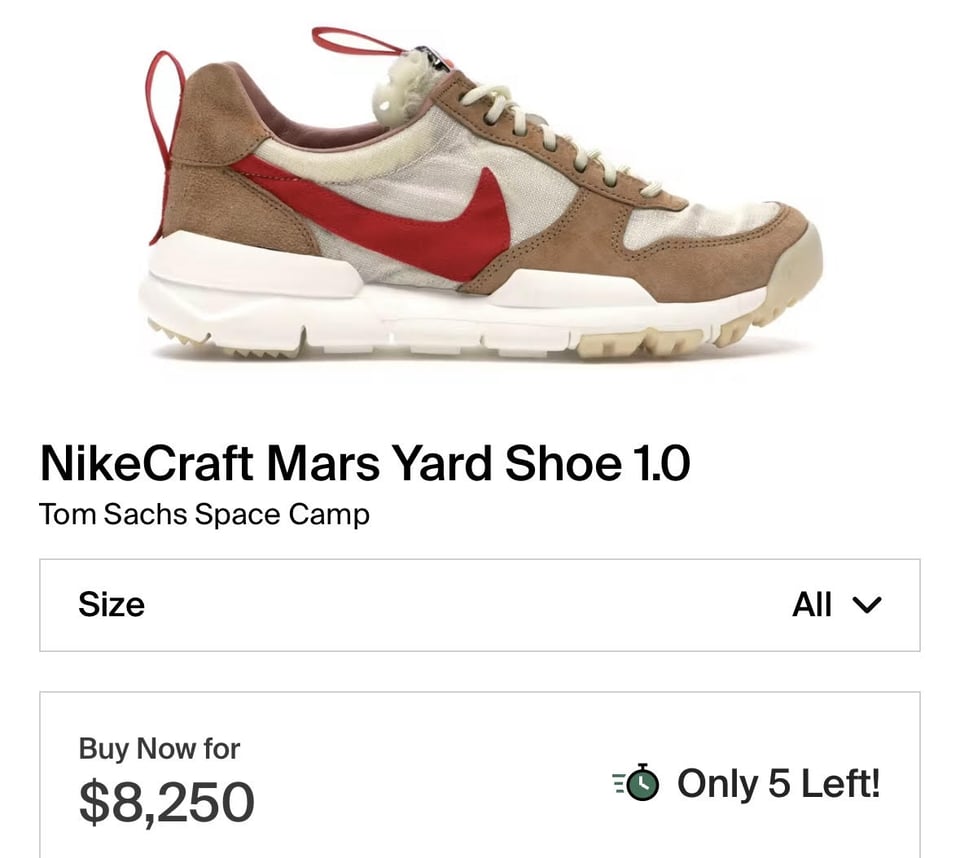
Now this will sound silly, but I've spent a large part of my July (up to an hour a day) doing challenges given to me in an app, and when I do them I am awarded points, and if I get enough points by September 5, I will win the opportunity to purchase a pair of shoes.
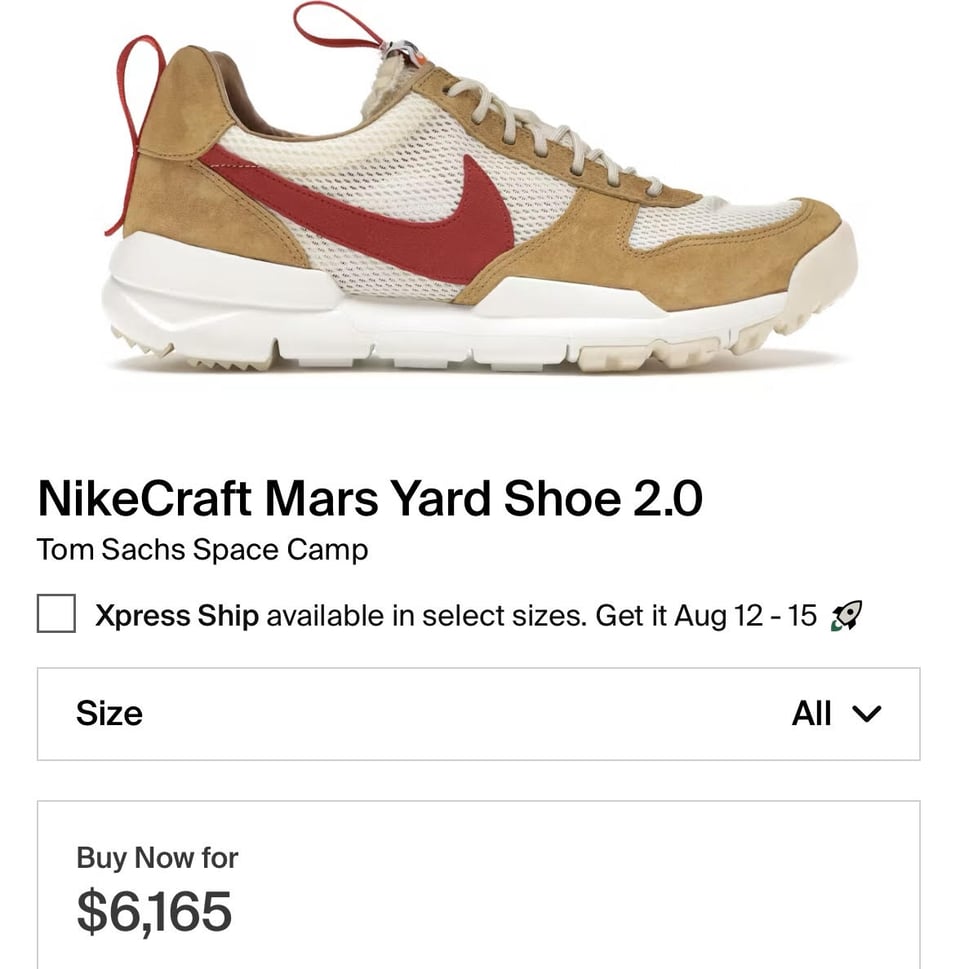
The shoe in question is the Nikecraft Mars Yard 3.0, designed by artist Tom Sachs. He made the app and the challenges so that people will get the shoes instead of resellers (the Mars Yard 1.0 and 2.0 each fetch thousands and thousands of dollars on resale).
The challenges are great. I would like to think I have enough self-respect to not do the challenges if they were stupid, but thankfully they aren't. The first was to shoot ten free throws every day, the second was "Output Before Input," which means you need to do something creative like drawing or writing before you look at your phone every morning, and the third is to run for twenty minutes. All of these are very valuable habits to build. I'm feeling more creative. My body feels better after I run. I am still very very bad at free throws but after hanging out at the courts for a few minutes every day, I got invited to a pickup game on Sunday, which was really fun! My team of three lost 11-7, which is not the result we wanted, but I'm proud of the effort.
The app is called I.S.R.U. (stands for "in situ resource utilization" a NASA term that means using materials you find wherever you are) if you want to give it a spin. I can't promise you'll get any shoes but I will tell you with confidence it is nice to accomplish little tasks every day.
Another Tom Sachs video I watched this week was called How To Learn How To Surf, which is a video about Tom and his studio crew going to Bali to learn how to surf. They were not very good at surfing but they learned to try to enjoy the process, not the result. My favorite part was seeing one of the kids of one of the Indonesian surf teachers they worked with, the kid was 8 and way better at surfing than anyone on the Sachs team, because he does it every day and he looks at it like play (the Americans were very goal-oriented and they were treating surfing like work). But this kid Sinar was just playing in the water.
I have no plans to learn to surf, but I think that same lessons can apply to writing, which is a craft I enjoy and would like to get better at. If I can find the writing equivalent of playing in the water, just getting out there and having fun every day, I think it would be really good for me and for the work. I guess Septology is pretty close.
Also on the subject of habits, I read two really good articles over the past few weeks (one, two) about general life admin, keeping organized and so on. If you have a certain kind of self-critical personality I would caution you to read these in a time when you are full and expansive, otherwise you might read them as a kind of criticism and feel like you are deficient, instead of reading them as an invitation and feel like you have many opportunities ahead of you to live a fulfilling life, no matter what shape that takes. I learned that lesson the hard way reading the first article but recovered well in time for the second. Useful tips in there either way.
On an adjacent note, I've long played the game with myself to see how low I can get my phone screen time (<2 hours a day is ideal). I read a New Yorker article by Kyle Chayka about how the app Opal helped him do that better, and it's worked pretty well. So do with that what you will.
Months ago I saved this keyboard on are.na to share on here. Not sure why. It is $3,600. Not sure why that is either.

In Septology 7-7, I talked about my new Bandit running shoes, and shared the mood board that Bandit made to help guide their design and development. They've done another one for their summer collection.
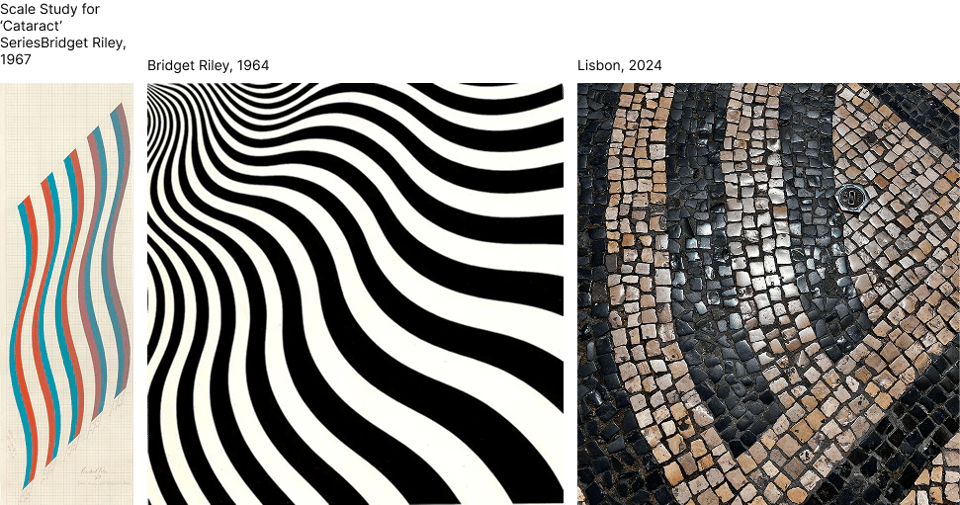
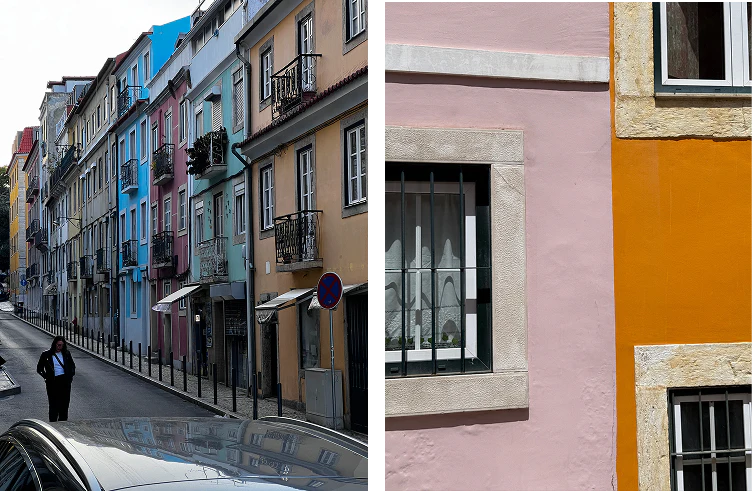
It's amusing to note how little this has to do with running or gear, and it's really more of a vibe, the idea of what these could clothes could seem like. I fell prey to this same trap when Becky and I were designing our wedding last year:
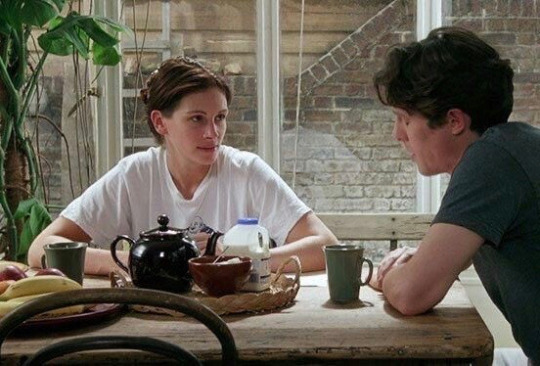

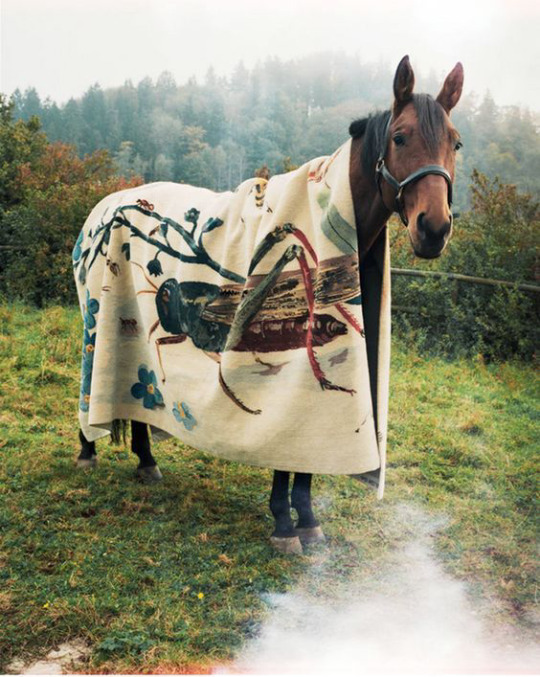
One might argue that these images of tattoos and horses are not super closely related to wedding planning. Perhaps I could have spent my time in more productive ways. But I did have fun.
Lastly, and sadly, I'm in the air today because I'm traveling north for my Grandpa Hatton's funeral. I wrote his obituary. Pour one out for him.
From Chicago-O'Hare,
Tim