Seinoza Walks Ed. 3 - Cultivating connection
“AUSSIE!?” the tall, tanned surfer dude in the car park shouted up at us.
“YES!” this Aussie, walking along a seawall and somewhat startled at hearing English in this tiny town, shouted back.
“I love surfing! I lived in Manly!” came the reply from a beaming face.
How on earth… I wondered. What on earth are the chances that in this tiny town, in this quiet corner of Japan I’d run into a guy who loved surfing, and who’d lived on one of the beaches on which I spent my childhood.

A few hundred metres further down the road, Kalia and I settled on a bench overlooking Atashika Bay; we were ravenous for a well-earned lunch: seaweed salad, sushi, barbecued pork and fried chicked, mikan — Japanese mandarins — and an ice cream sandwich for good measure.
I pulled out my phone to look at Google Maps, curious to see if there was any digital evidence of this dude and what he might be doing here. It turned out that he runs a juice bar and guesthouse. His wife bakes fresh bread, cakes, and tarts. He has a citrus farm up the hill. And he radiates the kind of joy that made us feel oh-so-welcome in this tiny seaside town. After days of deserted playgrounds and toys rotting in the windows of decaying homes, all ghostly markers of Japan’s depopulation, this guy was like Atashika’s very own fountain of youth. His love for the placed bubbled up and out of him. He gave us a sense that, here at least, a quiet renaissance could be afoot.
Months later, Kalia and I started to think about the trails we’d want to walk with folk. Japan has a fair handful of beautiful, ancient pilgrimage routes and, given Kalia’s propensity for exhaustive research, this meant that we were considering them all. We drew up the criteria that were important to us — 7ish days of walking to allow the time and space for transformation, plenty of nature and few people because we’re so often starved of one and surrounded by the other, and a deep history of pilgrimage, because there’s something undeniably magic about following in the footsteps of countless others. We were going nuts with decision fatigue.
But that moment of connection with Surfer Dude (a.k.a. Hisashi) and all the others like it along the Ise-ji made the decision for us. We’d never have the chance to build roots with the communities that support us if we were walking a different path every time. The Ise-ji, in all its remote, ramshackle kookiness became our sole focus, and Hisashi and his wife’s guesthouse, a lynchpin in our planning.
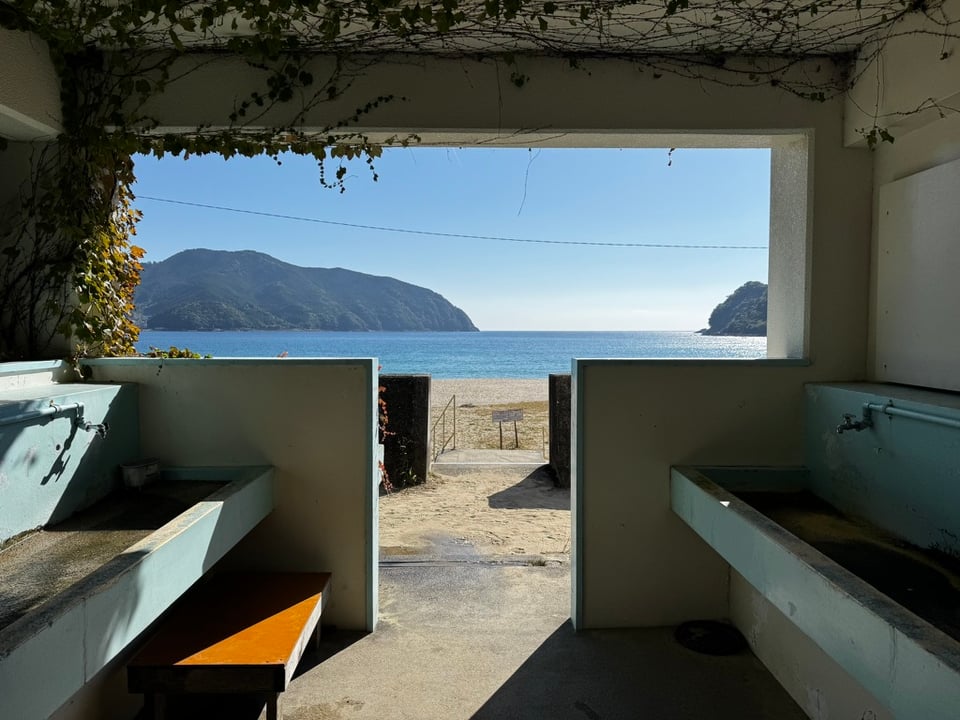
Two and a bit weeks ago, Kalia and I stumbled back into Atashika. After completing the two heaviest days of the hike, one in driving rain, the other made up of climb after climb after climb we were, in the words of transformational woo, tenderised. We were also ready for a rest. After a short day’s hike, we picked our way along the main street, stopping to buy mikan and gossiping with the chatty, clattery old folk at the udon restaurant. And there, sitting at the big table in the juice bar at the end of the street was Hisashi’s tanned, grinning face again. And this time, he’d be our host for the night.
We told him why we came back, why we wanted to stay in this particular place on this particular walk: his greeting last year, and his love for his community and the land that holds it. And, pointing to the map on the table, he let us in on all the little secrets of Atashika and the deep green hills and brilliant blue coves that surround it, giving us the kind of insight we’d never have gained had we just walked through, or stayed at some random hotel.
A short while later, when we slipped into those brilliant blue waters, our bone tired bodies bobbing in rolling waves and surrounded by fish that seemed to jump for joy, I knew we had something really special on our hands. For Kalia and I, this kind of connection means we have the privilege of coming to a place time and time again so that with time, we might come to know it in our bones — and Atashika is a place that we want to know in our bones. And for the people that walk with us, this depth of connection offers the opportunity to not just move through a place and see it on some superficial level, but to be embraced by it, and even transformed by it. Our relationships with Hisashi and all the others like him that we’ve met are a fundamental part of that.
This is what we mean by connection, connection, connection. It guides us to explore depth over breadth, to say a thousand nos to find just the right yes, and to return time and again to the places that help us feel at home.
Starting next week, we’ll be answering some of the awesome questions you all have been sending us, like What is a pilgrimage? and What if I’m not religious? and What does a day on the trail look like? so if you’re keen to learn more about the nuts and bolts of walking with Seinoza, we got you.
And if you’re ready to get a head start, there’s always our website with all the juicy details, our Instagram, where you can get a sense for what it’s like to walk with us, or book a call to connect with us one on one.
Until next time,
Drew & Kalia
As you head into the end of one year and your mind turns to how you'd like to be in the next one, consider joining us on our April 2026 Ise-ji Pilgrimage.
Applications close December 31.
Details at www.seinoza.com