
It's a strange world
If you’re just tuning in: Last time I shared how Rear Window made me fall in love with Grace Kelly and, oh yeah, the very art form of cinema.
Rear Window at 13 was swooning, crushes, and dreams of canoodling.
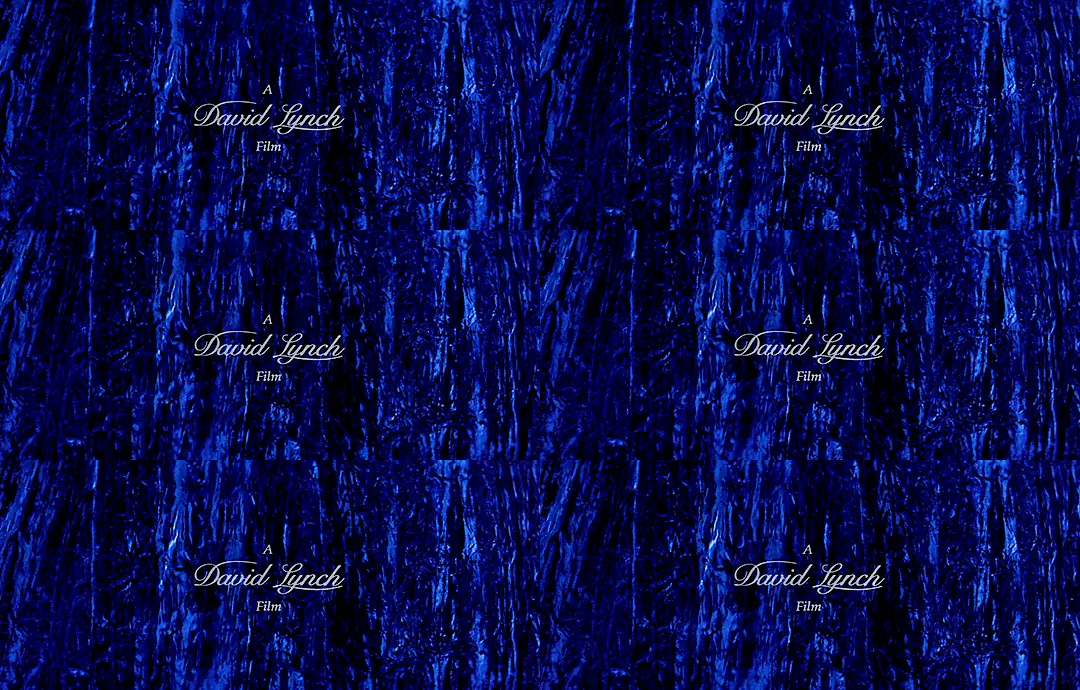
Blue Velvet at 16 was a surprise tour of Berlin’s notorious KitKatKlub. *Blue Velvet *showed me that movies could get kinky, before I had a true sense of what kinky was.
Kinky and intense and eye-opening, ripping the doors of perception off their hinges. It was fucking great, also fucking confusing.
(Fear not: This is not about actual kinks I may or may not have. No one wants to hear that. That’s not really what I mean, anyway; I don’t find Blue Velvet to be a particularly sexy movie, even though it’s an extremely horny one.)
I can’t imagine that watching Blue Velvet for the first time now, even if you are 16, has nearly the same impact, now that we’ve seen David Lynch become a pop culture icon, someone who has produced Twin Peaks and Fire Walk With Me and Inland Empire and regular weather reports from Los Angeles.
I saw Blue Velvet in 1986, the year it came out, at Milwaukee’s Prospect Mall Cinemas (RIP). I “snuck in” with two friends, which just meant brazening our way into the R-rated movie by acting like mature, MPAA-approved 17-year-olds. (Note: Most theaters didn’t give a shit in the 1980s. No ID? No problem. No one asked questions.)
(“Rated R for strong disturbing violent and sexual content, some graphic nudity, and pervasive language.” Yeah, that about covers it.)
My friends and I weren’t going in unprepared. We knew the movie was controversial. I’m sure I saw Roger Ebert call it “cruelly unfair to its actors” on Siskel & Ebert. My friend Will was only allowed to go because my other friend Michael was going along; Will’s mom was concerned about misogynistic themes, but thought that Michael was a counterbalancing influence. (I don’t think she knew me well enough to realize I would be a milquetoast influence myself.)
We also knew it was essential arthouse shit, unlike anything people had seen before, at least so far as we knew. And we were nothing if not arthouse kids.
The power of seeing Blue Velvet wasn’t seeing fucked up shit, or nudity. I’d seen fucked up shit and nudity on cable TV and from the local video store (I can’t remember if they were another institution lax about carding, or if my mom just put a note in our account that said I could watch R-rated movies).
Blue Velvet’s power wasn’t in what it showed you — though some that was eye-opening — but the way Lynch showed it to you. Yes, I’d seen boobs. But I had not seen a violent performatively masculine dude gulp amyl nitrate and try to revisit the womb while swearing up a storm and stroking a swatch of fabric.
What the actual fuck, man.
One of Roger Ebert’s complaints is not precisely wrong. There is a lot of funny shit in Blue Velvet. I remember howling with laughter early in the movie when the radio announces what time it will be at the sound of the falling tree. (Were we annoying at the screening? Maybe, though I like to think there was plenty of laughter throughout the crowd.)
As the movie goes on, though, that laughter serves more like a lifeline, something to clutch to keep you from just gaping at the horrors. Horrors like the ear that wasn’t just clipped off, but starting to mold.
“Heineken? Fuck that shit! Pabst Blue Ribbon!” stands out as a quote both because it’s ridiculous, and because it’s one of many terrifying moments with Frank, as Jeffrey gets abducted for an evening and it becomes ever more clear that saying the wrong thing might get him killed, fucked up, or fucked up to death. And it’s never clear that there’s a right thing to say. Hysterical laughter at hypermasculine danger.
In case it’s not obvious, I was not a hypermasculine kid. I’m quite straight, solidly cis, but I’ve never been anything close to macho. I’ve always loved women and femininity, and I’ve always found performative masculinity anywhere from sus to terrifying.
Blue Velvet, and Dennis Hopper as Frank, perfectly captures that. It’s not a horror movie, but it’s horrifying, and Lynch channels both desperate desire and menacing masculinity. Frank is terrifying in part because maybe, just maybe, as a straight guy he’s there lurking in my id, waiting for a crack to spill him out.
As we left the theater, Mike, Will, and I quoted lines like the Heineken one, and “Fuck you, you fucking fuck!” and “You're so fuckin' suave.” We marveled at the totally fake robin at the end of the movie and the blatant connection between the hose with a kink in it and Jeffrey’s father’s stroke.
What we scrupulously did not talk about: Dorothy talking Jeffrey through sex and BDSM, a terrified woman taking some control and enjoying the pleasure that gave her, because what exactly were three 16-year-old suburban boys going to have to say about that?
That was fucked up, all right, but the kind of fucked up that lodges in your brain and only starts to make sense over time, as you get older and see more of life and what people are capable of, bad and good and all the in-between.
It wasn’t hot, in any sense. It was a different kind of provocative, spurring a sense of wonder at the complex ways people can behave, the way damage and experiences can play out, and can spread, and maybe can’t be forgotten but can be incorporated into the rich bouillabaisse of a person’s life.
Reject the detective/pervert binary. It’s a spectrum.
Blue Velvet is not quite my favorite Lynch — that’s Mulholland Drive; some days I might also rank it below The Straight Story. But it was formative. Not just for me, but culturally. Eraserhead was weird; Blue Velvet was weird before midnight, out demanding that people who wanted to be cultured see it, talk about it, have opinions about it.
It did open my eyes to a greater variety of weird, provocative shit. I hadn’t only been interested in classic movies — famously low on “fuck” and kinky sex — but Blue Velvet was a major influence on the things I’d seek out later. The Cook, the Thief, His Wife, and Her Lover isn’t much like Blue Velvet beyond being provocative as hell, but that was enough to draw me in a couple years later.
In retrospect, it’s funny to think about a parent being concerned that David Lynch, of all directors, would be a misogynistic influence. I was recently thinking about Hitchcock (he is my Roman Empire) and wondering if there was a male director as infatuated with women who could put them through an emotional wringer without turning out to be abusive — then I realized, that’s Lynch. Two detectives, two perverts, one of them who took better care of all his actresses.
I didn’t appreciate in 1986 how clearly influential Hitchcock was on Lynch, though it clicked for me eventually. They both love the pleasures of movies, and they both love provocations. Dark magic sculpted with light.
One contemporary movie I did not end up seeing in theaters in 1986: Jonathan Demme’s Something Wild. That was an eye-opening VHS viewing for me, one that flipped on more purely pleasurable switches in my brain, being genuinely sexy but also productively dark. It’s not far removed from Blue Velvet, but more precisely my jam, and I’m sure having seen Lynch’s much darker work opened me up for Demme’s more overt humanism.
Good writing about movies
I’m always in the tank for Matt Zoller Seitz, but his reflections on Ebertfest in the wake of the last one are truly gorgeous. And dovetails nicely with my own experience of moviegoing as something that can be close to meditation.
“There’s a great quote from Roger—which I’m going to paraphrase really poorly, probably—where he talked about the mechanical aspects of cinema as it has always been presented, which is: you sit in the dark, which is what you do mentally when you meditate; when you take a moment, you clear your head; you clear your head of everything that’s extraneous. And you receive things that were not there before. You open yourself up.”
Always worth reading a Walter Chaw review, especially worth reading his zero-star reviews. In this case, Michael.
Priscilla Page on one of my favorite movies, John Sayles’s Lone Star.
Maris Kreizman had me at the term “hot-washing.”
Hollywood Needs to Stop Hot-Washing Literary Adaptations
Hot-washing is when source material that’s complicated has its edges smoothed out by the casting of conventionally hot people who are made to look conventionally hot in a way that clashes with the source material, and it’s ruining a bunch of recent literary adaptations whose characters are meant to seem a little more real. Imagine if Bridget Jones’s Diary were remade in 2026 with Sydney Sweeney as the title character.
I'm probably one of the world's biggest fans of Jonathan Demme's Something Wild, but it's delightful to run across a piece like Zach Zahos's “The Music of Something Wild” and see someone else dive in to an even deeper end.
Ooh! Aah! (Shockingly hard to find on streaming, and regrettably not on the soundtrack album.)
Next time
I don't have a concrete plan. Want to ask me questions? Reply to the email!
Otherwise maybe I'll scroll through Reddit and weigh in on moviegoing debates there.
I'm on Letterboxd and usually get around to sharing some thoughts on the movies I see eventually.
