
A detour into my roots
OK, usually when we talk about roots, we’re talking about hometowns and extended families, traditions and cultural heritage. That’s not what I’m thinking about here - rather, I’m thinking about a Substack post by financial writer Michael Green about contemporaneous poverty in the United States - and I want to take a little time to write about economics, which is what I studied in college, and what I now spend my days teaching. It’ll all connect to old-time music in the end, though.
Green argues that the poverty line in the United States, presently $31,000 for a family of four, should be closer to $140,000. For context, the median household has an income of roughly $80,000, and 75% of American households make less than $140,000. The threshold for the global 1% of income earners is $124,000, and the average income in the world is roughly $13,000. Which is all to say: if Green is right, most Americans, and most people generally, live in poverty. That makes his theory pretty hard to believe for most people, and indeed, plenty of folks have written about why it’s wrong.
The only theory of poverty I really have a problem with is the idea that it is the fault of the poor. Its easy to examine one person’s life and point out why they might deserve whatever happened to them. Its difficult, however, to explain how we can waste so much food while so many people do not have enough to eat.
The crux of Green’s argument is the cost of participation in the economy: the idea that, in order to be a productive member of society, you need to meet your basic needs. For a family of four, this means housing, food, transportation, various minor expenses, and, crucially, child care, which all together costs $140,000 annually, on average. And, as economist Noah Smith points out, most Americans have a place to live, food eat, ways to get around, and someone to take care of them or their loved ones or whatever. The US is still a pretty prosperous place, at least, for most people anyways. But this is where my view diverges from that of most folks.
People responding to Green’s argument seem mostly focused on explaining why Green’s metric is correct or incorrect. If we put metrics aside, I think “most Americans are not poor” is more plausible than not.
In economics, income equals output is an accounting identity. “Gross domestic product” is, as the name implies, a measurement of the production of goods and services, but it is often called “national income” because the two are one and the same thing, by definition. It occurs to me that, if we say full participation in the economy for two people, including the cost reproducing themselves at replacement rate, consumes roughly $140,000 in goods and services annually. That’s rather a lot.
Now, before I go on, I must stress that I am not arguing here in favor of degrowth - the idea that we ought to produce fewer goods and services - I am arguing here in favor of productive efficiency. Americans would be more productive, in my view, if feeding, clothing, sheltering, and transporting us required fewer scarce resources - and I am thinking of basic inputs like water, food, fuel, and building materials especially. But I think accomplishing that sort of growth would mean primarily the growth of labor incomes as opposed to capital incomes, and because capital plays a dominant role in social decision making, it seems an unlikely policy choice. Nevertheless, I do not advocate degrowth.
Back to how we Americans live. We drive a lot. We eat a lot of meat. We live in houses that are too big, too spaced out, and too expensive to heat and/or cool. We spend too much time looking at screens. We spend a huge amount on replicating individual versions of what ought to be public goods: swimming pools, playgrounds, theaters, kitchens, and so on. The world I want to imagine is one with a whole lot more public goods, and fewer private ones. Where you could literally eat - and eat well - three times a day at a local cafeteria, within walking distance of home, without worrying about the cost. And, like, maybe that’s silly, and maybe it’s not, but here’s my point:
When I think about the world I want to live in, the tradition of old-time music and dance is part of it. We so often think of old-time as something from the past - hence the name, right? But I think its important to recognize it as part of our future, too.
Paradoxically, it’s hard to imagine old-time culture in the future because there’s no money in it. I mean, maybe a little, but not all that much. It’s an artform of amateurs, largely produced with public goods - tunes in the public domain, folk dances that can’t be copyrighted or trademarked on being too well established. There’s value there, but its difficult to monetize in the way so much of culture is.
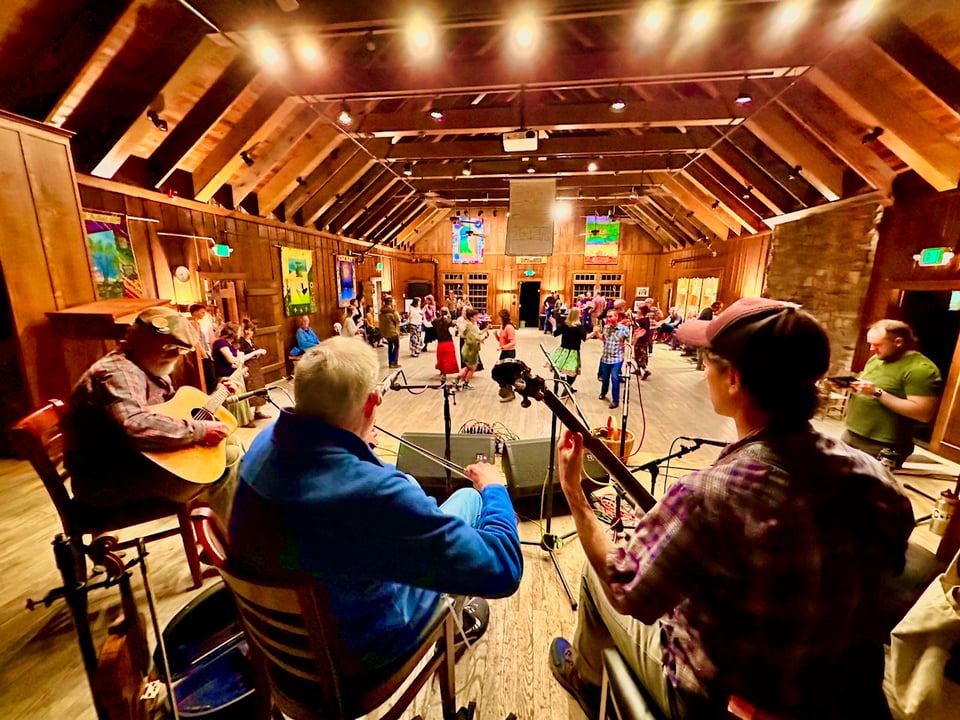
I recently made arrangements for a contradance at a new venue in the small(ish) town where I live. There are other varieties of folk music in town, but old-time is pretty much absent, for whatever reason. So we’re bringing a dance caller up from Springfield and putting together a little group and hopefully people will come and have fun and want to do it again. Not because anyone will make money, but because it will bring people together, help us live as a community.
That I have the time and wherewithal to help organize a community event is a privilege that comes with having the resources to attend to my family’s needs. People living poverty are often admonished to work more, which in turn means they might not have time to engage in community activities, which in turn makes their lives harder. It seems to me that an open community dance could go a long way towards helping people feel included and provide opportunities to meet folks from different backgrounds. Obviously dancing isn’t going to solve society’s problems, but I think it moves us in the right direction. And while I wish I could do more about all the terrible things going on in the world right now, this is at least something that I know I can do, and right now that’s enough.
Add a comment: