
My Destash Journey: Parts 3 & 4
Read the How of my fabric destashing journey, and my conclusions.
To read Parts 1 & 2 of My Destash Journey, click here.
Part 3: Time for the Fabric To Leave. But How?
I faced my fears. I opened all the bins and bags. I had a dozen or so clear bags of fabric on my living room floor. Now what?
TL;DR: I got rid of my fabric all at once with a (relatively) clean conscience by using Trashie. Yes I paid for it, and I will write that off as a business expense. Their rewards are not particularly rewarding.
There are lots of ways to get rid of fabric. I could have thrown it all in the dumpster. However, textile waste is a huge problem and I didn’t want to add to it.
The following highly scientific graphic lists some of the ways we can discard fabric. Some are slow and require a lot of effort. Some are fast and require very little effort, but pollute planet Earth.
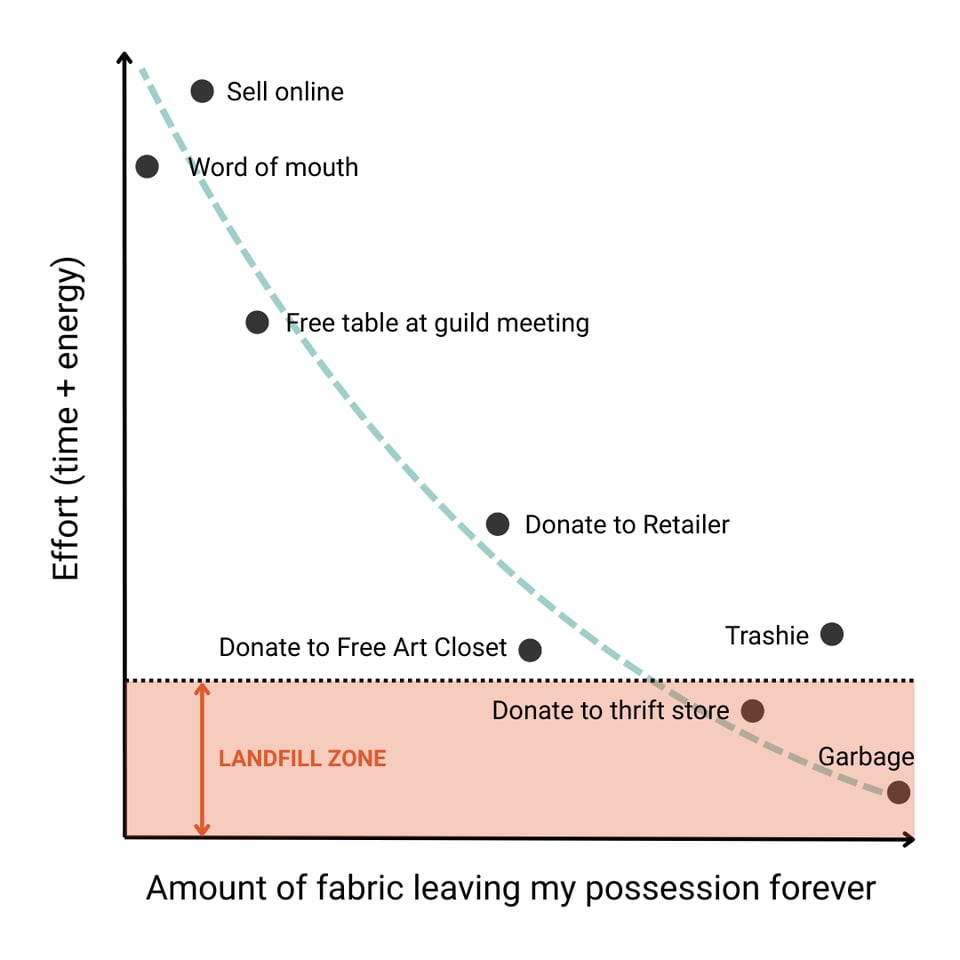
I could give my fabric away to friends. Our quilt guild has a Free table at every meeting, but those meetings are only once a month. Coordinating with other adults who have jobs and schedules is tough. I don’t own my home so a fabric-only garage sale wasn’t super practical. This is leaving aside the volume of fabric friends gave to me to begin with.
I could try selling it through an online platform like Feel Good Fibers. Problem: FGF is great if you’re selling yardage. Most of my fabric was small scraps, with a lot of deconstructed clothing. None of it was by fashionable fabric designers. Plus for every sale I would have to photograph fabrics, create posts, and ship packages to buyers. Pass.
I could take the fabric to retailers in my area that sell or give away secondhand art supplies, such as Nine Banded Crafts, OKC’s Free Art Closet, or Trove Arts & Crafts. However, they don’t take everything, and I don’t want to burden friendly businesses with stuff they can’t use. Reuse shops usually don’t want scraps.
I could donate the fabric to local thrift stores. But I would have no way to control how much of it goes straight into the trash.
I could send the fabric to Swanson’s, aka the No-Kill Shelter for fabric. Do you know how much it costs to ship fifty to a hundred pounds to another state? It’s out of my budget.
The real drawback is that most of these paths turn my fabric into someone else’s problem. If I could get my fabric to a recycling operation, it could be someone else’s solution.
I put the bags in my car. I drove to the parking lot with the bins that advertised themselves as a fabric donation drop point. Then I paused. Do these guys actually recycle fabric or do they just dump it overseas? I googled the company name on the bins. I read lots and lots of information about how to purchase a franchise, buy bins to generate passive income, start my fabric collection side hustle, etc. Nothing about recycling. I searched for “does [company name] actually recycle fabric?” and got zip. I drove home.
I decided to try Trashie. Trashie is a company that offers recycling by mail. Customers purchase recycling bags up front, fill the bags, and ship the bags back for free. In exchange, Trashie offers customers “rewards” such as discounts with other retailers. We’ll get back to that reward business in a minute.
I paid $110 for six bags. Heads up, if you want to go this route: the bags took a total of eight weeks to land in my mailbox. So if you need to offload fabric in a big hurry (say, if you’re moving), this isn’t ideal.
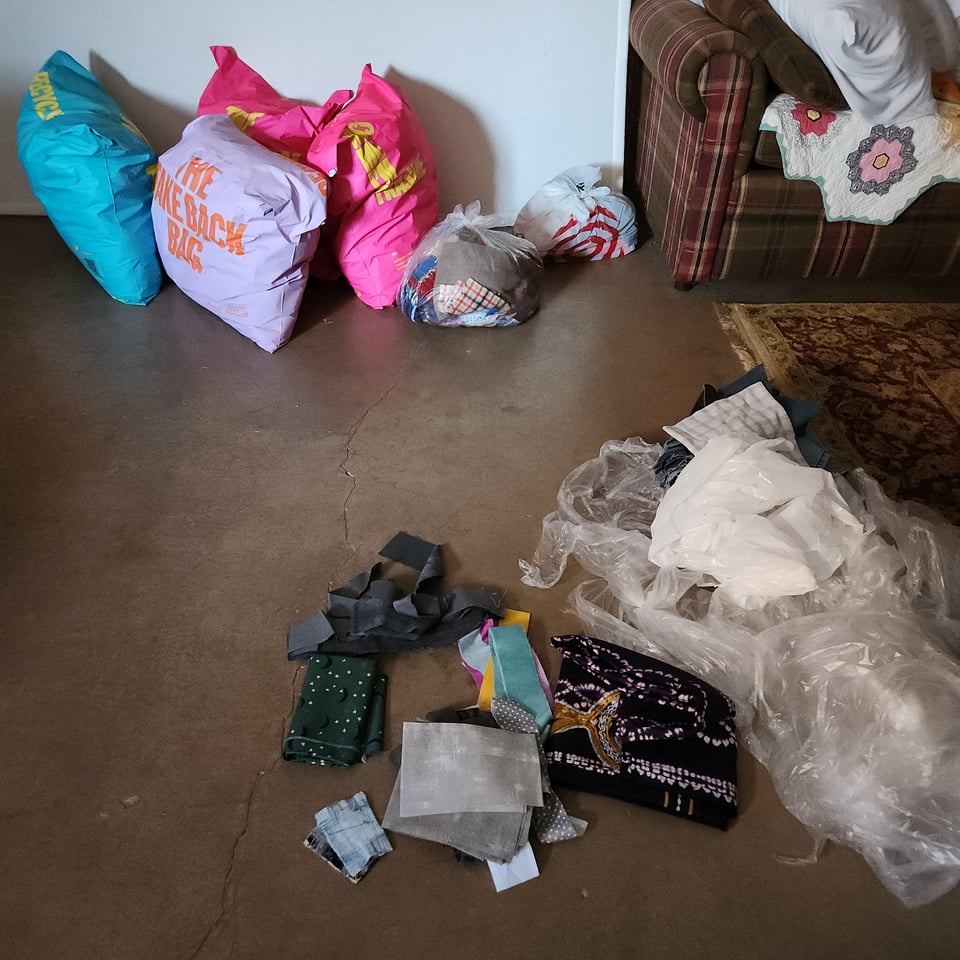
I filled five bags with my discarded fabric. The sixth bag is still in my studio space, catching scraps and waiting to get full. I sent the others back via UPS. The fabric was out of my house for good. My studio felt like a clean new space again!

Trashie promises cool rewards for their customers, right?
Yes. However, five full bags of fabric was not even enough to get a $15 gift card to Amazon, which I don’t use anyway. Most of their “rewards” are discounts you get if you spend large amounts of money with high-end online retailers. This is not my arena. So, I’ll take the write-off for purchasing the bags and consider our business concluded.
Would you like to support my fabric scrap recycling in the future?
It’s about $15-$20 per bag, depending on where I purchase them from. Your contributions are very welcome. Venmo: @sarahatleeart
What else can we do about textile waste?
Avoid fast fashion, shop used, upcycle, and shop recycled. A handful of clothing companies are tackling textile waste head-on. My colleague Laura Shaw mentioned that the Ridwell recycling company offers pickups in her area (not mine, sadly). There’s Terracycle, FabScrap, and ReTold Recycling, each with differing levels of accessibility.
I expect fabric recycling to become mainstream within my lifetime. We’ve already come this far. I think someday it will be the new normal.
Part 4: Conclusion
Dear fabric, thank you for teaching me so much. You brought me excitement, experimentation, and loads of possibilities. You taught me that I can make something out of anything. You also showed me how easy it is to get fabric for free. Now I know what I love and want to use in the near future.
Dear reader, thank you for coming on this journey with me. Hopefully there’s something here that you can use. If you know of fabric recycling options that aren’t mentioned here, please share!
xoxo Sarah