|
Shale Markets
Shale Markets Briefing — October 1, 2026
|
|
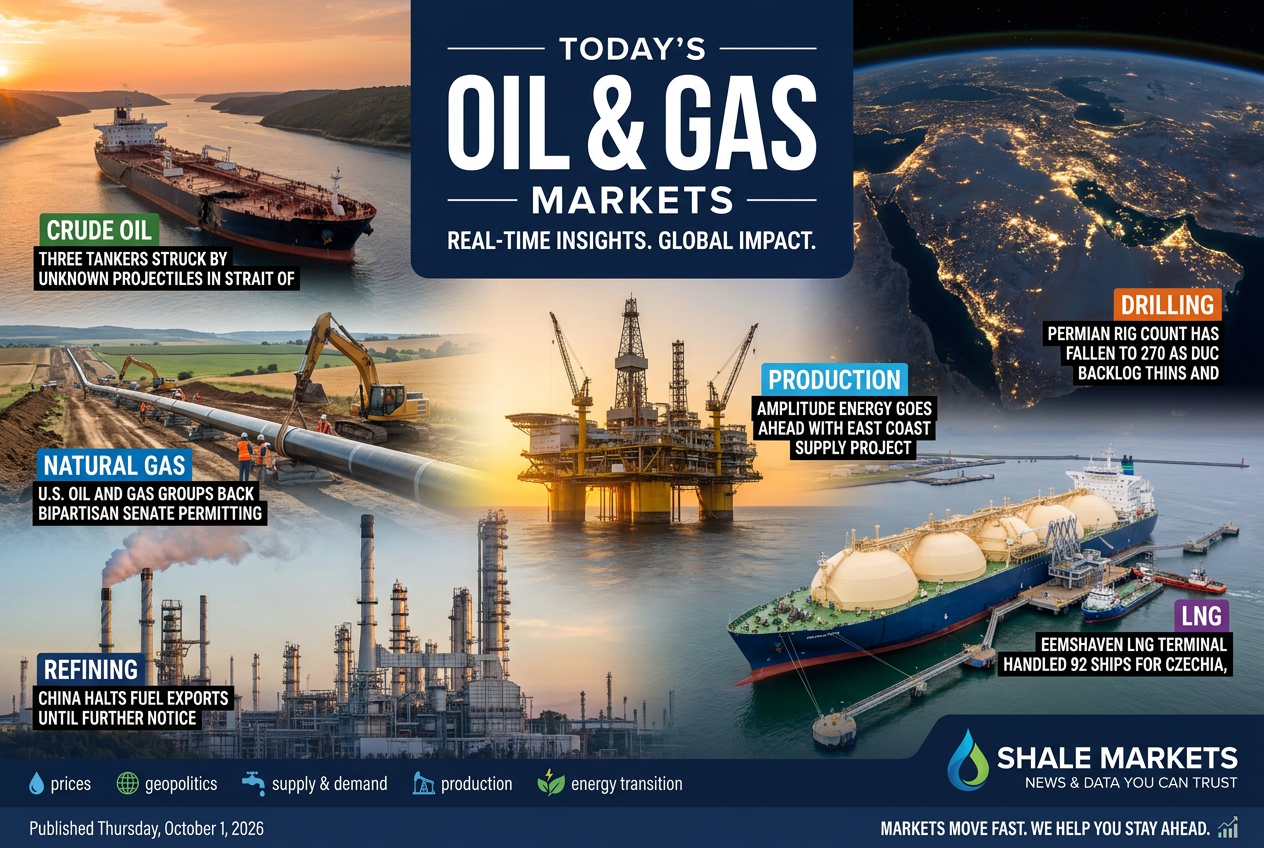
Today's briefing brings you 24 stories across drilling, crude oil, natural gas and refining from across the global oil and gas market. Leading today: Permian Rig Count Has Fallen to 270 as DUC Backlog Thins and Output Concentrates in Fewer Counties.
|
|
Texas RRC plugs record 2,022 orphaned oil and gas wells in fiscal 2026
The state’s record orphan-well cleanup signals stronger regulatory pressure on liability and a larger public spend to reduce legacy risks in mature oil and gas basins. For operators, it underscores that plugging obligations and bonding standards remain a real capital and compliance issue in Texas.
World Oil - Latest News
|
|
Atlantic Petroleum applies for new Faroe Islands exploration license
A new Faroe Islands exploration application signals continued capital being directed toward frontier North Atlantic acreage rather than only toward established shale basins. For executives, the key point is that Atlantic Petroleum is preserving optionality on future reserves with a carried stake, which can limit upfront cash exposure while keeping a foothold in exploration upside.
World Oil - Latest News
|
|
Monumental Energy identifies New Zealand gas targets in Taranaki basin
Monumental is still early in the cycle, but identifying gas-condensate targets in Taranaki signals where the company may direct capital if the permit is approved. For operators in the basin, it points to continued exploration interest in a gas-weighted play that could add supply in New Zealand’s domestic market.
World Oil - Latest News
|
|
Mexico’s Upstream Priorities: Sovereignty, Optimization and ESG
Mexico is signaling that upstream policy will stay focused on state control, better use of existing assets, and environmental scrutiny rather than a pure growth-at-any-cost push. For operators and investors, that points to a market where access, partner selection, and capital allocation will be shaped as much by policy and ESG expectations as by geology.
Mexico Business News
|
|
Rockhopper eyes 2028 first oil as Argentina seeks tougher sanctions
This signals that Rockhopper is still working toward sanctioned offshore development in Argentina, so executives should watch it as a read on capital commitment and project timing in a politically sensitive basin. The tougher sanctions backdrop also raises the risk that financing, partners, and execution costs could be affected before first oil.
Baird Maritime
|
|
Sponsored

|
|
Dallas Fed survey: More than one in five firms plan to grow capex in 2027
The survey points to a rebound in planned capital spending, which signals that upstream operators are preparing to reallocate budgets rather than simply defend current activity. For oilfield services and basin-focused companies, that usually translates into a healthier drilling and completions pipeline even if near-term spending remains uneven.
OGJ - Drilling & Production
|
|
Newsom signs bill boosting protections against federal offshore oil leasing
This signals tighter political and legal resistance to federal offshore leasing, which can slow future acreage access and complicate capital planning for operators with Gulf exposure. For executives, it reinforces that offshore investment decisions now depend as much on regulatory durability as on geology and economics.
Lassen County News
|
|
China Halts Fuel Exports Until Further Notice
China’s export halt points to tighter regional product supply and fewer barrels available to balance shortages in Asia and beyond. For refiners and traders, it can support margins abroad while signaling Beijing is prioritizing domestic fuel security over export revenue.
OilPrice.com
|
|
The World’s Diesel Problem Runs Deeper Than the Iran War
The piece signals that diesel and jet fuel tightness is not just a short-term trade route risk but a broader refining and supply-demand imbalance that can constrain margins and product availability. For operators and traders, that points to continued support for complex refiners, shipping routes, and middle-distillate exposure rather than a quick fix from any single geopolitical event.
OilPrice.com
|
|
Amplitude Energy Goes Ahead with East Coast Supply Project
Amplitude is committing to a gas supply project that leverages existing infrastructure, which signals a relatively capital-efficient way to add future volumes rather than a greenfield build. For gas-focused operators, it suggests continued investment in east coast supply security and a possible uplift in regional competition for downstream demand when production starts in 2028.
RigZone
|
|
Three Tankers Struck by Unknown Projectiles in Strait of Hormuz
An attack on tankers in the Strait of Hormuz raises the risk premium on a key crude shipping chokepoint and threatens to disrupt regional export flows. For oil and gas executives, it is a reminder that even short-lived security incidents can affect freight, routing, and supply reliability for barrels moving out of the Gulf.
OilPrice.com
|
|
U.S. oil and gas groups back bipartisan Senate permitting reform
A coalition of upstream and service groups backing permitting reform signals that U.S. operators still see regulatory delay as a capital-allocation problem, not just a political one. If the package advances, it could improve project timing and lower the risk premium on drilling, infrastructure, and workforce investment across the U.S. supply chain.
World Oil - Latest News
|
|
PTDF Summit: Active Oil Rigs Rose from 14 to 60 Under Tinubu, Says Lokpobiri
A rise in active rigs in Nigeria signals that upstream capital is returning to the country’s oil sector and that operators are becoming more willing to commit drilling budgets. For executives, the key takeaway is that policy support and improved activity can tighten competition for rigs, services, and attractive acreage.
THISDAYLIVE
|
|
Iran’s Disappearing Oil Is Becoming Everyone’s Problem
Iran’s shrinking export pool and China’s recovering demand point to tighter physical crude balances, especially for buyers that rely on discounted barrels or spot replacement cargoes. It also raises the stakes for Strait of Hormuz security, because any disruption would hit a corridor that still carries a large share of seaborne oil flows.
OilPrice.com
|
|
Venezuela’s Oil Revival Accelerates as Foreign Companies Return
The return of international operators to Venezuela signals a potential reopening of one of the world’s largest oil resource bases to foreign capital and technical expertise. For executives, it points to a possible shift in upstream allocation toward higher-risk, high-volume barrels if policy stability and contract terms hold.
OilPrice.com
|
|
US oil bosses say Iran war is disrupting long-term planning
The headline signals that Middle East conflict risk is now affecting U.S. oil executives’ investment horizons, which can delay drilling, M&A, and capacity commitments until supply-route and price visibility improves. For operators and investors, that kind of uncertainty tends to favor shorter-cycle spending and more defensive capital allocation.
thenationalnews.com
|
|
Guyana’s Oil Riches Are Transforming Its Economy at Breakneck Speed
Guyana’s rapid output growth shows how quickly a new offshore province can reshape national economics and attract more capital into the basin. For operators, it signals that Stabroek remains one of the most important growth engines outside North America, with implications for shipping, government revenues, and future development spend.
OilPrice.com
|
|
China Oil Comeback Loses Steam
China’s softer oil demand points to weaker import growth and less support for seaborne crude flows. For producers and traders, that can tighten competition for barrels and pressure assumptions about Asian demand-led balance recovery.
RigZone
|
|
U.S. Oil and Gas Production Climbs Despite Extreme Oil Price Volatility
Higher U.S. output despite sharp price swings signals that producers are still prioritizing volumes and holding activity even as visibility on future pricing weakens. For executives, the Dallas Fed survey suggests capital planning and hedging remain difficult, but basin supply is still flowing from key shale areas.
OilPrice.com
|
|
Costs squeeze US oil companies even as prices soar
Higher service, labor, and equipment costs can erode margins even when crude prices are supportive, which means operators may need to protect returns by tightening drilling plans or shifting capital toward the most efficient acreage. For executives, this is a reminder that cost inflation can restrain activity and weigh on free cash flow even in a favorable price environment.
Upstream Online
|
|
EIA: US crude oil inventories up 900,000 bbl
A larger-than-average U.S. crude build points to looser near-term supply-demand balance and can weigh on prompt pricing and storage economics. For producers and midstream operators, it is a signal to watch whether domestic output, imports, or refinery runs are shifting inventories higher.
OGJ - General Interest
|
|