|
Shale Markets
Shale Markets Briefing — September 25, 2026
|
|
Today's briefing brings you 23 stories across crude oil, lng, exploration and refining from across the global oil and gas market. Leading today: U.S.-Iran Talks Revive June Plan for Ending Hormuz Standoff.
|
|
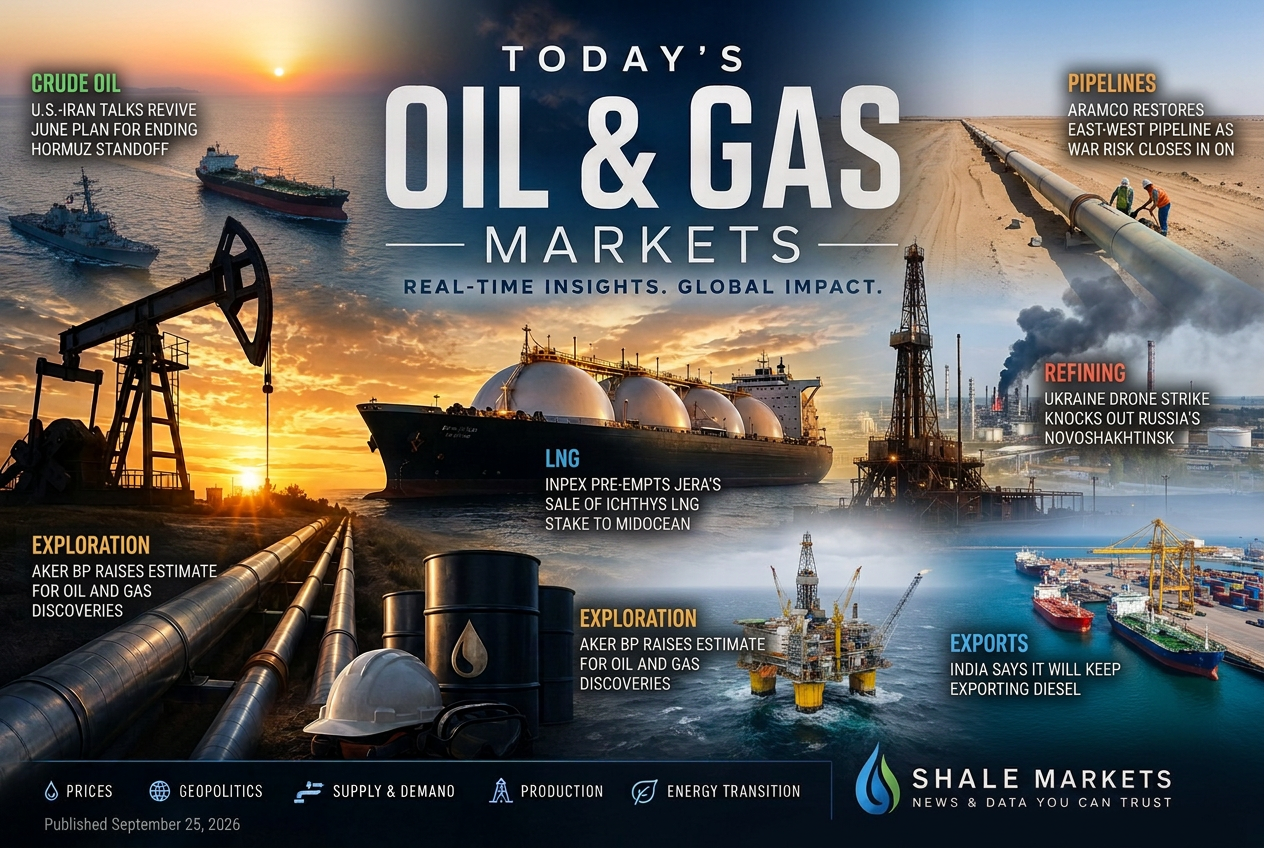
Aker BP raises estimate for oil and gas discoveries
A higher discovery estimate suggests Aker BP may have added reserve potential that can support future investment and longer field life in the North Sea. For executives, it is a signal to watch how the company converts appraisal success into development capital and whether nearby operators see follow-on activity.
EnergyWatch
|
|
North Sea appraisal ops up the oil & gas discoveries’ projected size
Appraisal success in the North Sea means early discoveries may be larger and more valuable than first modeled, which can improve project economics and justify more capital into follow-up wells and development planning. For operators, it is a signal to reassess basin inventory and competitive positioning as they decide where to allocate offshore spending next.
Offshore-Energy.biz
|
|
Badawi Highlights Egypt’s Energy Security, Upstream Recovery, Mining Reforms
Egypt is signaling that it wants to stabilize domestic supply by reviving upstream activity while also pushing mining reforms that could broaden the country’s resource base. For operators and investors, that points to a policy environment aimed at attracting capital into core oil and gas assets rather than relying on short-term imports.
Egypt Oil & Gas
|
|
Eni awarded Sapukala block offshore Indonesia
Winning a new offshore block in Indonesia extends Eni’s exploration runway and gives it more control over a contiguous operating area. For executives, the signal is that the company is still committing capital to high-upside frontier acreage rather than relying only on existing fields to sustain growth.
OGJ - Exploration and Development
|
|
CNOOC UK renews offshore EPC agreement
Renewing this EPC framework signals that CNOOC is keeping established offshore support in place for a mature North Sea portfolio, which usually points to steady maintenance, integrity work, and selective life-extension spending rather than a sharp change in capital strategy. For service providers, it also helps lock in recurring revenue around assets that still need engineering, operations support, and eventual decommissioning planning.
OGJ - General Interest
|
|
Sponsored

|
|
ProPetro to Supply 230 MW to Targa
This points to more power-intensive Permian operations and signals that service and infrastructure spending is following the basin’s activity levels. For executives, it underscores how midstream and oilfield-service firms can win work by supplying the energy needed to keep large producer and processor networks running.
RigZone
|
|
INPEX Pre-Empts JERA's Sale of Ichthys LNG Stake to MidOcean
INPEX increasing its stake in Ichthys signals tighter control over a major LNG export asset in Australia and underscores that strategic holders are choosing to keep capacity aligned with their long-term supply plans. For executives, it points to continued competition for high-quality LNG exposure and less room for third-party capital to enter landmark projects.
RigZone
|
|
Qatar’s LNG juggernaut faces its biggest test
Qatar’s LNG expansion matters because it signals how much new supply the market must absorb from one of the world’s most important exporters. For industry executives, the issue is whether additional Qatari volumes tighten competition for long-term contracts and reset capital allocation for LNG projects elsewhere.
Upstream Online
|
|
Trump Backs Argentina LNG Project
U.S. export credit backing for an Argentina gas project signals that upstream and LNG buildouts can still draw major financing support when they improve export capacity and long-term supply security. For operators and investors, it points to continued capital allocation toward liquefaction-linked gas assets outside North America’s core shale basins.
RigZone
|
|
India Says It Will Keep Exporting Diesel
India is signaling that it will keep sending diesel abroad even as domestic refining capacity expands, which matters for traders and refiners watching how new barrels are allocated between export markets and local supply. For executives, it suggests India intends to stay a reliable product supplier and use refining growth to strengthen its position in global diesel trade.
OilPrice.com
|
|
API’s Sommers warns U.S. diesel export ban could worsen fuel shortage
A diesel export ban would force refiners to rethink throughput and could tighten an already sensitive distillate balance. For executives, the message is that trade restrictions can hit refinery economics and product availability faster than they solve a supply problem.
World Oil - Latest News
|
|
Turkish Petroleum extends contract for Sakarya Phase 3 commissioning
This extension keeps Turkish Petroleum’s Sakarya development moving toward first production and shows continued spending on Türkiye’s Black Sea gas buildout. For service contractors, it signals another tranche of offshore work tied to a strategic domestic supply project rather than a one-off maintenance job.
OGJ - General Interest
|
|
Dutch to Ask EU to End Mandatory Gas Storage Targets
The Netherlands is signaling that Europe may be moving away from mandatory storage build targets and toward a more flexible approach to winter gas security. For suppliers, storage operators, and LNG marketers, that could change the timing and scale of refill demand and affect how much working gas the region must carry into each heating season.
RigZone
|
|
Henry Hub natural gas prices this summer were 6% lower than last summer
Lower summer Henry Hub pricing signals that gas supply was comfortable enough to offset stronger weather-driven power demand. For producers and gas-weighted basins, that points to continued margin pressure and a need to watch whether drilling and capital budgets shift toward higher-return liquids or away from marginal gas programs.
EIA Today in Energy
|
|
U.S.-Iran Talks Revive June Plan for Ending Hormuz Standoff
A phased U.S.-Iran deal that restores shipping through Hormuz would directly affect crude and LNG transit risk, which matters for pricing, freight, and security planning across the Gulf. It also signals that sanctions relief and frozen assets are still on the table as leverage in any broader normalization of trade.
OilPrice.com
|
|
Aramco Restores East-West Pipeline as War Risk Closes In on Yanbu
Restarting the East-West pipeline restores a key Saudi export corridor and reduces near-term disruption risk for crude flows that bypass the Strait of Hormuz. For executives, the signal is that Saudi export flexibility is being rebuilt, but at lower rates, so regional supply security and tanker routing risk still remain in play.
OilPrice.com
|
|
Ukraine Drone Strike Knocks Out Russia's Novoshakhtinsk Refinery
The strike highlights how refinery outages in Russia can quickly affect product supply and raise operational risk across the region. For executives, it underscores the vulnerability of downstream assets to wartime disruption and the possibility of tighter refined-product balances if attacks persist.
OilPrice.com
|
|
Saudi Oil Export Costs Surge as Red Sea Risks Mount
Saudi exporters are seeing the cost of rerouting crude rise to a level that can erase much of the advantage of avoiding the Strait of Hormuz. For executives, that means Red Sea and Gulf routing risk is now a direct margin and shipping-availability issue, not just a geopolitical headline.
OilPrice.com
|
|
Saudi Arabia intercepts wave of Houthi missiles as oil climbs to one-week high
The market is reacting to a direct Middle East security risk around a major oil producer and shipping region, which can tighten crude supply expectations even before any barrels are actually lost. For executives, it is a reminder that geopolitical disruption can quickly affect pricing, hedging, and logistics planning across the region.
The Guardian
|
|
Petrobras signs MoU with Mozambique’s ENH for oil and gas cooperation
The memorandum signals Petrobras is keeping an options-based footprint in frontier African acreage rather than committing capital outright, which can preserve strategic access while limiting near-term spend. For Mozambique, it keeps the country in the conversation for future upstream development and potential technical partnership support.
World Oil - Latest News
|
|
Soaring Freight Costs Make Japan’s Crude Imports the World’s Most Expensive
Higher tanker rates are effectively raising landed crude costs for refiners, which can reshape sourcing decisions and make longer-haul supply more competitive only when freight is manageable. For Japan and other importers, this signals tighter delivered margins and more pressure on voyage economics across the global crude trade.
OilPrice.com
|
|
Crude Gains on Tight Supply Signals
Tight supply signals suggest the market is still pricing in a constrained crude balance even with diplomacy around the Strait of Hormuz. For producers and traders, that keeps attention on upstream discipline, export-route risk, and how quickly any new barrels could ease pricing pressure.
RigZone
|
|
Spiritus Secures Preliminary Deals to Supply CO2 for EOR
Spiritus is turning carbon-capture supply agreements into a practical route for incremental oil output, which matters for operators looking to lower development risk and secure CO2 feedstock for EOR projects. For executives, the larger signal is that demand for captured CO2 is starting to look like a real commercial outlet across multiple U.S. producing regions.
RigZone
|
|