🌕 october hunters' moon reflections
rage, resilience, and autumn exhaustion
the format of these monthly updates is directly inspired by how my family and I stay connected with each other. you can expect some main points, some tangential stories, some vulnerable reflections on things that feel uncertain, and an invitation to share what’s up with you too.
There’s a lot to catch up on, but I also can’t remember a recent time where there wasn’t. October was a packed month; I write this uncharacteristically early in the morning on the day before Halloween, and alongside having plenty to celebrate, this is also the least festive I’ve felt leading up to Halloween plans. I feel a bit buried under the backlog of things to do resulting from unexpected developments, on top of our expected developments. I am exhausted; amongst a lot of adulting annoyances, I am happy to have so much to look forward to — including rest.
🌕♉ here’s some snapshots of what it’s looked like since the last full moon:
🗄️ For the first time ever, my partner and I have matching nightstands (yet another Marktplaats find).
🎲 GAME NIGHT!! Truly one of my favorite ways to spend time with friends.
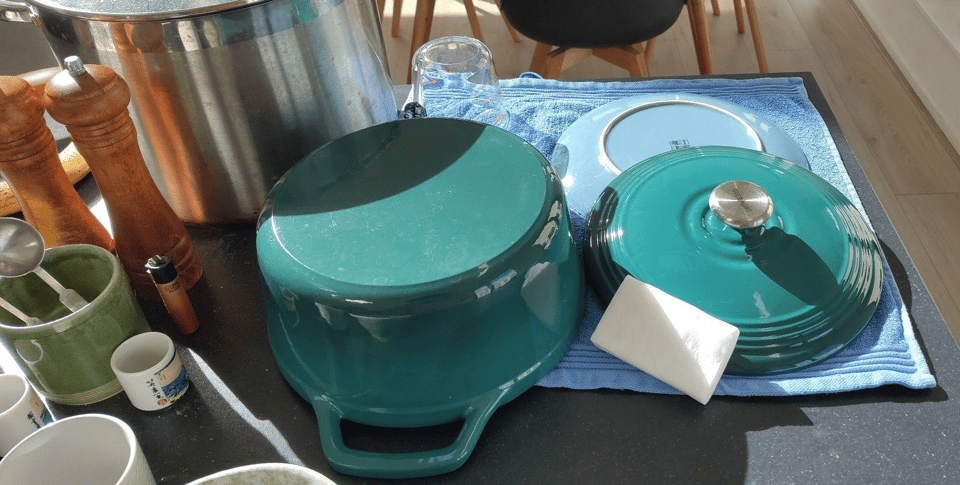
🌮 We cook our first meal in the Dutch oven we received as a sweet housewarming gift. Taco bowls!
🎮 Progress is slow but fun playing Dreamfall: The Longest Journey with friends back home during their Friday lunch hour.
☕ We have a cozy coffee and a stroll with some friends who stopped by to give us an air purifier and a robot vacuum that — with some repairs — could soon giving our floor a much-needed cleaning.
🧝🏻♀️ We have another fun D&D session with our budding disaster-relief adventurers!
🌀 We Still Move starts meeting again for autumn programming and 2027 planning!
🩺 I start the process of switching doctors to somewhere within range of my registered area.
👾 Still fully enthralled with bitburner, I code scripts to find the “contiguous subarray with the largest sum within an array,” and finding the “maximum profit in an array of historical product prices.” Still relatively simple but still also blowing my own mind.
😣 I start experiencing yet unexplained bloating and abdominal pain/pressure.
📜 I earn a Javascript Fundamentals certificate that I didn’t know I was working towards on the free coding website that I’ve been learning with. On the same day, I also code a simple script that finds the largest prime factor for a given number.
🚊 I go to my new huisarts for the first time, and all by myself no less (no appointment, just to drop off a sample).
🧑🧒🧒 I have a sweet catch-up with my dad and my sibling.
💸 After much unnecessary and ridiculous back-and-forth, I file U.S. taxes — hopefully the beginning of the final few times I’ll have to do so.
🌱 A plant gifted from a friend officially sprouts its 12th leaf!
After much unnecessary and ridiculous back-and-forth, the party supplies and props I ordered from the printing company are available for pick-up the day before our housewarming/murder mystery/partner’s birthday party, and not shipped as originally arranged.
🎰 We have a jackpot night of high-rolling, big-spending, scandalous murder mystery fun — even including a couple of VIP family members who hop in and slay their roles virtually! Thanks to our friends and family going all in with their support and their characters, the case is closed, my partner has a wonderful birthday bash, and our house is thoroughly warmed. The pictures are wonderful, there’s a surprise epic slot machine prop, and people have a fantastic time. We leave with full hearts, hearty smiles, and plenty of hot game goss to last us into next year. Thanks to our collective and thorough precautions against airborne illness, nobody has to gamble with their health to have all the fun we did.
😴 We have a glorious glorious day of rest — complete with delicious leftovers for charcuterie breakfast and sliders for dinner.
⚕️ I meet with my new GP for the first time. He makes the one weird comment upon meeting that a lot of folks make about whether our masks are protecting him or us, and then is relatively cordial for the rest of the appointment.
🏦 I file ZZP taxes for Q3.
🏥 For the first time since my surgery last December, I return to the hospital for a gynecological check-up and ultrasound. Everything seems to be healthy, but apparently they had not removed the IUD after surgery last year (which they promptly correct). A strange revelation to have on a Tuesday.
👾 I create my first script that automates other scripts.
💃 I have the most bittersweet dream that I’m having a fantastic bachata at a dance social.
🎭 With a group of fellow masked-up friends, I attend the first play I’ve ever been to here in the NL. It’s all still in english, and the community production is super fun.
collective experiences over the past month
(continued from part 1 in october’s new moon entry) In spaces where I’m an attendee and in spaces where I’m a facilitator, I noticed two distinct themes that felt very present this month — both in sharing my own experiences and in what resonated with others.
Nowadays, as I become more and more acquainted with what a safe(r), anchored me feels like, it has also become easier for me to recognize spaces and people with whom I don’t feel comfortable or even safe. Some of these I have a choice around and some of these I don’t, but the awareness helps me assess how to leave spaces when I can, and what support looks like in spaces where leaving isn’t really an option, which, broadly-speaking, brings me to my next observation around collective experiences from this month.
“What somatic tools help us with experiencing anger / rage?”
My initial thoughts on this question are that the tools are the same for how we navigate any other emotion that can come along with stress. We might practice them differently, but within the Resilience Toolkit practices I facilitate, we can start with the same process within our guiding questions. Anger as an emotion isn’t necessarily exclusively indicative of which stress state we’re in. Speaking for myself, I’ve had anger show up in ways that cause me to shut down, to lash out, to seethe quietly, and I’ve even had anger show up as a sign that I felt safe enough to share what was real and present for me.
As we get more fluent in our body’s own signals, needs, and which tools are helpful in which states for us personally, we can still start with “how is anger showing up in my bodymind? What would feel supportive?” Understandably, evaluating what would feel supportive — in moments of stress that stem from anger as well as moments of stress that stem from any other emotion — depends a lot on our current needs, capacities, environment, and available resources.
And it’s at this question that I think folks experience some pause. With anger, there’s oftentimes both an urgency and a clear desire for something to be different than it currently is — which may or may not be possible in the moments during which we experience anger. And knowing what could feel supportive in this moment vs. in the long-term can be hard to parse. Okay then, what do I need in order to feel supported in having the space to parse my options? The stress that can be inherent just in exploring these considerations is further exacerbated by cis-heteronormative, capitalist, patriarchal systems that dictate who is allowed to be angry — systems that then also enforce violence against folks who deviate from these systems with their anger. So it makes sense that experiences of anger can feel more intense and/or urgent for a lot of folks, especially along racialized and gendered intersections of identity. There may even be a lot of grief in facing the fact that our options might be limited depending on how much safety we have access to in that moment.
Speaking for myself, the process for navigating anger isn’t actually any different than the ones I use for any other emotion. The awareness leads to options. With anger, it’s not always options that I’m happy about. Options offer us a choice point. Do we have capacity to lay out our options right now? Do we have capacity to navigate the emotions that come up with weighing a choice that only offers challenging or undesired options? A lot of times, these heated choice points reveal dynamics that we may not be resourced to change in that moment, or dynamics that we’ve maybe known about for awhile but not had the time or capacity to really acknowledge what they mean for ourselves and our lives. It’s understandable that with anger, what could be supportive in that moment could be very very clear, or completely unclear.
For folks looking for ways to dissipate, repress, or numb out to the anger, I don’t have any advice or tools for that. While not always the case, something I’ve observed in myself is that a larger part of the often unnamed stress that can come with feelings of anger is then the simultaneous question of “what do I do with it?” And then experiencing overwhelm from feeling like we have to figure that out right here right now. Most of the time, I have a hard time communicating when I’m angry, which in turn lands in my body as reduced access to problem solving, which feeds the sense of overwhelm and exacerbates the difficulty communicating, all in a frustrating cycle. The way I lean on tools for myself in these moments is to provide support for the overwhelm. Get back to a sense of stability. As a Black woman born and raised in the U.S., there’s also a deeply embedded awareness and fear that my anger will actively invite violence towards me, no matter how “valid” my anger is in any given situation. What that specifically looks like for me is removing myself from the situation when possible — whether for the rest of the day or for a couple minutes. I have scripts for myself to explain to folks that I may have a hard time communicating verbally, and may even request to switch to communicating via a text-based channel instead. I noticed that scheduling time (or at least scheduled reminders) to write down my experiences or talk them out with a trusted friend at a later date can be helpful for me in the moment.
The question I can offer for folks asking themselves similar questions is: what do you want to do with your anger? What impact is it having on your in-the-moment capacity?
What might feel or be supportive may look different based on whether you’re experiencing collapse, overwhelm, activation, dissociation. I’ve experienced moments of anger where I feel the urge to lash out, to run, to go still, to move with hypervigilance. Sometimes those mobilizations are an adaptive and helpful response to navigating the present circumstances. Other times they aren’t.
While I can’t offer any shortcuts in what it looks like to build this type of discernment for ourselves, what I can offer is that it takes practice in all sorts of states to then be able to access these tools in more intense moments.
Finally, I look to the clear boundaries for what the Resilience Toolkit is and isn’t for. While the tools can be supportive for stabilizing within moments of chaos and overwhelm, different tools will be needed to process and repattern the impacts of trauma once stability is found.
My personal relationship with rage is long, storied, intimate, and sacred. Rage is one of my dearest comrades, after a long time of being one of my sharpest fears. I used to only operate in extremes of either repressing my anger or dialing it up as far as it would go. One of the most valuable things I’ve learned for myself is that not everyone deserves the labors of my anger — especially those who aim for me to be burnt out and beyond capacity from wielding it so effortfully all the time. Here’s what I mean by that:
During the George Floyd uprisings, I swung and swung and swung at anyone in my circles who were denouncing the “riots” and lamenting the “property damage” and the traffic inconveniences. I burnt myself out so fast arguing with people who never had plans to change and treated the whole thing like a piece of theater — including people in my own family. And I learned that so many non-Black people were content to just watch me exhaust myself from the sidelines without ever joining in. When the push to “go back to normal” started while still in the middle of a pandemic, I remembered these lessons. It required me to face a lot of realities about a lot of relationships, and to grieve a lot of the intimacy and solidarity I thought existed within those relationships.
A big part of how rage and resilience have interacted for me is being able to understand when my rage (like any other sensation/emotion) is an adaptive response to a situation and when it is not. Part of this also includes understanding that this is separate from the “validity” of my rage at a situation.
There are times where it’s not safe for me to exhibit rage no matter how “right” I am. And, there are times where my most present desire is to express rage in ways that aren’t aligned with the values I’m committed to practicing.
The more I’ve gotten to know my body’s capacities and become fluent in my body’s cues for stress/relaxation, the easier it’s becoming for me to sit with, hold, and express rage — knowing that I will know how to navigate/regulate/care for myself during and after, even when it feels uncertain in the moment. This increased knowledge of my body and cues — and the collection of experiences in tending to them — also helps me feel deeper self-trust in being able to navigate emotions in ways that don’t gaslight myself. I noticed this shift when I started dancing 20+ years ago, and it got even more intentional and pronounced when I started practicing the Toolkit — particularly in it’s incorporation of acknowledging and accounting for systems of oppression as part of its practice. Knowing and understanding that the stigmatization of anger is part of upholding oppressive systems helped a lot in giving myself permission to be “new” at feeling/expressing anger, and to be gentle with myself around the fact that I’m trying to deconstruct something that’s internalized in our everyday culture-at-large from birth.
Before that, I had been socialized to believe that anger was not only harmful but shameful, and that people were allowed to dismiss/invalidate any concerns no matter how valid/serious if you showed even a modicum of anger. You could be mean, dismissive, gaslighting, harmful, outright wrong etc. under the guise of being “honest,” but you could not be angry.
Now, in my own personal spiritual practices — as a person whose ancestors faced (and still face) violence and death for their righteous rage in the face of colonization and systems of oppression, my rage feels sacred, I allow it to exist and move in me for all those before me who were struck down because of it, or who never got to express it because of survival needs (lots of parallels to my rest practices as well).
As someone at an intersection of various privileges as well, it’s generally safer for me to be outspoken with my rage than it can be for others who may be more systems-impacted, so it also feels like community responsibility to express rage at injustice when I can in spaces where others may be trying to enforce an absence of tension as “peace” or “unity.”
And, I know that rage and activation for me tend to come together, and I know the toll that frequent activation has on my body. For example, despite the lessons I learned in 2020, about 2 years into the pandemic, I would feel rage every time I saw someone in a public space who chose not to mask. After months of that, I was seeing that the activation was still accompanying the rage, and that being so activated multiple times a day was taking a noticeable toll on my body. It was becoming untenable. I too struggled with weighing whether I was gaslighting myself by trying to find something different. I leaned heavily on the Toolkit’s guiding questions — it was easy to identify what I was feeling and how I knew. The “is it serving me” part was where a lot of the reflection took place (as well as reflection on resting for myself and all my ancestors who didn’t have a choice in living every day enraged about things that didn’t change in their lifetime). My rage wasn’t alerting me to any new situational or environmental information, and there wasn’t anything I could do about random folks on the street not wearing masks — nothing I planned to do at least. It’s something I still navigate every day, but the urge to “do something about it” while finding a way to give my body a break eventually started to flow into cultivating spaces and relationships that were putting in the care and safety of masking and practicing meaningful COVID safety.
I still feel a range of anger every day seeing folks choose not to mask — which is still a super valid thing to be enraged about — but it’s becoming easier to acknowledge my rage, thank it for caring so much, and then center taking care of my body — whether that looks like staying enraged in the moment or cooling off. The things I’m angry about are still true, and it’s still true that I’m angry about them — even when I’m not actively stewing over them. If my rage is there to let me know that something needs to change (internally or externally), I still feel like I’m honoring both it and my body by incorporating practices/activities where I can then enact that change while not staying in any potential activation of it longer than I need to. I’ve related a lot to language that differentiates “sitting with” a feeling vs. “being in” in a feeling, like a “pilot vs. passenger” verbiage that I’ve witnessed in other discourse.
There’s a lot of grief in the idea that not masking during the ongoing pandemic might be the norm-at-large for the rest of my life, but knowing that there are spaces that do still care helps me feel better in the face of the helplessness of it at a larger scale, which speaks to the necessity of community in my journey of healing my relationship with rage.
Here’s an example of an experience in which valid rage existed, but it was applied in a way that wasn’t in line with shared values.
Me, my partner, and a former friend walked into a restaurant, masked. I was relatively new to the Netherlands and still spoke no Dutch, so I didn’t catch on to the employees towards the back of the shop laughing at us and throwing around terms used to make fun of people who still mask. Our white friend (who had been here 6+ months at this point) heard them, told us they were making fun of us, stormed over there to tell them off, and walked out without us.
Was this effective for expressing oneself and sticking it to those folks? Totally. Did this feel like solidarity to myself and my partner to be left in this restaurant with a bunch of white people who had also just been told off by another white, masculine-presenting person? Absolutely not. This could have gone so many different ways; luckily my partner and I left just fine.
Again, the feelings were valid, but feelings are distinct from action and impact. In moments of intense anger, the tools have been helpful for me in creating a moment of space between what I’m feeling and the actions I choose. Sometimes even enough space for me to consider the potential impacts of different paths of action. The tool is not a substitute for feeling my anger, nor is it a way to repress it. It provides space for me to exercise agency and choice, rather than feeling like reacting Right Now is my only option. If there’s time and space to use a tool (because sometimes there isn’t; sometimes reacting is the most adaptive choice in the moment), I might still choose to fight/flee/freeze/appease after having that bit of space to check in with myself.
In my own navigation of anxiety, PTSD, depression, PMDD, and recovery from a host of predatory practices disguising themselves amongst co-opted spiritual practices, it’s been part of my moment-to-moment existence to discern whether the intensity of what I’m feeling is matched with what my needs are and what is (or isn’t) going on in the environment in the moment.
I saw somewhere on Instagram a quote that said something like “the true measure of success is a calm nervous system.” It led to some friends and I having a nuanced conversation around how exclusive and limiting that is to the breadth of human experience, and how it felt like a repackaged way of policing behavior. We reflected on how this definition of “success” excludes a lot of trauma survivors, disabled folks, and many other marginalized people, or that somehow being validly upset over something legitimately harmful is somehow not successful. Or that being nervous also is not “successful” behavior. Or that overresponding to something less than you did the day before is somehow not a victory still.
My own reconciliation with rage has been iterative. It’s non-linear, and it takes up space in multiple dimensions; my relationship with rage has seasons, weather, missteps, repair, but also foundation and roots now. It’s been less about certainty around external factors and more about self-knowing and self-trust in my ability to respond and take care of myself — which includes asking for help when and where I can. There have definitely been days where success looked like being able to access a supportive tool more easily after being in distress, or feeling and expressing an amount of distress that was adaptive for me in that moment (all of which aren’t as instagrammable as the overapplied fallacy that inspired this reflection). It’s not to say that a calm nervous system isn’t a valid measure of success for some situations, but if wisdom is knowing when and how to apply knowledge, this general statement feels a bit naive at best, and spiritually bypassing or gaslighting at worst.
I was reminded of these questions posed by Kai Cheng Thom:
(link here: https://www.instagram.com/p/CwT5v7puty4/?img_index=1)
To what extent are we attributing mystical properties to the vagus nerve as a way of oversimplifying the sacred and terrifying mystery of what it means to be human?
In what ways do we use “somatics” and nervous system theory as a way of dissociating from intensity of feeling and the cultural roots of spiritual practice?
When do we use “nervous system regulation” as a scientific-sounding way to reinforce our preferred norms and shut down emotionally charged conversation?
How can the body and embodied experience be drawn upon as a source of empowerment, agency, and self-determination rather than another form of fundamentalist religion?
Maybe I’ve rambled and repeated myself so much around this because so much of it still feels like work-in-progress.
I hope any of this is helpful, and wishing you so much grace and ease as you navigate/explore your own relationship with rage, anger, and righteous fury.
Thanks for reading, wishing you moments of ritual, rest, and restoration.
misha | ritual as:

Add a comment: