Bird of Passage: February 2026
Let's talk about bird eyeballs.
I’m back! I could try to write something profound here about despair and resilience and finding hope in birds and nature. But wiser people than me have already written many, many words like that, so instead I’m going to write about bird eyeballs — because it’s also okay to take a break from current events once in a while.
So: eyeballs! A really wild paper came out this month about birds’ retinas, the part of the eye that converts light into signals for the brain. This is a bit outside my wheelhouse but it’s fascinating so I’m going to try to break it down for you.
Background info you need to know: retinas are oxygen-hungry. They need a big, continuous supply of oxygen to fuel the hard work of processing vision. They get this through a whole lot of capillaries, tiny blood vessels that constantly deliver fresh oxygen to the cells in the retina. This is how eyes work in all vertebrates, except — yep — birds. Birds are the only vertebrates with no blood vessels supplying their retinas, and until recently no one knew how this was possible.
For a long time, the assumption was that birds must have some other way of getting oxygen into their retinas. Apparently there’s a weird organ in birds’ eyes called the “pecten oculi” that some folks thought might be an alternative oxygenation mechanism. (I Googled it, and it’s like a little comb that sticks out into the goo inside the eyeball.)
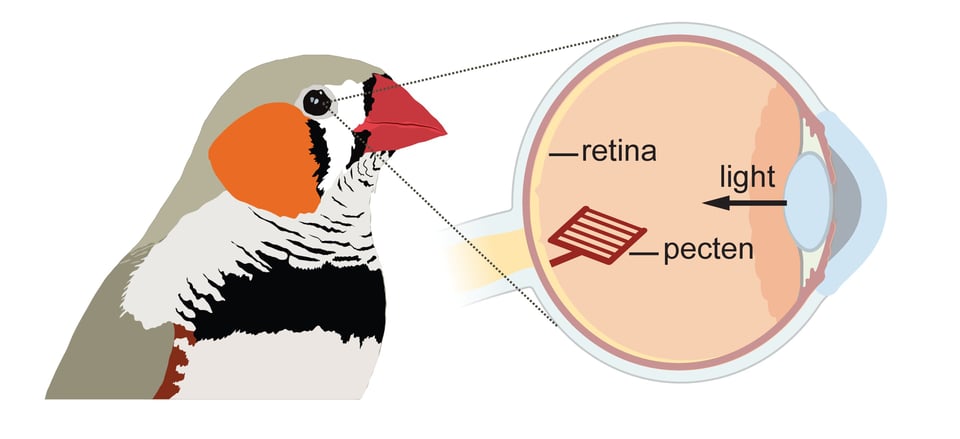
BUT, the group of Danish researchers behind this new paper figured out a way to measure the oxygen levels inside the retinas of living birds, something no one had ever done before. Turns out there’s actually almost no oxygen getting in there at all, from the pecten oculi or anywhere else!
Next the scientists mapped gene expression in the birds’ retinas and found that genes involved in “anaerobic glycolysis” were really active. (That means breaking down sugar for fuel without using oxygen.) This is really inefficient, so birds would need a TON of sugar to keep the retina functioning. Taking a new look at the pecten oculi, the researchers realized that what it’s actually doing is delivering all that glucose and taking away the waste products that the process produces.
The press release tries to spin this discovery as something that could someday lead to a treatment for strokes, in which the brain is damaged by a lack of oxygen supply. What I think is cool, though, is that this is probably all an adaptation to give birds extra-sharp vision.
You don’t notice it, but having a network of tiny capillaries worming through your retina does make your vision a bit blurrier than it would be if they weren’t there. So, birds just got rid of those capillaries entirely and evolved an alternative.
Birds, man! They are so incredibly weird and cool.
[Note: In the original text of this newsletter I misidentified the researchers behind this study as Dutch instead of Danish. This was an error, and I apologize.]
Words About Birds
My latest script for the short-format public radio program BirdNote Daily aired in December! (I actually just discovered this a couple weeks ago.) I wrote about a study that was published back in 2023 but hadn’t left my brain since, about how Acorn Woodpeckers’ social behavior changes on days with heavy wildfire smoke. Just like us, they stay home and are less active.
Moving onto things not by me: In case you don’t have enough microplastic-related worries, it seems that scientists around the world are now finding microplastics in the nests of backyard songbirds and the feces of recently hatched chicks. It’s unclear so far whether there are any patterns in the prevalence of this sort of pollution or what its impacts might be, and answering those questions is the first step in coming up with potential solutions.
And in other unsettling news, three penguin species in Antarctica are breeding way, way earlier than they used to. This is almost certainly because of climate change and could lead to big problems if it throws their nesting season out of sync with when food resources are available or leads to more competition between species for nest sites. Of the three species studied, Chinstrap and Adélie penguins are declining while Gentoos, which have the most generalist habits, are increasing.
I don’t want to be a complete downer, so I’ll leave you with an excellent essay from The Revelator about how to stubbornly resist despair and keep moving forward even when optimism feels really, really hard. “Hope isn’t something we wait for. It’s a discipline we practice,” writes ocean conservationist Rick MacPherson.
And stay tuned — I currently have stories in the works for Living Bird, National Wildlife Magazine, Audubon, bioGraphic, and The Revelator. This is the busiest I’ve been as a freelancer in quite a while!
Book Recommendation of the Month
The Beast in the Clouds: The Roosevelt Brothers' Deadly Quest to Find the Mythical Giant Panda by Nathalia Holt. I really enjoyed this tale of Theodore Roosevelt’s eldest sons’ expedition to the remote mountains of southern China in 1929 in search of the elusive giant panda. Ted and Kermit Roosevelt succeeded in becoming the first white men to shoot a panda and document its existence for science, but they both came to regret the long-term impacts on the species that resulted from its introduction to the Western world.
Upcoming Events
February 11: Virtual book talk for Southern Adirondack Audubon Society
February 12: Virtual talk on “Surprising Secrets of Bird Biology” for Saint Paul Bird Alliance
March 8: IN PERSON book talk for South Sound Bird Alliance Annual Dinner (Olympia, WA)
March 20: IN PERSON book talk for Sea & Sage Audubon Annual Dinner (Orange County, CA)
That’s it for now. Feel free to forward this newsletter to a friend you think might like it, and I’ll see you next month!


Add a comment: