
Us Well Behaved
Field Report 22.08.25
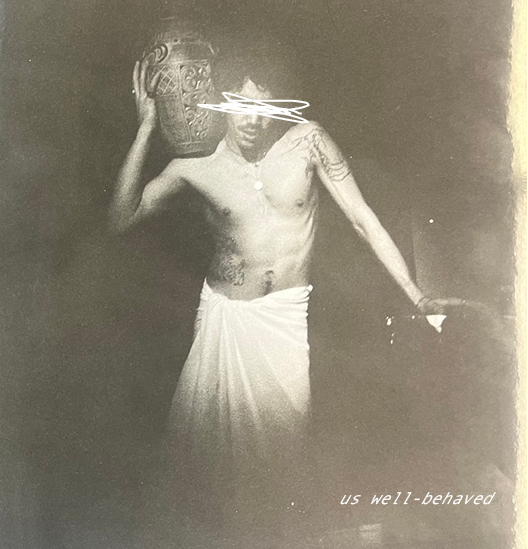
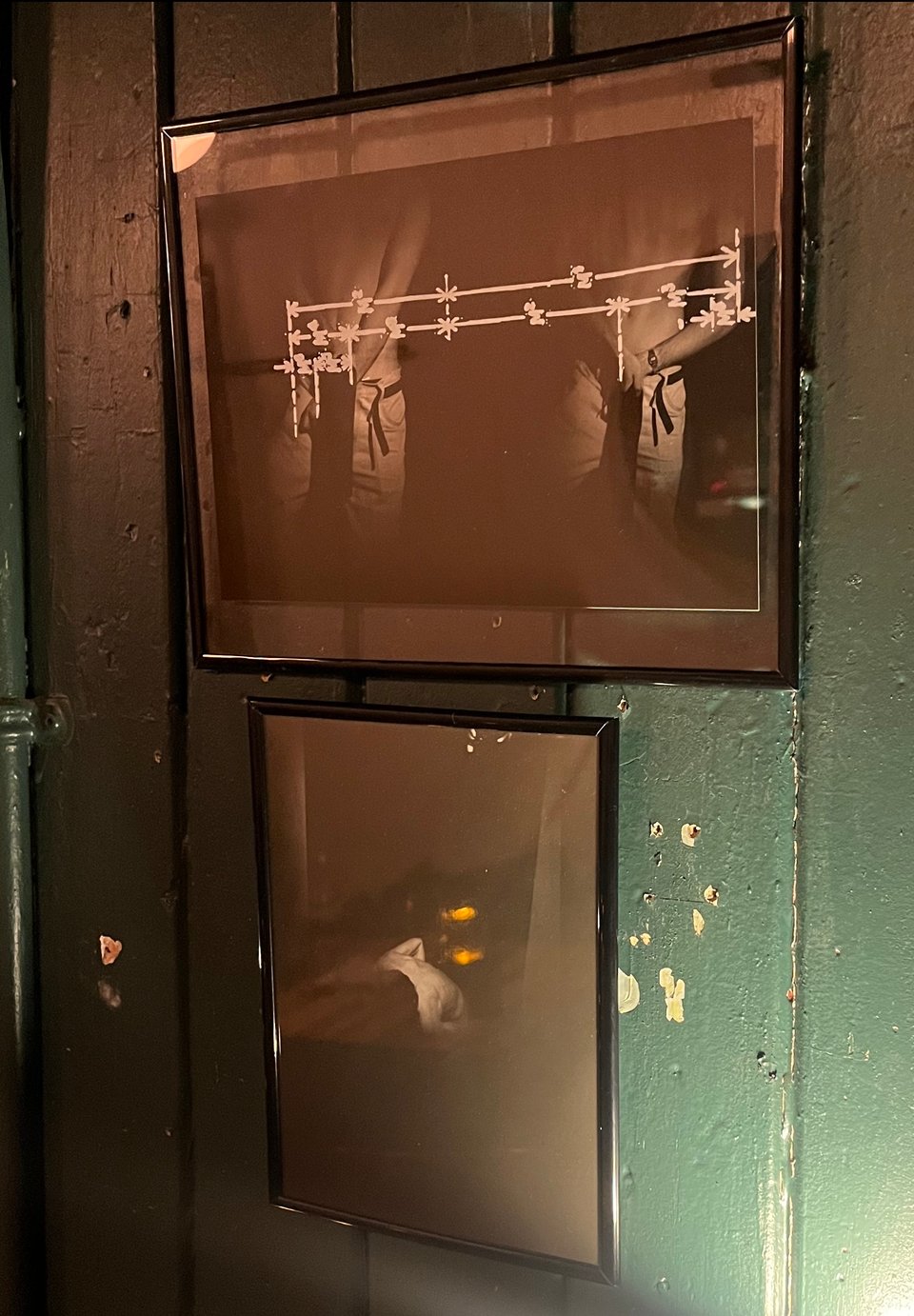
Elliot Mann, Photo Series at Lux la Lumière, 2024. Gelatin silver-prints, ink, magazine clippings. 12 photographs. Montreal, Canada.
The following interview excerpt with Julia Kristeva is clipped from the december-january 2019 issue of French periodical Philosophie Magazine, n.135. Following a mostly banal back and forth on disability, the trans question, and youth leftist radicalisation, Kristeva is asked:
Philosophie Magazine - La psychanalyse servirait à former des citoyens? / Could psychoanalysis serve to train citizens?
J. K. - Il n’y a pas de politique de la psychanalyse. Elle est ce lieu interstitiel où vous découvrez que vos étrangetés sont transférables. En introduisant cette entente entre altérités en souffrance, au plus intime de l’homme et de la femme, la psychanalyse met en mouvement le langage, les identités, les liens et les idéaux. Ce faisant, elle participe à cette refondation de l'humanisme dont nous constations aujourd'hui les échecs. / There is no politics of psychoanalysis. It is this interstitial place where you discover that your strangeness is transferable. By introducing this understanding between suffering othernesses, at the most intimate level of man and woman, psychoanalysis sets language, identities, bonds, and ideals in motion. In doing so, it participates in this refoundation of humanism whose failures we are seeing today.
Psychoanalysis is the study of people prior to symbolic exchange, making it the site of art without pretension, and the smoking gun of deconstruction. So what exactly is Post-Structuralism? Or Post-Modernism? Or Deconstruction? Or Disassociation? Or the Constant References? Or Contradiction? Or the washing of the hands and the garish re-painting of your walls to suit.. well… you. To suit a different kind of you? I was, for a while and still, singularly obsessed with what we said when we photographed our bodies. The way photographs had become laboratories for our intimacies, and for our recognitions of each other. You see this all the time online.
Kristeva refers to the truce between alterities as the pre-condition for language. Our relationship with others, subject/object, as foundation for our relationship with meaning-making, sign/referent. This interstitial zone before we become aware of ourselves is weird, transferable - it can never be nailed down. Kristeva spent her life trying. Her failure (and the failure of psychoanalysis) means bad news for meaning, as when the faulty connections between words and the things words are meant to point at eventually spiral back to their terrible and false creation myth, you’ll never get the kids to listen ever again.
Fifty years ago, around Jacques Derrida’s time, meaning-making went up in smoke for good. The subject/object relationship itself became commodity, transformed into capital, widened to a platform-market where the aesthetic codes you pay attention to become the spaces you inhabit. What this means, materially, is that everything is now fair game: a camera is a net and a photograph is a terrain to make what is and always has been yours.
The interior touch, oikeiôsis, the art of appropriating. Welcome to the war, get in it.
This photograph series came as a sort of amateur cartography project. My 35mm Kodak was already giving up the ghost; light seeped in through the film-chamber and lethally degraded most photos I took. As a reaction I “borrowed” theatre spot-lights to stage these photos. The prints came out just as I had hoped: pseudo-archival, soft-core pornographic, a penny-arcade peep show at the history museum.
I won’t write it all out so plainly, but the subjects are boys that I more-or-less know intimately. Though this doesn’t have much of an effect on the photographs. Photo-mechanical reproductions create islands of visuals without tight attributable meanings. The tensions comes from the fidelity of the lens (which has captured something necessarily real) and the infidelity of the photo-chemical distribution (which, like a memory, can be made to say just about anything).
Photographs interrupt context, segregate meaning, and flatten bodies. With a camera as broken as mine was, it doesn’t even do this well.
Comme si, tout en étant depuis toujours immergé dans le symbolique du langage, l’être humain subissait, en outre, une autorité. Par frustration et interdictions, cette autorité fait du corps un territoire avec zones, orifices, points et lignes, surfaces et creux où se marque et s’exerce le pouvoir archaïque de la maîtrise et de l’abandon, de la différenciation du propre et de l’impropre, du possible et de l’impossible. / As if, while always being immersed in the symbolism of language, the human being also suffered an authority. Through frustration and prohibitions, this authority makes the body a territory with zones, orifices, points and lines, surfaces and hollows where the archaic power of mastery and abandonment, of the differentiation of the proper and the improper, the possible and the impossible, is marked and exercised.
Julia Kristeva, p. 87.
The body photographed is a body under authority.
If the initial prints had delivered grainy orifices, holes, and chasms without names, I had wanted to infuse new ones after the fact. An inter-personal fascism. For this, I screen-printed on top of the photos.
The idea was to ram these bodies with deferred-meaning that I grabbed from anywhere I could. I had already begun this process with poses that I took from art history. Thank god for the pose.
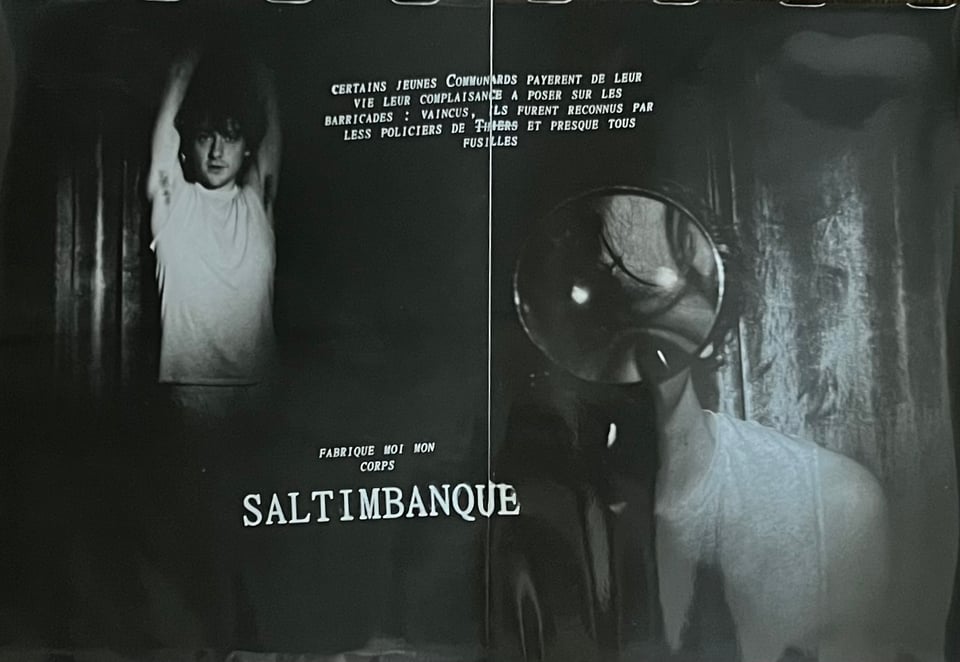
The loose causality of the photographs’ intimacies, and the pretence of historicity from the photographs’ forms and subjects, became a game of proper/improper.
That became my wicked streak - emptying and filling, a process of beckoning and calling to bodily engulfing or erasing, self-making. The photos ended up representing so much, or so little, that any visual codes are immediately contradicted elsewhere.
The original cameras where chronographic rifles. The original photographs were aerial bombing routes. The photographers that first understood photography were partisans. Staged silver-prints in general remind me of the work of Claude Cahun and Marcel Moore who, beyond roleplaying with one another in pleasantry or in perversion, had impersonated soldiers as guerrilla traffickers during the war. Some of the words are borrowed from them. Others from Picasso. Others from failed french riots. Some, where my body looks least like a body, don’t have words at all.
In the space before language, the exterior is constituted in each of us by the projection of the interior; from which we only have the experience of pleasure and pain. When language comes, it cleaves pleasure from pain as separate forms, and distinguishes inside from outside. Too quickly is this taken for granted.
Deconstruction is misbehaving - returning to a childlike state of tantrum. The pre-language child has no politics insofar as he submits to no one. He refuses interpretation. This is the job of the poet, who is always in effect a man-child anyways. Cling to Rimbaud, the most eroticised and righteous someone can get while still throwing a tantrum.
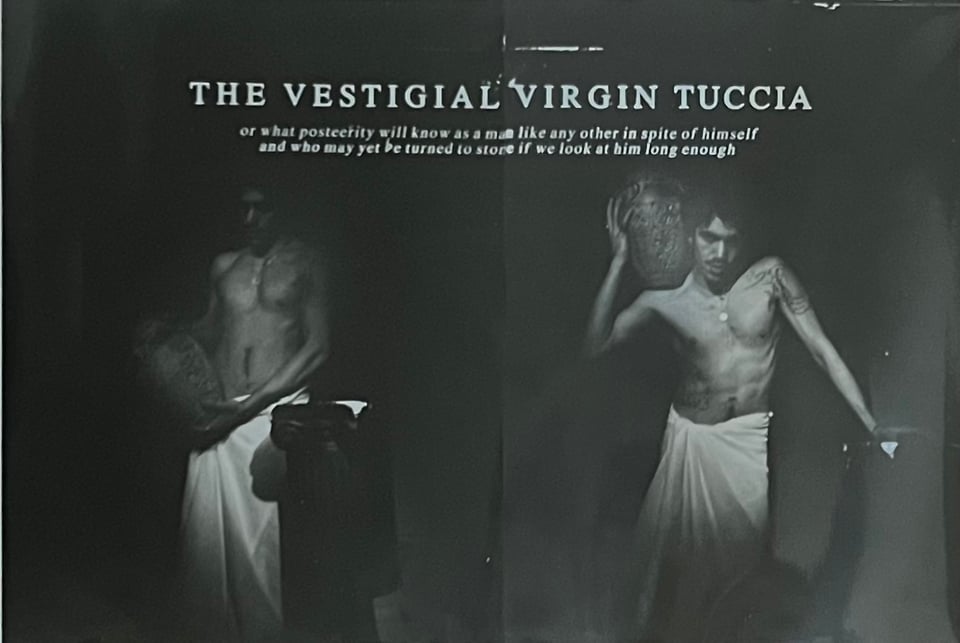
I posed one as Tuccia, the Vestal Virgin, which is a story, mostly told in genre paintings, where Tuccia carried water in a sieve to prove just how hermetically sealed her virginal body was. This is in roman times, I think. A refusal to enter into a symbolic exchange of swallow/spit. Virgins were priestesses because their bodies couldn’t fail. The vestigial body is the body without meaning. The self as atrophied.
The platform-politics of Us Well Behaved have everything and nothing to do with politics. Photographs, but photographs published on social media platforms especially, appropriate codes to create individual vocabularies. Each person pulls from history, which opens up to our generation panoptically, and forms, through transference, photographic identity. It’s a game of pretend where all the stakes are removed. Each personal curation arbitrarily sealed.
The role of photography as a communal historical memory (like in textbooks, or museums) is partially to blame. It means that experiences can be integrated into the public perception of an identity through photographs - the resurgence of film photography only proving a more believable method. There has, also, never been a generation as good at severing meaning as ours. Our generation is born with a sixth sense of framing, of creating blank canvases out of actual group experiences so that those experiences may be tied to something more. Even solitary activities, like reading or writing in a diary, for the first time in human history can be visually testified to, and for. The goal of a social photograph is to upstage the social experience.
In the arms race towards platform-authenticity, much of abjection has been domesticated - even the most gruesome fetishes have been mediatised to the point of infantilisation. The abjection of the you-that-isn’t-you (menstrual blood, sperm, urine, etc.) seems nearly outdated. As is the mutilated body, which has been part of the MoMa’s main draw since the 60s.
What really gets us going now here at the R.Y.F.F is the dirty crust within the mediatization system itself. The danger of unclean ideas are the dangers of a cosmically impotent language system. Black and white photographs as code for a vague “history-ness” hardly works anymore, but this is a cute example. The photo-identity-market has absorbed the role of the artist so completely that a new, strange, mutant kind of person has begun to grow beneath it. Beyond the authorship destroyed by generative AI, out of view of the market that could never monetise it’s unnatural production.

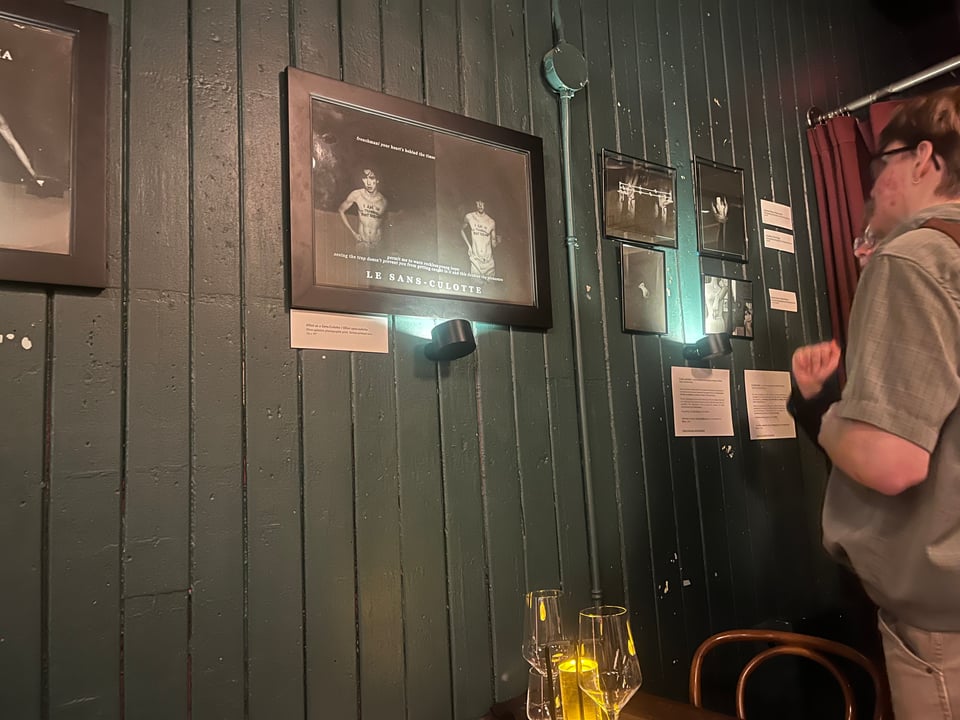
Us Well Behaved was exhibited at a bar/gallery in Montreal. It was exhibited for a month, in spring of 2024. This is to mean that people drank and ate next to my print-clusters.
George Harrison said John Lennon could never truly meditate because he was looking for an answer. There is no answer. You gotta let it all hang. I hate when my friends start talking about the body and meditation because from that moment on you know the conversation’s really over.
Elliot Mann is a writer and dirty derridian living in Paris. Reach him at elliot.l.mann@proton.me

Write, pitch, submit HERE
READING LIST
▪ Power of Horror - Kristeva
▪ Of Hospitality - Derrida
▪ Why I Want to Fuck Ronald Reagan - Ballard
▪ Cancelled Confessions - Cahun