Tyrant's Tooth Reveals Cretaceous Face Bite
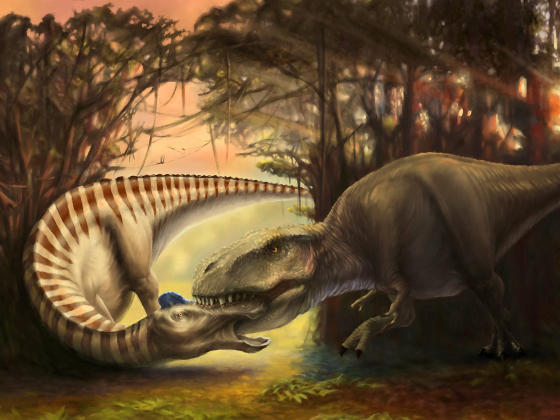
The fossil had been on display for years. MOR 1627, the shovel-beaked skull of an Edmontosaurus found in 2005 among Montana’s Hell Creek Formation, was a gorgeous addition to the exhibit hall of Bozeman’s Museum of the Rockies. Not only was the skull near complete, but it contained the fossil of an even more iconic dinosaur. Stuck in the snout of MOR 1627 was the serrated tip of a carnivorous dinosaur’s tooth - perhaps left behind by a ravenousTyrannosaurus.
Paleontologists love fossils like these. Bitten bones immediately bring up that favorite topic loved by experts and the public alike - feeding - and often invoke the famous carnivorous of every time and age. Who did the tooth really belong to? Was the carnivore hunting or scavenging? Could the skull’s isolation mean the rest of the body was eaten? It’s an immediate invitation to come up with hazy scenarios of enormous reptiles tussling among ancient wetlands, biting and honking and stamping.
It would be easy to leave the questions hanging and say that we’ll never know for sure. Often, experts point out that it’s very difficult to distinguish between possible predation, feeding, and scavenging. But the wonderful and strange thing is that we can know a great deal about how bones were bitten and who was doing the biting. Study after study has begun to reveal how carnivorous dinosaurs put their jaws to work and the sorts of traces they left behind. MOR 1627 is the latest subject of this paleo detective work, a fossil that records a moment that must have happened often but is rarely recorded in bone.
