Monday Fragments #21
A great white shark with smooth-sided teeth? Let me introduce you to Carcharodon hastalis.
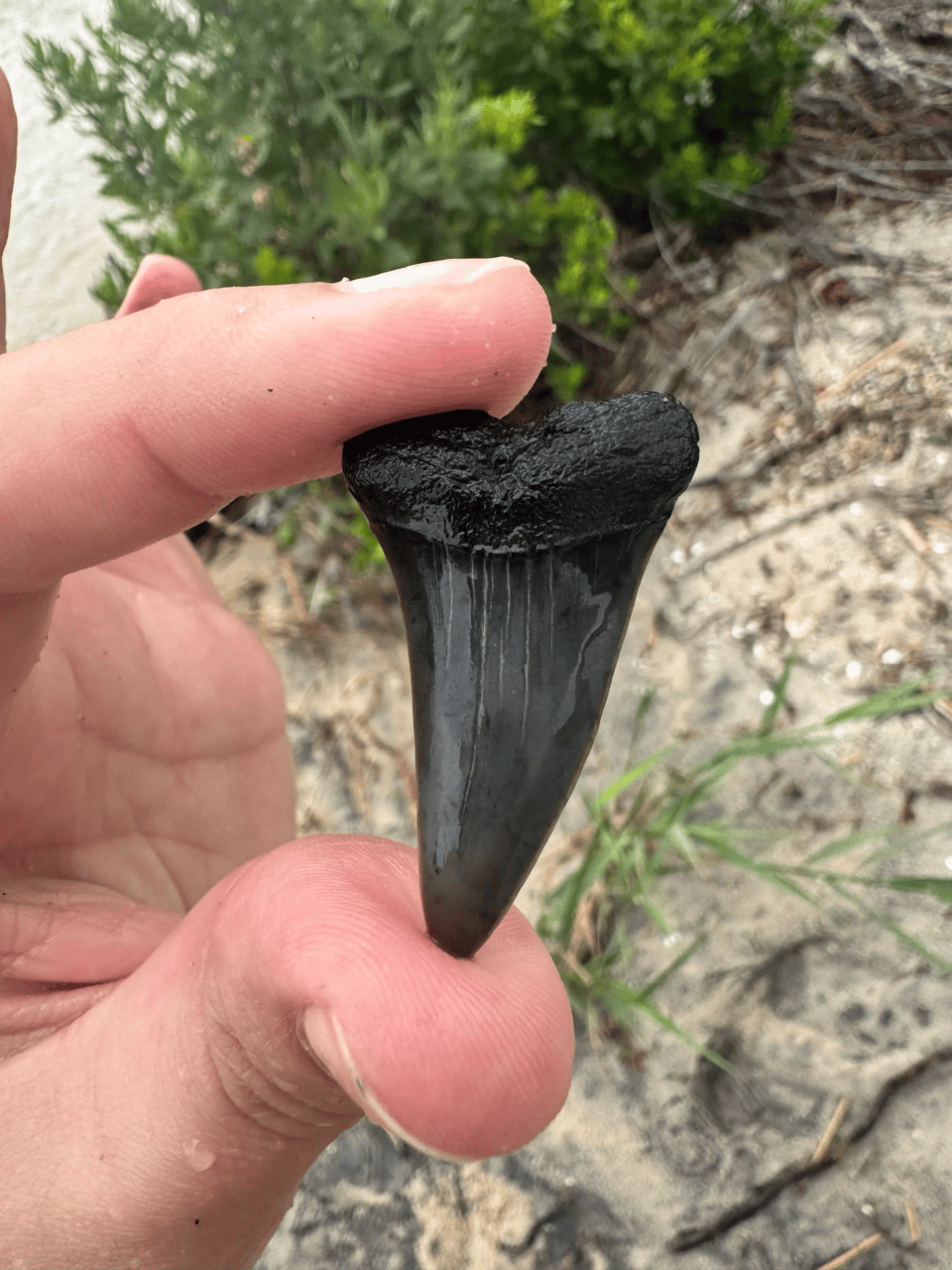
We used to think it was a mako.
The smooth sides of the triangular teeth fit the profile. But not the flat and blade-like nature of the teeth, how broad they are compared to the narrow, curved spikes of mako teeth that Hemingway once described as like “a man’s fingers when they are crisped like claws.” And so the broad-toothed mako was nudged around different genera - ‘Oxyrhina’, Cosmopolitodus, Isurus - to create a line between large makos of the ancient past and the big-eyed speedsters in the modern oceans.
If I had found the same tooth as I pulled out of the sand yesterday afternoon two decades ago, I’d likely say I’d found a mako. Instead, when Splash asked me what I had in my sieve, I grinned and yelped “great white!”
Paleontologist Dana Ehret and colleagues sorted out the mess in 2013. Fossil shark teeth are hard to categorize. Shape and function are closely entwined, and it can be hard to sort out what’s a real kinship signal and what’s convergence because of similar habits. In the case of that pesky species hastalis, found from Peru to Maryland, it turned out that the broad, smooth-sided teeth place the ancient fish along the lineage leading to today’s great white, Carcharodon carcharias. So now we label such transitional teeth Carcharodon hastalis.
The tooth I picked up yesterday morning grew in the mouth of a fish-hunting shark that swam in the same waters as Otodus megalodon more than 10 million years ago. The lack of serrations suggests an evolutionary relationship with tuna, other sharks, and fish packed with fatty oils, although the cutlery would have still been suitable for seals and scavenging whales. So many marine mammals were lounging in the seas during this time, a smorgasbord for warm-running sharks in need of energy, it’s not hard to envision how variations among ancestral great whites suitable for slicing through hide and carving out blubber became more and more widespread as the fish-chasing forms fell away. I’m just glad we have some modern relatives to look at, to envision the fantastic fish beyond the dark triangle I plucked off the tideline.
Want to support original science writing?Upgrade to get the good stuff!
Scribblings
Every single state in the US contains marine fossils, the Smithsonian’s From These Lands exhibit highlighting some of these stupendous finds. I wrote about a few for Smithsonian, and how important ancient oceans remain to our sense of time, place, and self.
You just couldn’t stop prehistoric fish from making bad choices. For premium subscribers, I wrote about ancient relatives of starfish that were nibbled by fish that didn’t seem to like the hard-shelled morsels.
Early tetrapods did not metamorphose like frogs and salamanders. I’ll tell you more at my blog.
For premium subscribers, I took a look back at the classic Dinosaurs: The Terrible Lizards. If you love stop motion and haven’t seen it, do yourself a favor and check it out!
Stomping to a City Near You
Coming this Friday! On July 17th I’ll be at Solid State Books in Washington, DC to help hype the crowd for John Wiswell’s new book The Dragon Has Some Complaints. If you like dragons, dinosaurs, and dinosaur-like dragons, you’ll want to come.
On July 28th I’ll be joining the Snug Books nonfiction club to talk about When the Earth Was Green. You can grab tickets for the event here.
East Coast tour dates for Tyrant Lizard Queen are starting to come together! On October 27th I’ll be at the central Enoch Pratt Library in Baltimore, on November 4th I’ll be at the public library in Lewes, Delaware, with dates to come for VA, NY, and MA.
Ear Perks
Guess what? Synapsid butt! This is definitely a candidate to do a deep dive article, but go check out the paper if you can’t wait.
The dinosaurs I grew up with were different from those of previous generations, and dinosaurs are certainly very different now than they were in the 1980s. It’s led me to love comparisons as a way to talk about how science works, and, from Dino Dad Reviews, Great Dinosaur Mistakes sounds like an enthusiastic exploration of how science has corrected and changed what we used to think.
Does the new Godzilla Minus Zero give us much information? No. It may even be misdirection. I’m still excited for it, though, especially because we don’t get that many direct Godzilla sequels.
