Friday Fragments #7
Contemplation on cardinal color and my new writing from the week!
32 days until the paperback release of When the Earth Was Green
207 days until the release of Tyrant Lizard Queen
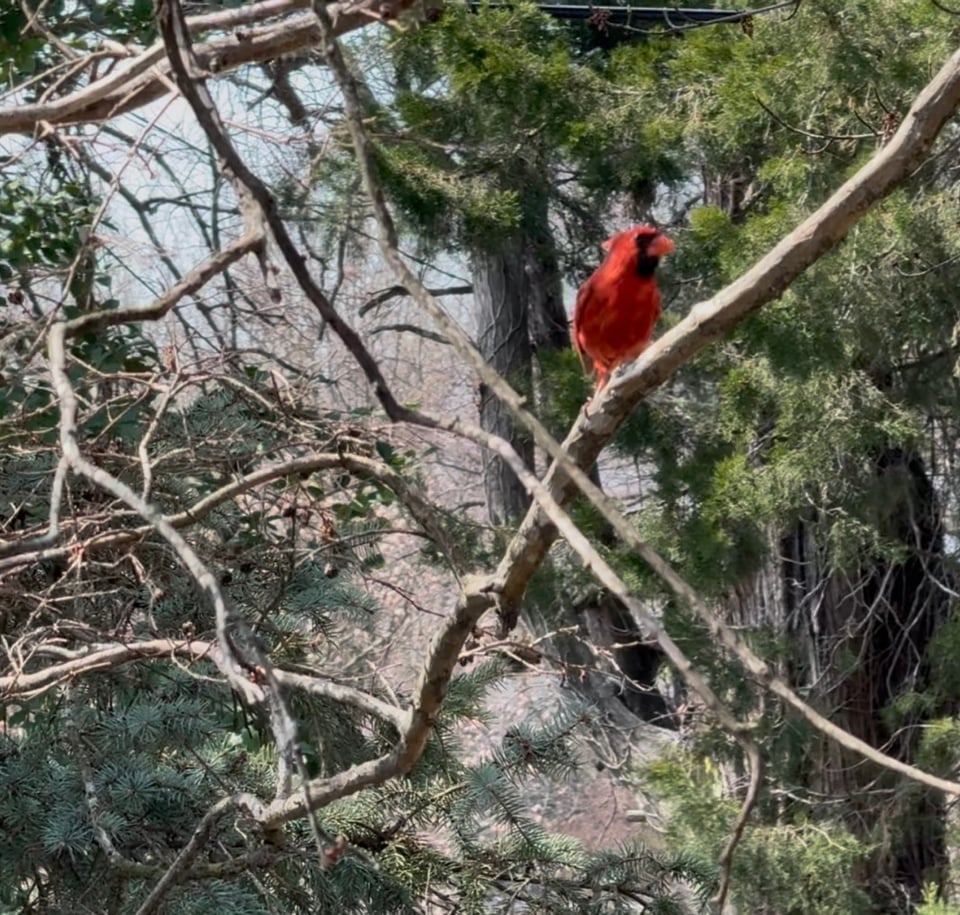
I had never seen anything more red. The bird looked like a sudden gout of 1970s horror movie blood, bounding flight to a branch where the little peeper was soon joined by another equally-scarlet cardinal. The shade was so bright that my head jerked the moment I saw the bird flutter through the trees, as if the flier were some kind of projectile headed my way. Beautiful.
I wonder if Mesozoic birds were as starkly-colored. It’s funny, isn’t it? Cardinals are common birds. Common visitors to feeders and backyards. But if an artist were to give an ancient, toothed bird such a brilliant shade of all-over red, they might be criticized for pushing the feathered dinosaur palette a little far. Even as experts begin to detect dinosaur color and color patterns, the resulting restorations - with rare exception - are often relatively dark or washed in subdued rusts and grays.
Naturally, paleontologists deeply value accuracy. The restorations of dinosaur color we’ve seen so far very much have to do with the ways we detect fossil color. Saturated, vivid colors are often chemically-created in feathers and scales in ways that we can’t yet detect. Imagining a bright red dinosaur with a black mask is, so far, beyond where we can reach with direct evidence. But, if we pull away from a literal reading of the rock record for a moment, I still have to wonder about history. About how we came to even look to birds for clues about other dinosaurs at all.
Had paleontology first coalesced as a science in eastern Asia, where compressed fossils of feathered dinosaurs and fluffy dinosaur parts in amber are abundant, perhaps the fact that birds are dinosaurs would have come into focus a century earlier than it had. And within such an alternate history, I wonder what birds might act as inspiration for dinosaur art - because it’s impossible to imagine a history where paleontology exists but paleoart does not.
This is mostly just an impression on my part, but modern restorations of feathered dinosaurs often seem to draw from Northern Hemisphere favorites such as ravens, turkeys, and magpies for their possible colors and attitudes. But what if paleoartists, aware much earlier that birds are dinosaurs, drew from neotropical birds or other colorful avians? In such an alternate timeline, might we feel more comfortable with extremely bright and eye-catching dinosaurs in the mix? Earth tones are only a small sampling of nature’s color.
Maybe this is all silly. It rests on several major “what if”s that would require seismic shifts not only to the history of science but the history of the world. But I still like the exercise. Science is a tool with a particular history, just like a hammer or a stone hand axe. Ideas don’t form along inevitable pathways, as if someone just stumbles into a point of inspiration and certain set stages must be argued over to unlock the truth. We could have known that birds are dinosaurs far earlier than we did, had certain historic conditions been different, and the fact would have undoubtedly affected the entire idea of what a “dinosaur” is - and surely what they looked like.
I would’ve told the cardinal all about it, but they were busy swearing in their own language at another streak of hopping crimson. It would’ve been impolite to interrupt.
Subscribe nowScribblings
Spinosaurus is a dinosaur superstar, but what do we really know about this icon? I dive in over at Smithsonian.
SIERRA asked me to reflect on our connection with nature for a piece in anticipation of Earth Day. I chose to tell about the trees that grew us.
I watched episode 2 of Netflix’s The Dinosaurs, and, well, I don’t know if you’ve ever had the experience of a tv show making you mad before…
In my latest for premium subscribers, paleontologists have revealed the oldest known chelicerate, the sort of Cambrian invertebrate that set the anatomical foundation for spiders, mites, and horseshoe crabs.
Ear Perks
Enzymes that can make progesterone are essential to helping octopus mate, which makes me look at my morning dose a little differently.
Rainforest animals just love to poop at the strangler fig. (Thanks to friend Bee Brookshire for pointing this one out - check out her newsletter!)
Remember that part of When the Earth Was Green where I talked about Carboniferous oxygen levels and how high oxygen may have actually been a problem for invertebrates? Well, now there’s even more evidence that the old “more oxygen equals big bug” hypothesis isn’t accurate. Higher oxygen didn’t make breathing more efficient for insects, as often proposed, and so can’t be what nudged millipedes to grow as large as a living room rug.
