Friday Fragments #37
How did crocs survive the big hit? By staying where the warm was.
I forget how we got on the topic. I only remember that I horrified the room.
The spectre of the K/Pg catastrophe kept getting invoked during my visit to Scrawl Books this week. So I decided to tell the story. About the asteroid. About where and how it hit. And how it got so much worse, and worse still. My eyes kept flicking over to someone in the back of the audience who was slack-jawed at what I was saying, the air so quiet that I felt emotionally obligated that 25% of life survived, that what remained grew into something new, to buffer the horror.
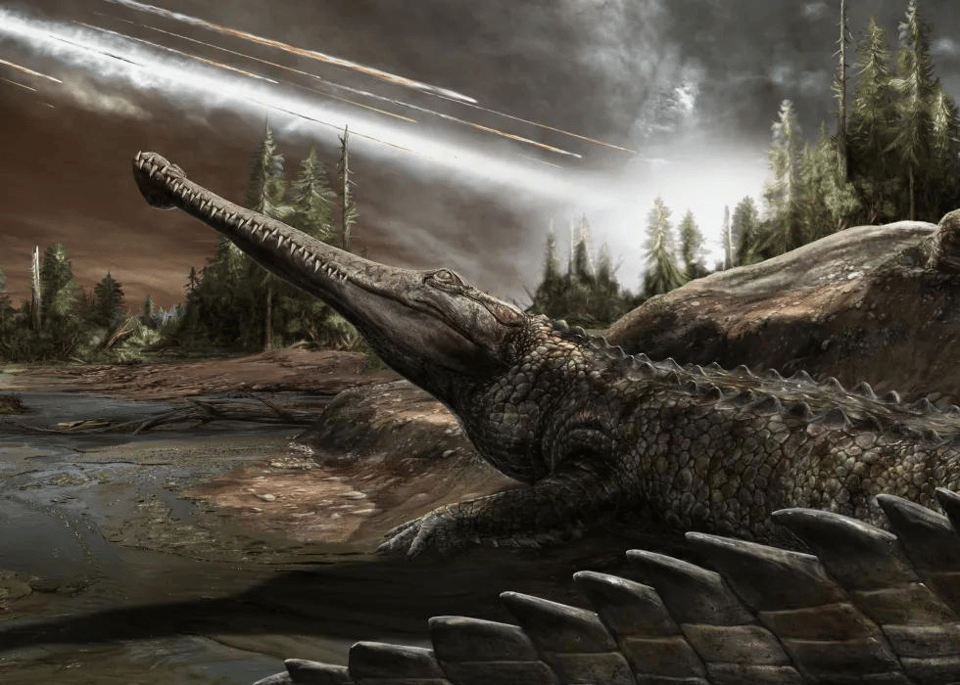
I wish we knew more about how that too-small slice of Cretaceous life survived. We’re starting to get some ideas. But even as I was writing The Last Days of the Dinosaurs, there was one group that bothered me. The crocodiles. Large crocodiles were present in the earliest parts of the Paleocene. I knew their bones from my days as a hatchling paleontologist in New Jersey, gharial-like crocs stretching 20 feet long found in the sandy layers just after the big hit. How could these carnivores, reliant on other animal life for their survival, have persisted during a time of such ecological chaos?
Paleontologist Alfio Alessandro Chiarenza and colleagues have given us some new clues. In a Science Advances study published earlier this month, the researchers proposed that crocodiles survived not by adapting to changing conditions but following the world’s warm spots.
Modern crocodylians are warm-weather reptiles. Their distribution around the planet, the researchers point out, is circumtropical - and may expand as global climate change continues to raise annual temperatures. Paired with models of prehistoric climate and the geographic occurrence of fossil crocs through the past 250 million years, the researchers tracked how precipitation and temperature affected crocodile evolution.
During times when the world grew warm, like the end of the Paleocene 56 million years ago, crocs expanded towards the poles. And when global temperatures cooled, like the onset of the Ice Ages around 2.5 million years ago, they contracted towards the warmer tropics. But what happened at the end of the Cretaceous?
The end-Cretaceous world was warm, favorable to crocs, but suddenly plunged into an impact winter that the reptiles could not have prepared for. But volcanic eruptions may have provided the necessary cover. The Deccan Traps eruptions of ancient India dumped such vast quantities of greenhouse gases into the atmosphere that the chilling effects of the impact winter were mitigated, at least enough to preserve croc-suitable climates across Earth’s middle. Tropical temperatures remained within the optimal range of 72 to 95 degrees Fahrenheit crocodiles seem to thrive at, and so croc species already living there were able to hang on. At least when it comes to temperature.
I want to know more. We’ve focused so long on the trigger for the K/Pg catastrophe, and the loss of the non-avian dinosaurs, that the stories of the survivors have often been overlooked. Perhaps because it’s easier to understand why animals would perish in oven-blast temperatures and years of debris-laden atmosphere than how any survived such strange phenomena. But it’s the survivors we most need to hear from, especially as we are in the throes of a homemade mass extinction. I hope crocodiles will still be smiling on the other side of it.
Scribblings
Tyrant Lizard Queen is here! I hope you love it, and, if you do, please leave a review wherever possible to help Snaggletooth get her flowers.
I’m back on I Know Dino to talk T. rex!
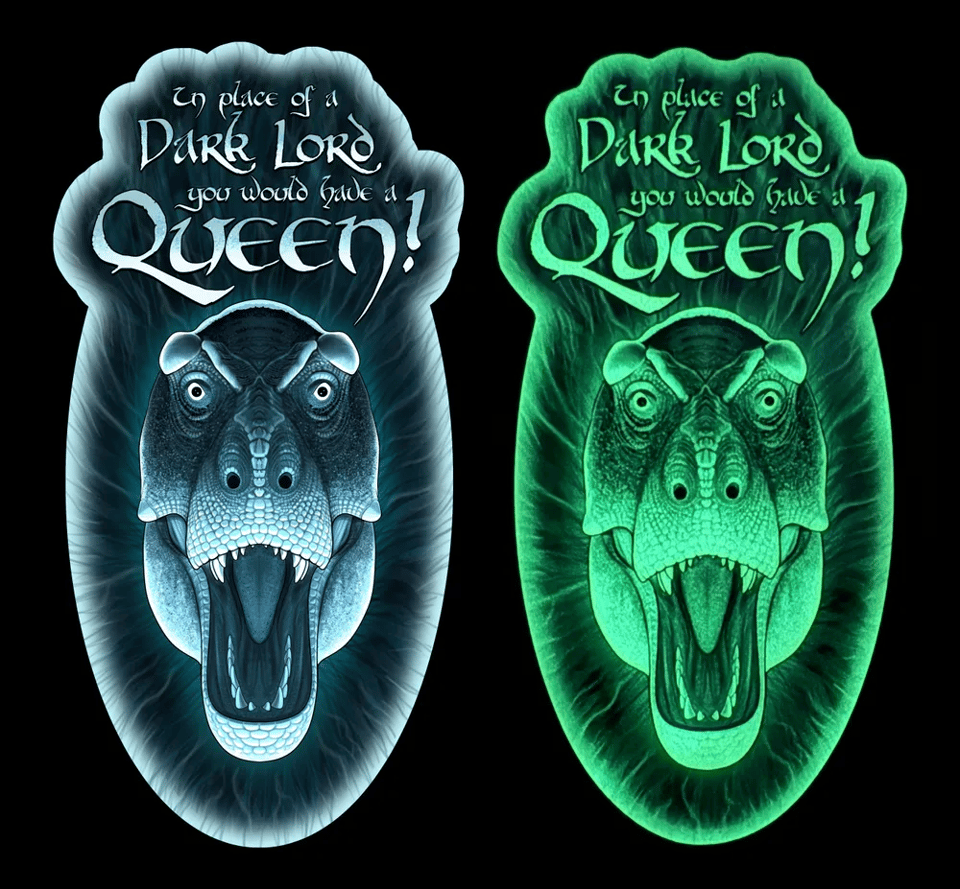
Remember the poster for Tyrant Lizard Queen? Artist Emma LeRae made a special glow-in-the-dark surprise sticker for the book’s release. You can get it from her shop.
Years before Walking With Dinosaurs, The Ultimate Guide: Tyrannosaurus rex gave us epic dinosaur moments. I look back at the transfixing puppets in this week’s I Want My DinoTV.
Guess what? Squid butt. Sort of. Belemnites aren’t technically squid, but close enough to make the joke and introduce you to one of the chunkiest ancient cephalopods yet found.
I spoke to SINC about our living dinosaurs, birds.
We’ve got a new hell chicken. I spoke with the CBC about Inferogallus, a parrot-like dinosaur that may have munched a lot of fruit.
Stomping to a City Near You
If you missed the launch day event at Baltimore’s Enoch Pratt library, you can watch the whole thing on YouTube!
November 4th I’ll be in Lewes, DE at the public library for a joint event with Browseabout books.
November 5th I’ll be at the Bureau of General Services - Queer Division in NYC.
November 6th I’ll be at the Harvard Bookstore in Cambridge, MA.
December 2nd I’ll be at the Natural History Society of Maryland in Baltimore, MD.
If you’d like me to do an in-person or virtual event closer to you, encourage your local museum or library to get in touch.
Ear Perks
“Science fiction, double feature…” The Broadway cast of Rocky Horror puts on a Tiny Desk Concert.
Have you seen Killer Klowns From Outer Space? If not, it’s a great Halloween treat (complete with dinosaur).
And here’s something classic for your Halloween weekend. Whenever this song comes on shuffle, I think of Snaggletooth.
