Friday Fragments #34
Slam. Start. Mosasaurs.
I love when paleontologists give us an awesome new piece of jargon. A term that is said seriously but with a smirk.
Like slam-start.
Slam-start mosasaurs.
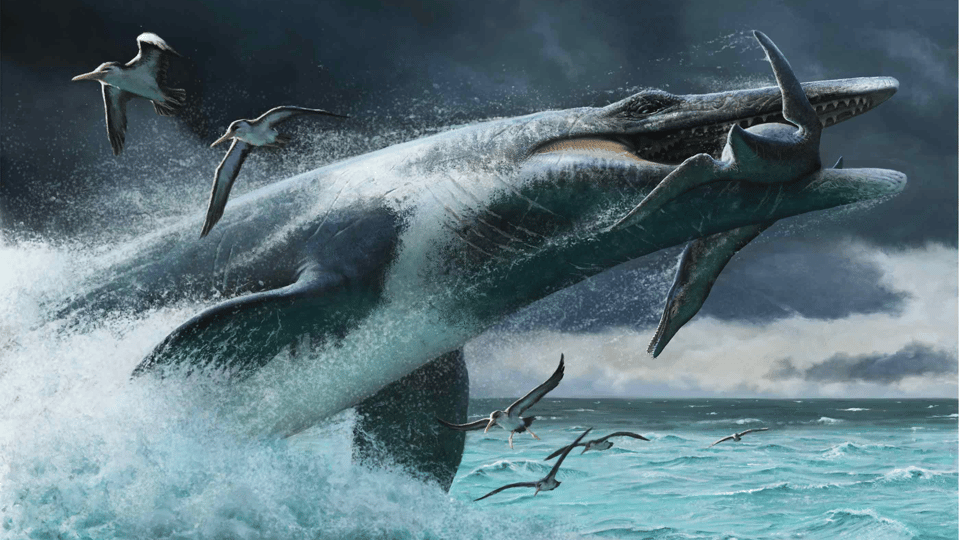
We’ve known for a while now that these prehistoric sea lizards we love so much were both diverse and disparate. Pannoniasaurus was a noodly lizard that lived in rivers. Globidens was a coastal cruiser hungry for crunchable clams. And Tylosaurus was a speedy apex predator - the latest species so large it was named T. rex as a bit of a jab at the terrestrial namesake. But what was the lifestyle difference between big, predatory mosasaurs like Tylosaurus and other big, predatory mosasaurs like Mosasaurus? Their tails contain some potent clues.
Earlier this week, paleontologist Kiersten Formoso and colleagues published a new study on how mosasaur tail shape related to their swimming performance. The physics of swimming is well-established, we have some good mosasaur skeletons and soft tissue fossils, and we know from animals like sharks that tail shape relates to how that tail moves the body.
Much like the giant, meat-eating sea lizards, I’ll cut to the chase. The new study found evidence for a split between a group of mosasaurs called russellosaurines - like Tylosaurus - and mosasaurines, like Mosasaurus. The iconic Mosasaurus was a cruiser, a predator of the open ocean that chased prey like pelagic sharks do. Tylosaurus and its relatives had tails capable of a slam-start - a rapid lunge, and the mark of ambush predators. Great white sharks, with their half-moon tails, hunt this way. The sharks frequent shallow waters near the coast, staying low in the water and looking up before they spot appropriate prey and then accelerate to deliver that first terrible bite.
The starting gate differences between the mosasaur lineages might explain how both were able to coexist. Aside from the big question of Mesozoic ocean productivity - the ecological apportioning that allowed many large predatory animals to exist - broad diversity often comes with niche partionining. Similar animals that feed in slightly different ways, on slightly different prey, in slightly different places, can live at the same time or in the same space. Mosasaurs certainly show signs of these specializations in the time before the big asteroid strike. If the mass extinction didn’t cut them off, I wonder if mosasaurs would still be here, diverse as sharks, swishing those characteristic tails through the water.
Scribblings
With Tyrant Lizard Queen hitting shelves in less than three weeks, T. rex has been on my brain.
At Smithsonian, I get into five ways that our image of T. rex has changed over the past century.
It seems T. rex was a bit solitary as an adult, but this doesn’t mean that the dinosaur had no social life. For National Geographic’s Stones and Bones newsletter, I dish about the dinosaur.
In the past month we’ve been introduced to not one, but two otter-like Mesozoic mammals. They lived over 40 million years apart, a case of convergent evolution that hints at repeat radiations of semi-aquatic beasts in the time of the dinosaurs.
I’m tired of games bringing dinosaurs to life only for players to blast them into oblivion all over again. My thoughts on the game Clawed, for you premium subscribers.
And I was on The Weirdest Thing I Learned This Week to talk about the new book, the fossil cat Miracinonyx, and why people kiss. Check it out here!
Stomping to a City Near You
We have a T. rex! tour. When Tyrant Lizard Queen reaches you on October 27th, I’ll kick off an East Coast run to talk about Snaggletooth and her story. Here’s where I’ll be stopping:
Launch day! October 27th I’ll be at the central Enoch Pratt Library in Baltimore, MD.
October 28th at Scrawl Books in Reston, VA. This is a trivia night event, so make sure you’re ready for dino questions!
November 4th I’ll be in Lewes, DE at the public library for a joint event with Browseabout books.
November 5th I’ll be at Hive Mind Books, NYC!
November 6th I’ll be at the Harvard Bookstore in Cambridge, MA.
December 2nd I’ll be at the Natural History Society of Maryland in Baltimore, MD.
If you’d like me to do an in-person or virtual event closer to you, encourage your local museum or library to get in touch.

Ear Perks
Stressed by late capitalism? Nostalgic for reticulating splines? Check out Car Park Capital.
I love this cover. But I do enjoy yearning.

Finally, a new release to get excited about. Wicker.
