Friday Fragments #33
A new tyrannosaur species indicates the tyrant dinosaurs were evolving fast towards the end of the Cretaceous.
Happy Friday! I can say that genuinely because we got a new tyrannosaur today.
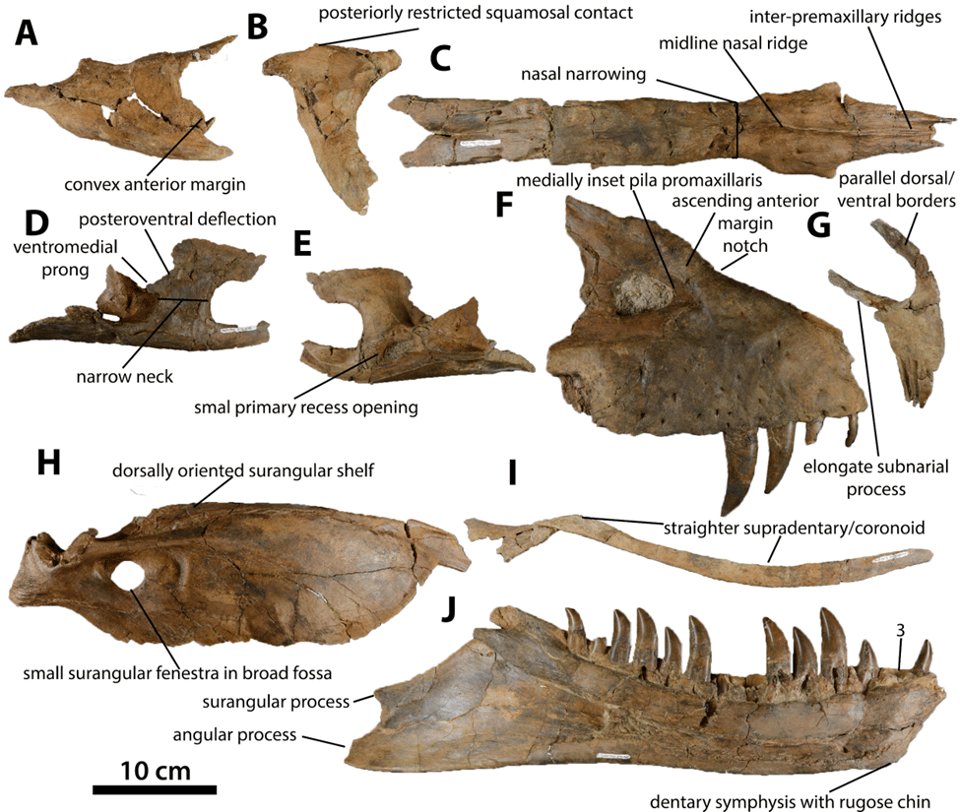
Named Tromerosaurus solumons by paleontologist Mark Powers and colleagues, the dinosaur was found in the 77-76 million year old rocks of Canada’s Oldman Formation. Fossils of the carnivore are very similar to the classic big tyrannosaurs of the time - Gorgosaurus, Albertosaurus, and Daspletosaurus. That’s part of what makes it special. Tromerosaurus resembles tyrannosaurs from what were thought to be two different, diverging lineages, shifting what paleontologists expected of tyrannosaur evolution in the hot and humid days of the Campanian.
Up until recently, the Late Cretaceous tyrannosaur species of western North America seemed to be long-lived and relatively stable. Even as crested lambeosaurs, horned dinosaurs, and heavily-armored ankylosaurs all showed relatively rapid evolution and turnover in habitats from Alaska to Mexico, tyrannosaur species seemed to last twice as long and not change very much. The carnivores were big-headed predators that were evolving stronger and stronger bites, as useful on a Lambeosaurus as a Parasaurolophus. It seemed to make sense that tyrannosaurs were in relative stasis as their prey species evolved rapidly.
But about 15 years ago, the story started to change. Fossils labeled “Gorgosaurus” and “Albertosaurus” turned out to be entirely different genera like Bistahieversor from New Mexico, Teratophoneus from Utah, and Labocania from Mexico, not to mention new species of Daspletosaurus distinct from the first-named species D. torosus. The discovery of even older genera, such as Thanatotheristes and Lythronax, further underscored that Cretaceous North America was a riot of tyrannosaur evolution. The continent wasn’t stalked by a small cast of long-lived tyrant species. The carnivores were spinning off new species and lineages just as enthusiastically as their prey. It was just harder to tell without the ornamentation and plant-eater abundance that allowed the herbivorous species to be more precisely split and categorized.
So now we have Tromerosaurus. The dinosaur is very similar to the sleek Gorgosaurus - a personal favorite - and yet still has some skull bones similar in shape to the bulkier Daspletosaurus. (In fact, fossils of Tromerosaurus were previously mistaken for both genera before.) The best-supported assignment is closer to the svelter gorgosaurs, which may mean that some of these tyrannosaurs were starting to converge on the anatomy of the bulkier lineage that eventually spun off T. rex. Or maybe tyrannosaur evolution is more complex than researchers previously knew, with a shallower divergence between the Gorgosaurus and Daspletosaurus lines than they expected. In other words, tyrannosaurs were evolving so quickly, and converging on similar anatomies often enough, that the picture only looked simple because we were still missing so many pieces.
Tyrannosaurs were evolving fast towards the end of the Cretaceous. Which makes me wonder what else is waiting out there, in the rock and in museum drawers that will need new labels.
Scribblings
Tyrant Lizard Queen is one of Barnes & Noble’s Best Books of October 2026, and Nautilus is looking forward to the book’s release, too! Pre-orders make a huge difference in the weeks leading up to publication, so now’s a great time to ask for Tyrant Lizard Queen from your favorite bookshop or library.
It’s been a big week for mistaken identity in paleontology. Fossils mammals thought to be predecessors of today’s antelope and deer have turned out to be shrew-bunnies that hopped around ancient Mongolia. New for my premium subscribers!
You knew it’d happen eventually. For my first piece on dinosaur comics, I look back at Topps’ Raptors Attack! series - that somehow brought back Muldoon.
South America was an island incubator for sauropod diversity, including species that nested at high latitudes. Now up on my blog.
Stomping to a City Near You
We have a T. rex! tour. When Tyrant Lizard Queen reaches you on October 27th, I’ll kick off an East Coast book tour to talk about Snaggletooth and her story. Here’s where I’ll be stopping:
Launch day! October 27th I’ll be at the central Enoch Pratt Library in Baltimore, MD.
October 28th at Scrawl Books in Reston, VA. This is a trivia night event, so make sure you’re ready for dino questions!
November 4th I’ll be in Lewes, DE at the public library for a joint event with Browseabout books.
November 5th I’ll be at Hive Mind Books, NYC!
November 6th I’ll be at the Harvard Bookstore in Cambridge, MA.
December 2nd I’ll be at the Natural History Society of Maryland in Baltimore, MD.
If you’d like me to do an in-person or virtual event closer to you, encourage your local museum or library to get in touch.

Ear Perks
We’ve got a cool new Mesozoic mammal! Meet Dongoconodon, an otter-like friend.
Working on a shark book means I’m always looking out for more shark books, and I’m very excited for Jack Cooper’s upcoming title on megalodon and other prehistoric sharks.
“Monsters are hot,” and I agree entirely with Cassandra Khaw.
And finally, a little synthwave to slide into the weekend.