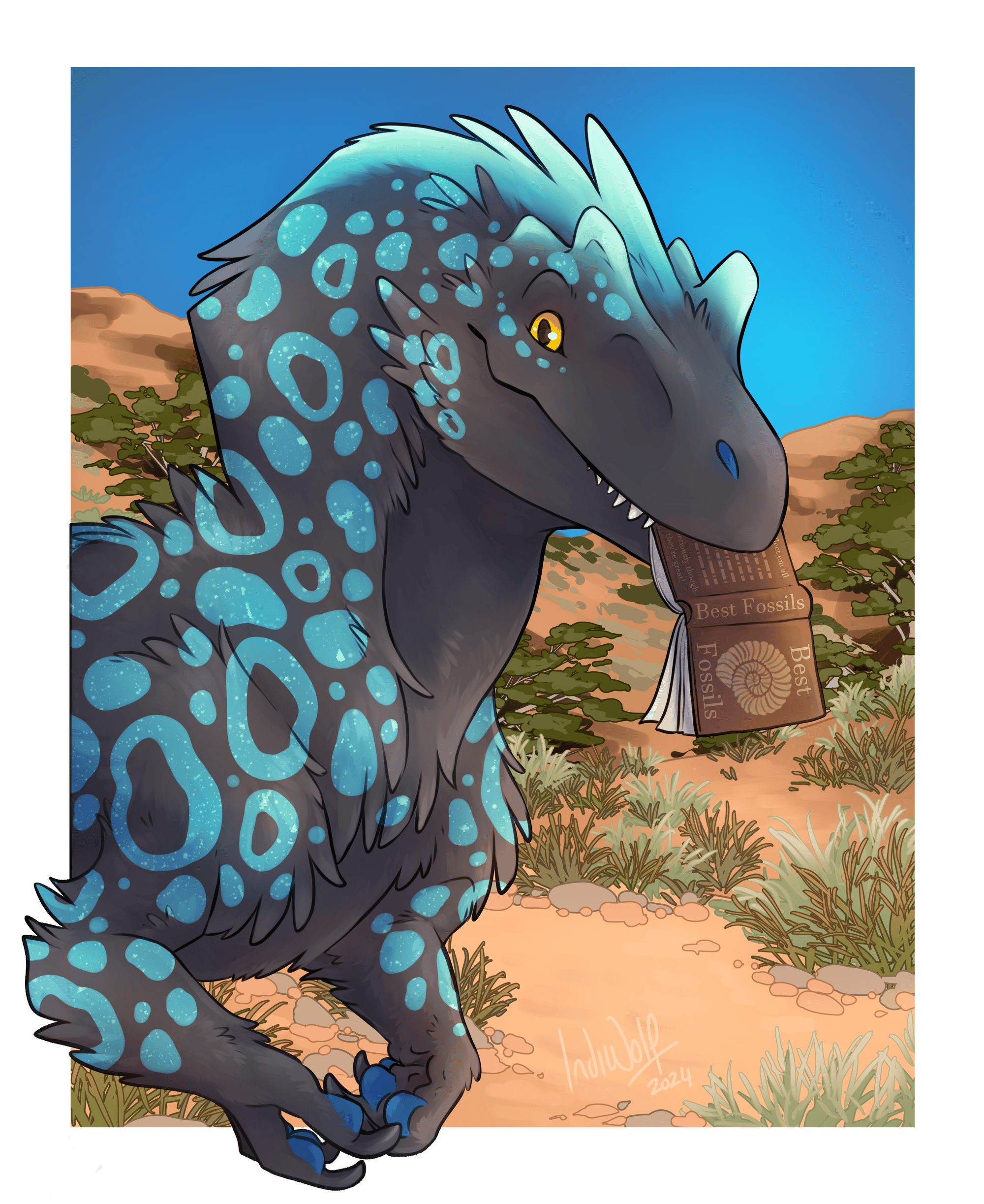
Friday Fragments #31
Tyrannosaurus rex really was a hot-blooded dinosaur.
Tyrannosaurus rex ran hot.
We’ve known this for a little while now. Research conducted two decades ago indicated that T. rex had the elevated, and perhaps even constant, body temperature implied by the rest of the animal’s paleobiology. But science is about testing, and testing, and testing, checking what we thought we knew yesterday. So while the new paper out this week supporting T. rex as an endotherm similar to you and me isn’t exactly a shocker, the findings still fill out a little more about the iconic terrible lizard.
You can check out the new study yourself in Science Advances. Randon Flores and colleagues looked to geochemical isotopes - proxies for aspects of dinosaur ecology and biology - to investigate the tyrannosaur’s body temperature, whether that body temperature fluctuated, and how it differed from ectothermic animals whose temperatures shifted with ambient temperature (in this case, crocodiles).
T. rex had a relatively constant body temperature of about 97 degrees Fahrenheit. I’ve seen that thermometer reading for myself before. The crocodile temperatures ranged between 80 and 100 degrees Fahrenheit, as expected for animals related to modern crocs who regulate their body temperatures by basking, sliding into the water, and otherwise directly managing their physiology. Hot as Late Cretaceous environments could run towards the end of the Mesozoic summer, T. rex were generally warmer inside than the surrounding air.
Keeping so consistently warm likely allowed T. rex to range as widely as the dinosaur did. The carnivore is thought to have evolved from an ancestor in eastern Asia, closely related to Tarbosaurus, and expanded through western North America from Saskatchewan, Canada to New Mexico, USA (the NM T. “mcraeensis” fossils are likely T. rex bones found in ambiguous rock layers, geologically younger than what the authors of the paper proposing the new species understood). Analyses of Late Cretaceous rocks in North America indicate that preservational basins are only showing us part of the dinosaur faunas that existed on the continent just before the asteroid strike, as well, so it’s possible T. rex ranged even further than we presently recognize. The rocks are only showing us part of the picture. The T. rex body temperature estimates help explain how the predator managed to stalk so far and wide for two million years.
According to the new study, T. rex could have tolerated temperatures between 14 and 122 degrees Fahrenheit. The fact that related tyrannosaurs, like Nanuqsaurus, lived in polar habitats heavily influenced by months of darkness and cold suggests this broad tolerance is correct. Dinosaurs like T. rex could withstand seasonally cold and permanently cool habitats that were too chilly for turtles, crocodiles, and lizards. T. rex was able to cope with the temperatures to travel from Asia to North America, then spread throughout a continent that was cozy enough for the carnivore. Had the asteroid not struck 66 million years ago, I have to wonder how the incredible predator would have continued to evolve. But you’ll have to read Tyrant Lizard Queen if you want to know my thoughts on how that might have played out.
Scribblings
LibraryReads selected Tyrant Lizard Queen as its October Notable Nonfiction pick! This is cool because the selections are based on what library staff are into and recommend. The feeling’s mutual, librarians, I adore you, too.
Let’s say you wake up in the Mesozoic, like a certain hapless family recently in theaters. How would you be able to tell? I give you five tips over at Smithsonian Magazine.
Miracinonyx was not an American cheetah in an evolutionary arms race with pronghorn. Cougar-like cats that gorged on salmon in the ancient Yukon provide some key evidence.
There’s been a cartoon intro stuck in my head for about 30 years. In this week’s I Want My DinoTV, I go back to T-Rex.
Diplodocus is the latest Morrison Formation dinosaur to also turn up in western Europe. The find hints at waves of dinosaur dispersals between the continents we’ve only just begun to understand.
Stomping to a City Near You
On September 25th, I’ll be at Charm City Spec in Baltimore, MD to read from When the Earth Was Green! Details here.
We have a T. rex! tour. When Tyrant Lizard Queen reaches you on October 27th, I’ll kick off an East Coast book tour to talk about Snaggletooth and her story. Here’s where I’ll be stopping:
Launch day! October 27th I’ll be at the central Enoch Pratt Library in Baltimore, MD.
October 28th at Scrawl Books in Reston, VA. This is a trivia night event, so make sure you’re ready for dino questions!
November 4th I’ll be in Lewes, DE at the public library for a joint event with Browseabout books.
November 5th I’ll be at Hive Mind Books, NYC!
November 6th I’ll be at the Harvard Bookstore in Cambridge, MA.
December 2nd I’ll be at the Natural History Society of Maryland in Baltimor, MD.
If you’d like me to do an in-person or virtual event closer to you, encourage your local museum or library to get in touch.

Ear Perks
Friend Jason Bittel has a new book out! Grizzled: Love Letters to 50 of North America’s Most Misunderstood Animals is exactly what the subtitle says, and you’ll find a certain dinosaur lady you know quoted in the chapter on gar.
We got a new cat this week! Leopardus tilcayo, the first new cat species found in a century.
I’d missed Ella Red until now, so I’ve been listening to her all week. I think Snaggletooth would like her.
