Friday Fragments #30
Why didn't pronghorn make it to South American when so many other North American mammals did?
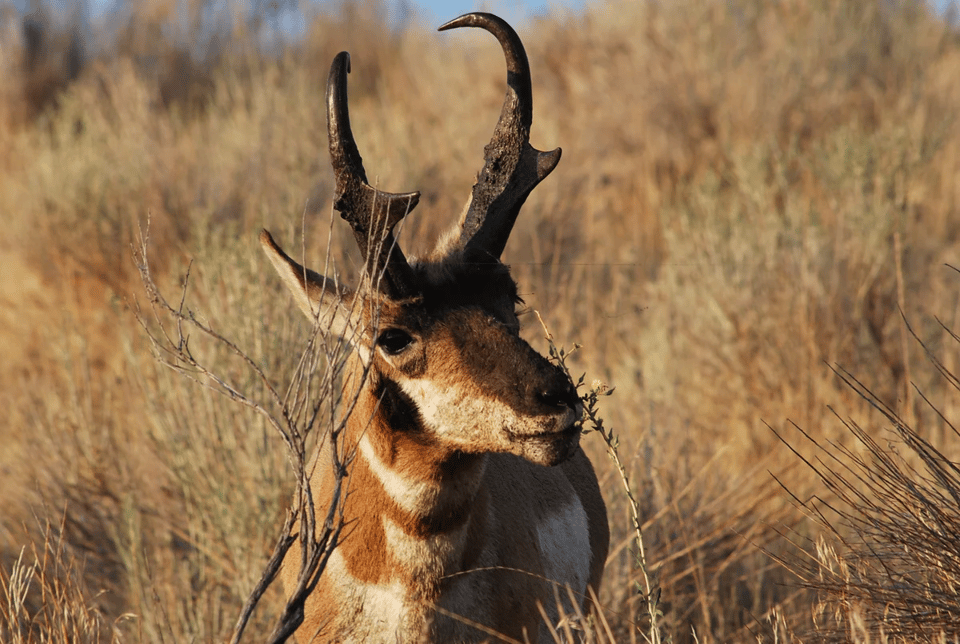
Pronghorn had millions of years to prepare for the trip. But they never made it. Even as gomphotheres, sabertoothed cats, horses, and other ancient mammals spread from the southern reaches of North America to the newly-connected South America, pronghorn didn’t join their megafaunal neighbors.
The big pulse of the Great American Biotic Interchange, or GABI as she’s sometimes known, happened about 2.8 million years ago. By that time, the continents were connected by Panama and explains why there were giant sloths in Iowa and jaguars in Peru by the Ice Age. But pronghorn - hoofed herbivores with prong-like horns in the genus Antilocapra - stayed in North America.
Paleoecologists Katherine Magoulick and Charles Marshall suspect that pronghorn didn’t have suitable habitat to make the same journey other big mammals did. Especially during the time leading up to the GABI, pronghorn were becoming beasts of the open grasslands. American savannas full of sage and other bristly shrubs were home to the Pliocene and Pleistocene antilocaprids, preferred by these mammals to the point that there was no contiguous span of grasslands for them to move over the equator to South America.
It’s possible that pronghorn made it anyway and went extinct - there are always new things to be found in fossil collections - but it is in some ways strange that pronghorn don’t live in South America today given suitable habitat in Venezuela, Guyana, Suriname, and French Guiana. It’s possible that such habitats only exist at higher latitudes, meaning that no suitable corridor for these herbivores opened even as other long-ranging mammals were able to shift along the interfingering ecologies between continents.
It may be that life joined so strictly to grasslands prevented pronghorn from ecologically preparing. The herbivores were becoming more specialized to life in a habitat continually maintained, if shifted around, by the relatively cooler and drier global climate that’s been fidgeting since the beginning of the Pleistocene. But pronghorn could have been nudged to a more flexible ecology, just as other big mammals were. The process began about 10 million years ago, long before the Americas would touch.
Upgrade and support human-written science writing, if you like!It’s not as if mammals lined up on the southernmost tip of ancient Central America, waiting for the continents to touch like a ferry pulling into dock. The main interchange happened around 2.8 million years ago, but different mammals lineages were beginning to island hop, swim, or otherwise make their way between the closing gap between 7 and 3 million years ago. Raccoon relatives moved south, some giant sloths moved north, all leading up to the big event. But evolutionary preparations began even earlier. A Science study published earlier this year by Jack Tseng and colleagues proposed that southern México was a “holding pen” for many lineages that took part in the GABI starting around 10 million years ago.
In broad strokes, the holding pen hypothesis makes sense. The habitats of ancient México and northern South America began to resemble each other as the landmasses drew closer, experiencing similar climates and already sharing commonalities in vegetation and some animal life. (The ancestors of today’s capybaras, for example, made it to South America tens of millions of years earlier than the mammals of the Interchange.) But the hypothesis may also explain why so many mammal lineages from the north were so successful in adapting to habitats in the south while those from the south struggled. The northern lineages, shaped by similar ecology for millions of years, were effectively pre-adapted to South America’s ecology and were able to easily make the hop while the same wasn’t necessarily true of the southern mammals. It’s not a one shot hypothesis, other factors mattered for how evolution and extinction unfolded through all of this, but it makes a little more sense of the biological flow that’s stood out as paleontologists have investigated this event.
Apparently pronghorn either did not take part in these preparations, perhaps already excluded from the area, or were but never traveled south in significant numbers - already on the edge of their preferred range. If so, with a single species left when there were at least three in the Pleistocene, maintaining grasslands for the herbivore is critical for the mammal’s survival. Common as they might seen, prancing across I-80 or chasing each other in the Yellowstone front country, Antilocapra are survivors who have their fate inextricably linked to seas of sage. Where the American savannas grow, pronghorn follow.
Scribblings
Tyrant Lizard Queen is coming out soon, and today’s the last chance to get my new book 25% off from Barnes & Noble. Use code PREORDER25 at checkout. And whether you’re pre-ordering now or already have, fill out this form to get a free signed book plate and digital goodies when the book releases on October 27th!
For the first time ever, paleontologists have find fossil bird feathers in dinosaur poop. It’s not just a cool find, but one that might explain why some toothed birds didn’t survive the K/Pg. I’ll tell you more over at NatGeo.
I felt a little inspired to write about pronghorn today because I just covered a new Miracinonyx study earlier this week. Turns out the ancient mountain lion did not rely on pronghorn, but enjoyed an array of meals across their range. The ancient cats in the Yukon feasted on salmon.
Did you know that McDonald’s infamous “super size” was brought back because of a Dino Size promotion for Jurassic Park? I’ll tell you about the megacorp’s strange relationship with dinosaurs, and bigness, in this week’s I Want My DinoTV.
Stomping to a City Near You
On September 25th, I’ll be at Charm City Spec in Baltimore, MD to read from When the Earth Was Green! Details here.
We have a T. rex! tour. When Tyrant Lizard Queen reaches you on October 27th, I’ll kick off an East Coast book tour to talk about Snaggletooth and her story. Here’s where I’ll be stopping:
Launch day! October 27th I’ll be at the central Enoch Pratt Library in Baltimore.
October 28th at Scrawl Books in Reston, VA. This is a trivia night event, so make sure you’re ready for dino questions!
November 4th I’ll be in Lewes, DE at the public library for a joint event with Browseabout books.
November 5th I’ll be at Hive Mind Books, NYC!
November 6th I’ll be at the Harvard Bookstore in Cambridge, MA.
December 2nd I’ll be at the Natural History Society of Maryland in Baltimore.
If you’d like me to do an in-person or virtual event closer to you, encourage your local museum or library to get in touch.
 |
Ear Perks
I caught Coyote vs Acme last week and it’s ever bit as ridiculous, funny, and warm as I wanted. It’s worth checking out, especially because it was rescued after Warner Brothers tried to scuttle the movie for a tax writeoff.
All the cool girls are having their corruption arc.
You should have seen my face when I heard the call at the end of the Godzilla Minus Zero trailer. I can’t wait.
