Friday Fragments #26
When you don't know something, look it up!
I’m in the soup now.
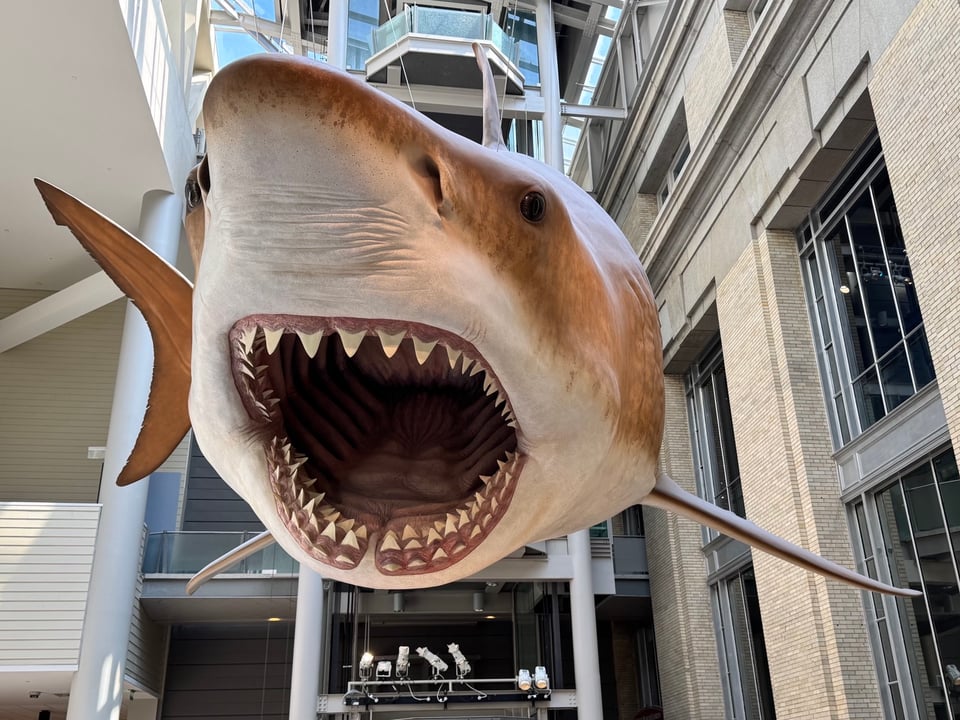
I don’t mean the dog days humidity that has me sweating even before I’ve toweled off from the shower. I mean that I’m getting deep into writing my next book, the life story of the biggest shark that’s ever lived.
Story comes first. It’s not a book, otherwise. I mapped out the life of MEGATOOTH’s central shark from beginning to end, an outline based upon what I already knew. But now I’m fleshing out each of the scenes, and sometimes writing a single paragraph requires that I go sifting for clues to answer questions I didn’t expect having.
The scene I’ve been brushing out this week involves an Odobenocetops. Imagine a beluga whale with walrus tusks and you’ve got the idea. I’m sorry to tell you that he’s not going to make it. While grubbing around on the bottom for clams, he’s going to become shark chow. I’m not going to simply say so like I’m writing a pulp novel like Carcharodon, though. I’m using the moment to talk about undersea senses.
I’d thought of our megalodon sensing the whale some ways off, a faint bioelectric hum that becomes clearer as the shark gets closer. But wait, I told myself, I don’t even know how far that sense extends. Sharks are famously, amazingly sensitive to electric fields and even have a network of specialized pores called the ampullae of Lorenzini to detect bioelectricity. I tried to imagine what it might be like to sense the ocean through such a unique system, the waters alive with life. But if I got it wrong, it would be a howler. I put on the brakes and went looking. Turns out that the bioelectric sense sharks use to pinpoint prey? It’s really only effective for about three feet or so around their heads. The sense is more like whiskers on a cat, useful for aiming beautiful jaws at swimming prey that the shark cannot see while biting.
I didn’t want to lose the scene, though. Learning more about Odobenocetops helped. The whale was a distant cousin of today’s belugas, chubby dolphins that scoop mollusks out of silty bottom waters and suck the soft parts out of the shells. But while belugas can use narrowly-directed echolocation to detect meals in the sand, Odobenoceratops skulls suggest the ancient whales lacked the wobbly cranial “melon” that’s important to the beluga’s sonic abilities. Paleontologists hypothesize that Odobenocetops may have instead had bristly whiskers to feel out shells. While foraging, the whale would have been head down and its visual field obscured by clouds of silt kicked up while pursuing clams. A murky enough scenario to let a hungry megalodon sneak up, and for me to contrast the sensory worlds of the mammal and the shark.
I love these moments. I love being a little bit wrong, or finding a challenge to what I originally thought. If this were fiction, I could have plowed right through and wrote something that would have had marine biologists tsk-ing. (Not that I’d want to, just could have.) But science is the skeleton of MEGATOOTH, same as it is in Tyrant Lizard Queen. Sometimes a little constraint makes the end result better. Now, with a better understanding of what the sensory worlds of whale and shark were like, the big fish can feed.
Subscribe nowScribblings
I’ll be in Plott Hound! My story “The Shearing Edge” will be in the anthology’s summer issue, bringing Warrior Cats and Secret of NIMH vibes to Jurassic dinosaurs.
I’m tired of seeing AI slop dinosaurs. This week’s I Want My DinoTV is all about why paleoart requires humanity to get anywhere close to accurate.
One of the earliest known ichthyosaurs was pregnant with at least 11 offspring when they perished. The find might offer new clues to how the “fish lizards” were so successful in Mesozoic seas.
Tyrant Lizard Queen is coming out soon - less than three months! - and so I thought I’d share a snippet that didn’t make it into the final book. It’s a sweet scene that didn’t quite fit, but I still hold close to my heart.
Stomping to a City Near You
If you couldn’t make the July event, on August 25th I’ll be back at Snug Books for a little nonfiction book club make-up session. Bring your questions about When the Earth Was Green, and I’ll be happy sign whatever books you bring!
We have a T. rex! tour. When Tyrant Lizard Queen reaches you on October 27th, I’ll kick off an East Coast book tour to talk about Snaggletooth and her story. Here’s where I’ll be stopping:
Launch day! October 27th I’ll be at the central Enoch Pratt Library in Baltimore.
October 28th at Scrawl Books in Reston, VA. This is a trivia night event, so make sure you’re ready for dino questions!
November 4th I’ll be in Lewes, DE at the public library for a joint event with Browseabout books.
November 5th I’ll be at Hive Mind Books, NYC!
November 6th I’ll be at the Harvard Bookstore in Cambridge, MA.
December 2nd I’ll be at the Natural History Society of Maryland in Baltimore.
If you’d like me to do an in-person or virtual event closer to you, encourage your local museum or library to get in touch.
Ear Perks
Fieldwork is critical for paleontology. But the field has become so contentious and unequal that early career researchers aren’t getting the experience and opportunities needed to uphold the science. A new study in Ecology and Evolution provides some data to back up the widespread feeling that change is very much needed, and how to accomplish it.
I feel like the latest update to Jurassic World Evolution 3 is directly targeted at me.
The Wrong Girls looks like Love Lies Bleeding meets Cheech and Chong. Can’t wait.
