Friday Fragments #25
Excuse me but that Mesozoic mammal was *how big*?
The fossil record is incredibly, maddeningly, cruelly incomplete. It’s hard not to have a wish list. The perfect skeletons of baby dinosaurs that must be somewhere. The tracks and traces that would leave no doubt over long-contested prehistoric behaviors. The sorts of fossils that would tell us so much if we could just find them.
Sometimes wishes come true.
Back in 2019, we met Lisowicia. The big beast wasn’t a mammal, but an earlier form of synapsid. The elephant-sized, beaked, tusked herbivore lived during the Late Triassic, around 205 million years ago. Such creatures were thought to have largely disappeared by that time, and yet here it was - far larger than anyone expected for a time when dinosaurs were supposed to be ascendant.
It made me wonder what else might be out there. If protomammals could reach startling sizes in the Mesozoic, what about the strange, varied, and fuzzy mammals?
Most known “mammals” of the Mesozoic are technically mammaliaforms, a broader group from which the common ancestor of all today’s mammals emerged. They filled an incredible array of niches during the Mesozoic, from squirrel to otter to aardvark to sugar glider to badger and more. Mammaliaforms were so widespread and prolific that these beasts, rather than dinosaurs, more forcefully shaped the history of our direct mammal ancestors. And it seems that some mammaliaforms were bigger than anyone expected.
Paleontologist Pedro Victor Buck and colleagues have the details.
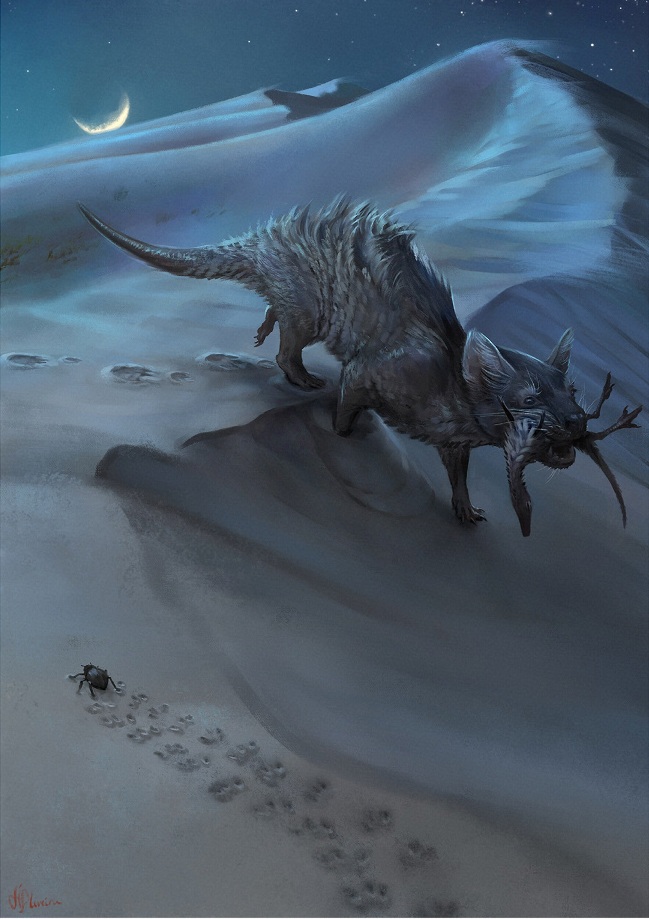
Let me just set your expectations a little - the tracks don’t indicate a mammal of Lisowicia- or elephant-stature. But the tracks found in Brazil’s Botucatu Formation are still remarkably large for an Early Cretaceous mammaliaform when the stereotyped image of such animals has been small, snuffling things, far beneath a pound in weight. The Botucatu tracks are more than twice as wide as the next-largest mammaliaform tracks from the entirely of the Jurassic and Cretaceous, more than five inches across. That’s comparable to tracks left by large mountain lions today. Based on the body proportions of mammaliaforms, and noting that this figure is very tentative, the authors suggest the Botucatu tracemaker was about five feet long.
Huge mammals lived alongside dinosaurs. The wish was fulfilled in the Mesozoic but I couldn’t have known until now.
I want more. Maybe the bones are out there. Other tracks very likely are. And the Mesozoic is a long time, after all. How many times, and in how many places, did mammals and their relatives become much larger than ever expected?
As much as we love the Age of Dinosaurs, it is absolutely strewn and cluttered with narrative expectations. Ever since Mesozoic beasts were found in the same rocks as dinosaurs in the 19th century, the stock narrative has been that dinosaurs kept mammals small and traumatized through the Triassic, Jurassic, and Cretaceous. But dinosaur experts - often loudest in the room - so often forget that most mammals alive today are small. Think mouse-sized. By diversity or by biomass, most modern mammals are very small and had a better chance at preservation simply by being so numerous. Not to mention that mammals may have favored forested or more closed environments away from the more waterlogged habitats that accumulated dinosaur bones - especially since we now know many large, durable dinosaurs bones sat exposed for days to years before being buried.
I’m not at all suggesting that Mesozoic mammals came in the vast array of body sizes we see today. That wouldn’t even be true for most of the Cenozoic. What I’m saying is that our narrative that all Mesozoic mammals were small, subordinate creatures that squeaked out a living alongside dinosaurs until the asteroid hit is wrong - and now demonstrably so. Some mammals did grow to impressively large sizes. We really should be looking for them, what a mammal’s-eye view of the Mesozoic might have been outside our crumbling underdog fable.
Scribblings
Prehistoric creatures aren’t the only ones I love. In Lilac Peril’s second issue, IDOLS, I’ve got an essay on why the slimy, toothy, hissy xenomorph queen is my icon, my idol, a monster after my own heart. You can check it out and pre-order the issue here.
An incredible fossil site in New Mexico demonstrates that canopy-covered forests full of angiosperms were thriving about 10 million years before the asteroid impact at the end of the Cretaceous. On my blog, learn about a significant change to the narrative of plant evolution - a mini update to When the Earth Was Green.
Stanley and the Dinosaurs has a simple message about creativity and individuality. But the stop motion short also raises the question of why we so seldom ask “What would the dinosaurs want?” My latest for I Want My DinoTV.
One of the earliest known ichthyosaurs was preserved with a litter of nearly a dozen fetuses. The find raises the possibility that the “fish lizards” had variable numbers of offspring, a potentially potent secret to their Mesozoic success. Check out this week’s new article!
Stomping to a City Near You

If you couldn’t make the July event, on August 25th I’ll be back at Snug Books for a little nonfiction book club make-up session. Bring your questions about When the Earth Was Green, and I’ll be happy sign whatever books you bring!
East Coast tour dates for Tyrant Lizard Queen are starting to come together! On October 27th I’ll be at the central Enoch Pratt Library in Baltimore, on November 4th I’ll be at the public library in Lewes, Delaware, with dates to come for VA, NY, and MA.

Ear Perks
I started Mina the Hollower yesterday and I’m already hooked. It scratches much the same itch as Hollow Knight, but in lavishly-pixelated, chiptune banger glory.
I’d better finish Mina soon, though, because xenomorphs will once again by slithering and bursting across my computer monitor by the end of August. ALIENS: Fireteam Elite was a lot of fun, but 2 is looking like another level of intense. I want it.
Liverworts have been around a long time, but we don’t know much about how fossil forms from the deep past compared to those alive today. Cretaceous liverworts found in Las Hoyas, Spain, preserve two different growth forms of the plant - a first in the fossil record - and narrow down where the liverworts were growing. Most likely? Among rocks, a habit technically called saxicolous.
