Friday Fragments #22
Gus the T. rex was sold at auction. What responsibility do museums carry for bolstering the fossil market?
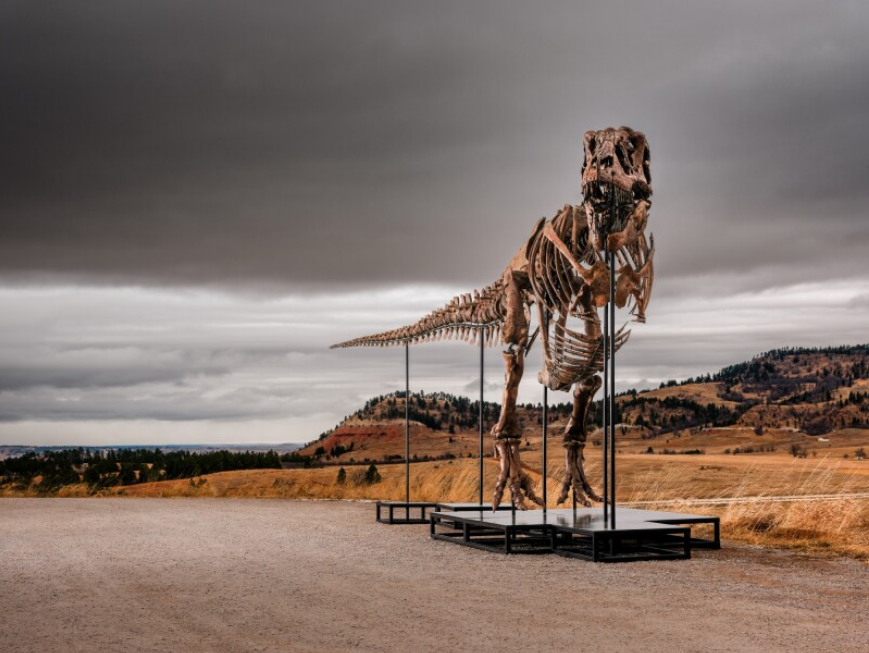
We need to talk about Gus.
When I heard about the remarkably-complete tyrannosaur’s impending sale, I didn’t know what to say. I didn’t know what to say that I have not said dozens of times before in response to auction after auction after auction, the commercial fossil market pushing prices ever higher. Billionaires are obsessed with dinosaurs as status symbols, carrying on the tradition of Andrew Carnegie making Diplodocus his personal herald. These are not the kind of people who are going to be open to the idea that funding science, museums, and students is better for all concerned. They want to own a dinosaur. US law will not stop them.
T. rex is a case study all by itself. Most significant Tyrannosaurus - and likely Nanotyrannus - skeletons are privately and commercially owned. The fact that Gus sold for tens of millions is sad. But it’s not shocking. Not when even museums and paleontologists bolster the commercial market.
“That belongs in a museum!” has long been a common chorus in arguments over important fossils sold to private buyers and put up for auctions where only the disgustingly-rich can afford them. It hasn’t worked. Nor have appeals that such fossils should be donated to museums or that billionaire money would yield so much more if it funded science directly. Not that any of these points are wrong. They just don’t mean anything to the sort of people who would think of buying a dinosaur in the first place. And ever since the Field Museum cooperated with McDonald’s, Disney, and other funders to buy Sue, museums have helped perpetuate the very market that prices T. rex so exorbitantly.
For most museums, the argument that no one has $50+ million to spare for a single dinosaur is true. And yet the Field managed to buy Sue and the North Carolina Museum of Natural Sciences gathered an undisclosed sum to purchase the “Dueling Dinosaurs.” Museums themselves have undercut the argument that dinosaurs at auction are impossible to obtain. If we look more broadly, the American Museum of Natural History entered into an agreement to display the Stegosaurus Apex even though the fossil is privately owned and can’t be published on, and some paleontologists such as the Field’s Jingmai O’Connor have questioned the call to halt the purchase and study of “blood amber” fossils that fund genocide through the black market. Getting more specimens described is treated as the more important goal, and that should absolutely be questioned. Even though organizations such as the Society of Vertebrate Paleontology put out statements against the high-profile sales of fossils like Gus (as well as the blood amber market), the museums and vertebrate paleontology community do not speak with one voice on this. Often, it seems as if purchasing fossils is perfectly acceptable as long as it gets fossils into museum care - with little thought to how such purchases perpetuate the very market that’s made dinosaurs collector’s items for the 1%.
I would love the United States to adopt natural history heritage laws like those instituted by many other countries, with an eye to also repatriating fossils from other nations held here. It would be a vast effort of decolonization. I don’t think I’ll see it in my lifetime, and I doubt it’ll be top-down. The places dinosaurs like Gus come from are stolen lands that carry a great deal of pioneer, anti-government, and conservative sentiment, a remarkable dinosaur skeleton treated the same as an oil strike. Any attempt to legislate a change to the state of fossils on private land will practically be a non-starter without forming local support. I have to wonder if fossiliferous states with greater enthusiasm for environmental and historical protections - perhaps California, or Colorado - could draw up state law requiring significant fossils to be held in the public trust, beginning an effort to copy paste such ideas to other states. Then we could at least start to build and prove an alternative to the current free-for-all on privately-held land.
But even that is still getting ahead of things. We need paleontological consensus and accountability. Some institutions and experts seem to be speaking out of both sides of their mouths, sliding back and forth between what is legal, what is ethical, and what is actually helpful for the science. I do hope Gus (and other privately-held fossils) end up at museums without a scratch on them, but getting fossils to museums cannot be the only goal. History and avarice have led us to a terrible system in which dinosaurs merely mean dollars - whether in a landowner’s pockets or in museum attendance to see hyped specimens. It’s time to get out own house in order.
Want more fossils in your inbox?Upgrade your Boneyard subscription
Scribblings
Legend of Dinosaurs and Monster Birds doesn’t have any dinosaurs in it. But that raises the question of how we explain to the public what a dinosaur is. I consider the puzzle in this week’s I Want My DinoTV.
Who would want to eat a blastoid? Apparently some ancient fish tried. Go over to my blog if you want to learn about bite marks.
Synapsid cloaca! Right on the tail of the first dinosaur cloaca ever found, we now have a vent impression from a protomammal. A new one for premium tier subscribers!
Stomping to a City Near You
Tonight! I’ll be at Solid State Books in DC to talk to John Wiswell about his lovely new book The Dragon Has Some Complaints. (Careful in the smoke if you come out.)
On July 28th I’ll be joining the Snug Books nonfiction club to talk about When the Earth Was Green. You can grab tickets for the event here.
East Coast tour dates for Tyrant Lizard Queen are starting to come together! On October 27th I’ll be at the central Enoch Pratt Library in Baltimore, on November 4th I’ll be at the public library in Lewes, Delaware, with dates to come for VA, NY, and MA.
Vox has launched a new podcast called Unexplainable, and I’ll be in next week’s new episode on Netflix! I was so thrilled to talk about trace fossils for a while.
Ear Perks
Back in 2023, I wrote an article about the snake clitoris. It’s still one of my favorites.
If you know mammal evolution, you know the importance of the tribosphenic molar. A new study in Science looks into how that shape led to dental specializations among Cenozoic beasts.
Sorry but my fixation on 80s music and movies is just going to continue.
