Friday Fragments #20
What in the world is going on with this horse's face?
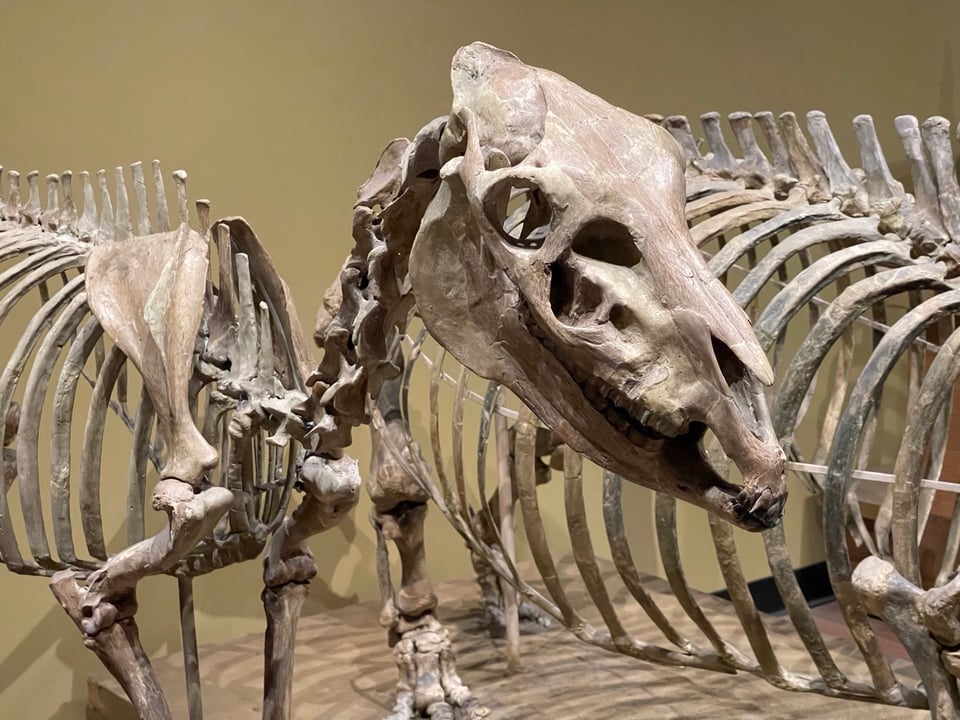
I don’t know what’s going on with this horse’s face.
No one else does, either.
The preorbital fossa of Pliohippus has been a paleontological head-scratcher since the horse was named in 1874. That’s the weird cavity in front of the eye socket and behind the nose, just above the cheek teeth. Modern horses had been thought to lack any such structure, and, while other fossil horses have some sort of divot in the same spot, it’s not nearly as pronounced.
Bizarre structures often seem to call for exceptional explanations. Perhaps the fossa held some sort of gland, oozing substances relevant to the Miocene horses. Or perhaps it enclosed an air sac, some open and resonant space to make incredible snorts and whinnies and roars. The horse just looks so different, and so must have been doing something different, right? But perhaps fixating on function obscured what was there all along. Modern horses have a remnant of preorbital fossa.
Last year, paleontologists Nikos Solounias and Sarah Gerard took a detailed look at the preoribital fossae of both extinct and living horses, assessing how this anatomical peculiarity expresses itself and varies. As it turns out, modern horses have the indentations after all - shallow bays just under their nasal bones, with internal components with a specific anatomical point, the tholos, representing the ancient border of what’s seen in fossil horses. Among modern horse foals, before they get their iconic long faces, the tholos develops right where the preorbital fossa is expected to be. Modern horses have the remnants of what we see so elaborately presented in the skulls of Pliohippus and kin.
So Equus exists on a continuum with extinct horses, connected by remnants of what was thought lost. (It’s happened before.) But what did these cheek pockets mean for the ancient horses?
We still don’t know for sure. The pockets weren’t sites for muscle attachment. The bone is too thin and muscles threaded over the area rather than pulling on the fragile spot. The gland hypothesis is still in play - perhaps in more closed, forested habitats early horses relied on scent more often to communicate and find each other - as is the idea that this was some sort of resonating chamber. Perhaps an exquisite fossil will show us someday. But Solounias and Gerard have an idea for why modern horses don’t have such deep or prominent scoops on their muzzles.
Modern horses are grassland runners, grazers that most often move on open ground. Earlier horses thrived in forested and woodland habitats, eating softer food on squishier ground like tapirs do today. The changes to the preorbital fossa may have been a matter of buttressing the skull, providing expanded space for teeth, masticating muscles, and other features needed to keep a skull healthy through all the repetitive chewing of coarse, dirty grasses and low-growing plants. The unusual fossae in fossil species may have been essential to parts of early horse anatomy, and behavior, that were modified away as our modern horses changed with Earth’s environments.
What must it have that been like, in the days before the grasslands spread, to be deep in the humid thick of plant life, watching a horse sample the juiciest leaves, maybe leaving a honk or scented calling card to tell the other horses it’s there?
Want to support original science writing?Upgrade to get the good stuff!
Scribblings
I’m a sucker for sabercats, so I couldn’t resist writing about a pretty kitty found in a museum cabinet. Last week’s new paleo piece, free on my blog.
Tiny amphibian fossils rewrite what we thought we know about how tetrapods emerged on land. Turns out, our fishy ancestors didn’t go through a multi-stage metamorphosis like frogs do. Baby fishapods were born closer to smaller adults, altering what we understand about when and how life got cozy away from the water. My latest, for premium subscribers.
You know how every new dinosaur movie brings up discussions and debates around accuracy? We’ve been doing this since the 1950s. In the latest I Want My DinoTV, I pull some lessons from the reaction to The Beast From 20,000 Fathoms. Monday’s dino media posts are premium exclusives, so sign up if you want in!
We’re less than four months away from the release of Tyrant Lizard Queen! (It even got a shout in Publishers Weekly.) Hardback, ebook, and audiobook will all be available at launch, and pre-orders help books a great deal. If this is one you know you want to read, ask for it at your favorite bookseller and library.
Stomping to a City Near You
On July 17th I’ll be at Solid State Books in Washington, DC to help hype the crowd for John Wiswell’s new book The Dragon Has Some Complaints! If you like dragons, dinosaurs, and dinosaur-like dragons, you’ll want to come.
On July 28th I’ll be joining the Snug Books nonfiction club to talk about When the Earth Was Green. You can grab tickets for the event here.
East Coast tour dates for Tyrant Lizard Queen are starting to come together! On October 27th I’ll be at the central Enoch Pratt Library in Baltimore, on November 4th I’ll be at the public library in Lewes, Delaware, with dates to come for VA, NY, and MA.
Ear Perks
Kazoo is growing up so fast! But of course she’s still very much a sweet, purring baby who puts her teeth on my nose to tell me it’s time for breakfast.
I spend a lot of time thinking about what it would be like to be other organisms. The amazing Lee Mandelo does the same, in a different fashion, in Feed Them Silence - a wonderful, searing novella I very much recommend.
I tore through Katherine Cross’ Log Off. Posting isn’t praxis, and often it gets in the way of spending more time creating real community offline (in addition to making us fight each other all the time). Cross’ essay looks at how social media exploits individualism, especially of the American sort, and offers an important reminder to find connection away from Bluesky, Insta, TikTok, or whatever app eats our time to leave us awash in performance and advertisement.
Movies are often my wells of inspiration for my books, and working on MEGATOOTH took me back to the Terminator films. This track, from the club scene in the first film, has been playing in my head all week.
