Friday Fragments #19
If science writing is going to have a future, it has to evolve.
Science writing is in trouble.
It has been for years now. When I started burrowing into the field, around 2011, the field had been searching for relevance as print was shredded by digital. The 90s had seen the science writing bubble pop. Magazines like OMNI vanished while there seemed to be little appetite for the kind of pop sci pontificating that made the careers of Stephen Jay Gould, Carl Sagan, and others. Who do you know still reads Natural History?
Blogging was a shafted light of hope. Even through the rise of what we used to call microblogging - Twitter (RIP), Facebook, Instagram, Snapchat, Tumblr, and more ascendant - blogs opened new channels of scientific communication between researchers, journalists, and the public. It’s what allowed a college dropout like me to develop my skills and create a career talking about old dead creatures with impressive teeth.
But science blogging, too, was too good to last. For many years, I paid my monthly bills by mixing blogging, book writing, and freelancing. I blogged for Smithsonian Magazine, WIRED, National Geographic, and Scientific American, hopping from one to the next as the professional landscape shifted. But even that’s ancient history. Over time, concurrent with the riptide pull of video, blog traffic dipped. What magazines saw as a bargain - expert writers turning out articles and commentary on what’s new in science for cheap, compared to freelance rates - was no longer bringing them the return they hoped for. Magazine-supported science blogs effectively went extinct, science writing shifting back to a more professionalized model where journalistic articles, longform essays, and books became its central expressions.
The landscape is buckling again. In 2023, Popular Science collapsed and stopped putting out a magazine. The same year, National Geographic laid off its last staff writers. Even publications that still exist and used to have vibrant science coverage, such as the Washington Post and CNN, have largely abandoned reporting science. There is a glut of suddenly out-of-work science writers in a shrinking pool, just as fewer publications are offering less work at stagnant rates. The pressure’s on.
Now Scientific American has been sold off, a “union-busting” move that may have also stemmed with higher up fears about public repercussions from the Trump administration - a bizarre fixation on appeasing fascists already marked by the magazine’s firing of former editor-in-chief Laura Helmuth in 2024 for daring to express emotion on Bluesky.
Science journalism still exists. I’m still writing assignments for multiple magazines, and publications oriented towards scientists and science journalists like Stat, UnDark, Quanta, and others continue to roll along. Hakai, which closed in 2024, morphed into Biographic, now trying to find new life as an independent nonprofit. But I’m not feeling hopeful.
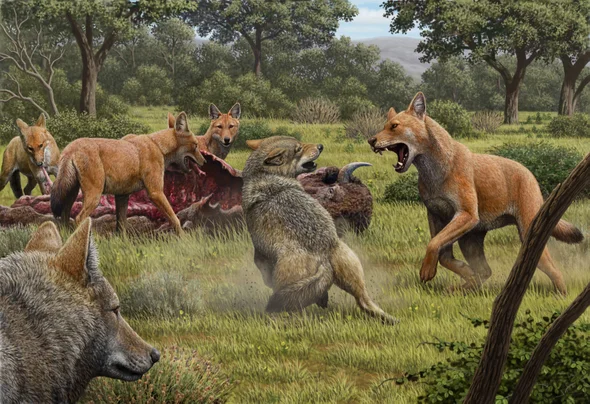
It’s becoming harder and harder to believe that science journalism, and science writing more broadly, is going to have a resurgence. There’s no single reason. Video’s hamstrung reading. Our smartphones and the apps on them are made to be addictive, fragmenting our attention spans to the point that it feels like an ask to get someone to read 500 words on a new discovery. I’ve heard from more than one editor that dinosaurs don’t get the numbers they used to, that the need right now is for big, exclusive, guaranteed-hit stories to drive pageviews and subscriptions. But it’s impossible to predict what’s going to hit. The dire wolf article I reference at the top is an example - I pitched the story, took a lower-than-usual rate at the time to write it because my editor wasn’t sure whether people would be interested, and the story rocketed to the top of Scientific American’s most-read list that week. (I’m often contractually barred from getting any royalties or bonuses when my articles do well for a publication.) Everyone seems desperate for a sure solution and it just doesn’t exist, as the available science publications draw further and further back from speaking to the public and instead are becoming trade publications mostly of interest to people already-invested in science.
I’m not sure we’re ready to meet this moment. Even though blogging was a successful experiment for over a decade, publications and writers were just getting into them as the public was moving to other forms of communication. I’ve seen the story continue to play out, science writers and publications arriving late to where the conversation is happening and wondering why the same approaches are not working. And so the cutting starts, deeper every time, leaving me to wonder what’s going to be left in another year. Almost every day for months now, I carry the small panic that it could be next month, next week, that there’s just not going to be enough to go around and I won’t be able to cobble together enough to keep writing as a career.
I wish I had a solution, or even a plan. Because I don’t think pivot to video is a silver bullet. I love seeing so many video-versed science communicators doing more with the medium, whether artistic, journalistic, fanatic, or whatever. But writing is its own art, and it’s especially suited to expressing the nuances we so often need to keep in mind when in conversation with science. Writing forces us to slow down a little. It makes room for metaphor and analogy. It invites readers to see things in their own imaginations in a way that charismatic narration and dazzling visuals just cannot do.
What I fear is that we long ago lost the struggle to get the broader public to value writing as something worth paying for. It rankles when I hear people bemoaning paywalls, that information about science should be free, as if the people doing the work behind those articles are just information-generating machines that should work on demand. And especially in the dire economic situation the U.S. continues to suffer due to the foolishness of our politicians, asking people to pay for what seems like an educational luxury is a very hard pitch to make. Especially when we are exhausted from the intentionally-inflicted fatigue that fascism uses to steamroll itself to greater power, it’s hard to blame anyone for having priorities other than a sustainable future for science writing.
I’m not sure how we meet this moment, or what’s ahead. You know that moment in The Thing when MacReady is talking into the tape recorder and says “Nobody trusts anybody now, and we're all very tired”?
I think it’s going to take many people trying many different approaches and seeing what sticks. Even looking at my own work, it strikes me how my narrative books - essentially novels informed by science - took off while my previous, more traditional science books never quite resonated with a broad readership. Perhaps science journalism, the news of what’s being found out today, is going to be best suited for the world of video and podcasts. But science writing as its own form of expression, I think its possibilities can still find connection through the poetic, literary, critical, and fantastical. Some people are already making these spaces. Starlog is coming back, helmed in its new form by Annalee Newitz, and I’m proud to have an article in the first issue. Get excited now, because we can certainly use some hype for projects like this.
I hope science writing can send its roots down a little deeper. I want there to be opportunities for other voices like mine, perspectives that come from places outside the jschool, staff-focused route that’s become over represented in the field. It’s not something we can assure only by writing well or sniffing out the most stunning stories. We need to be in greater conversation with the public and the people who care. Maybe the problem is not one that can be solved with a business strategy so much as a different stance, a different relationship. For my own part, I’m scared but I’m still moving. And if you know me at all, you know I’m not afraid to mutate.
Support original science writingUpgrade to keep this newsletter going
Scribblings
Tyrant Lizard Queen is coming out in four months, and it’s a great time to pre-order a copy! Bookshop.org is doing an anti-Prime Day sale with free shipping sitewide through the end of the day, and Barnes & Noble is on their last day of another pre-oder sale. If you’re a premium member or sign up for their rewards, you can get 25% off Tyrant Lizard Queen with the code PREORDER25 at checkout.
If you didn’t read the above - I know, it’s a lot - I’m proud to say I’ve got an article in the first issue of Starlog! It’s not out until the fall, but the magazine can use all the support it can get so get subscribed early. I can’t say what my piece is about yet, but I can tell you it includes some amazing creature art from Emma LeRae.
For the latest iteration of I Want My DinoTV, I had a look at a classic documentary about the Dry Mesa Quarry. Stunning fossils. It’s a shame they were sent to a religious school that discriminates against queer students.
Sometimes the most amazing fossils are already resting in museum collections, waiting for someone to ask the right question. An early sabercat is one such example, a misidentified skull providing new insights into the many ways there were to be a sabertoothed carnivore.
Last week’s article for premium subscribers, about Miocene thresher sharks that behaved like great whites, is up for free on my blog. Sign up for the premium tier to get articles like it first!
Stomping to a City Near You
On July 17th I’ll be at Solid State Books in Washington, DC to help hype the crowd for John Wiswell’s new book The Dragon Has Some Complaints! If you like dragons, dinosaurs, and dinosaur-like dragons, you’ll want to come.
On July 28th I’ll be joining the Snug Books nonfiction club to talk about When the Earth Was Green. You can grab tickets for the event here.
East Coast fans, I’ll have some book tour dates coming soon. Current stops include Baltimore, MD; Lewes, DE; NY, NY; and Cambridge, MA. Stay tuned.
Ear Perks
In When the Earth Was Green, I wrote about how forests thick with angiosperms primarily appeared after the K/Pg mass extinction. A Cretaceous site in New Mexico alters the story - dense forests of flowering plants were present before impact, perhaps beginning relationships with mammals that allowed both groups to prosper in the Paleocene.
Crinoid tube feet! Soft tissue preservation is hard to find among these animal cousins of ours - and honestly invertebrate fossils could use some more love.
Just as I was writing this newsletter, my phone told me that Blood Surf had been delivered to my door. It’s a 2000, direct-to-video killer croc movie that takes a wild premise - surfers who bleed into the water to attract sharks - and turns it up with a giant, ravenous saltwater crocodile designed by sfx legend John Carl Buechler (remember Carnosaur?). So, that’s my afternoon set.
