The Elephant within
In our second interview on Adult Swim's The Elephant, Remus & Kiki tell us about their work on the special's middle segment.
by Kambole Campbell

The second act of The Elephant shifts from a strange and abstract cyberpunk dystopia to something more adjacent to the past: both parts pulling from the 1980s in different ways (parts in act 1 reflect the sparkly but fraying technodystopia of Akira). The main character, a silent protagonist, wrestles with the giant button on their torso: they press it and techno music plays, inspiring a wild party around them. They're desired for this singular purpose, but aspire to more.
For those who haven't yet read the previous send, The Elephant is an animated special released on Adult Swim, produced in three distinct segments, all done in isolation from the other – each unit didn't know what the other was doing.
Act 1 was led by Adventure Time creator Pendleton Ward, the final section by Patrick McHale, creator of Over The Garden Wall. The trick middle act was taken on by Rebecca Sugar (Steven Universe) and Ian Jones-Quartey (O.K. K.O: Let's Be Heroes!) – who recruited London-based Remus Buznea and Kyriaki Kyriakou, who go by Remus & Kiki, to design and co-direct the segment. The pair have been working together since studying at the University of the Creative Arts in Farnham, including their 2014 short "Dateless," produced in their second year, their playfully anarchic and often raunchy work in shorts, adverts, Adult Swim bumpers (and hey look, stickers!) cited by Sugar and Jones-Quartey as the perfect compliment to what they wanted for their segment of The Elephant. The pair sent over some design materials and answered a couple of questions to illuminate the inspirations behind this segment, the glue which holds the other two together.
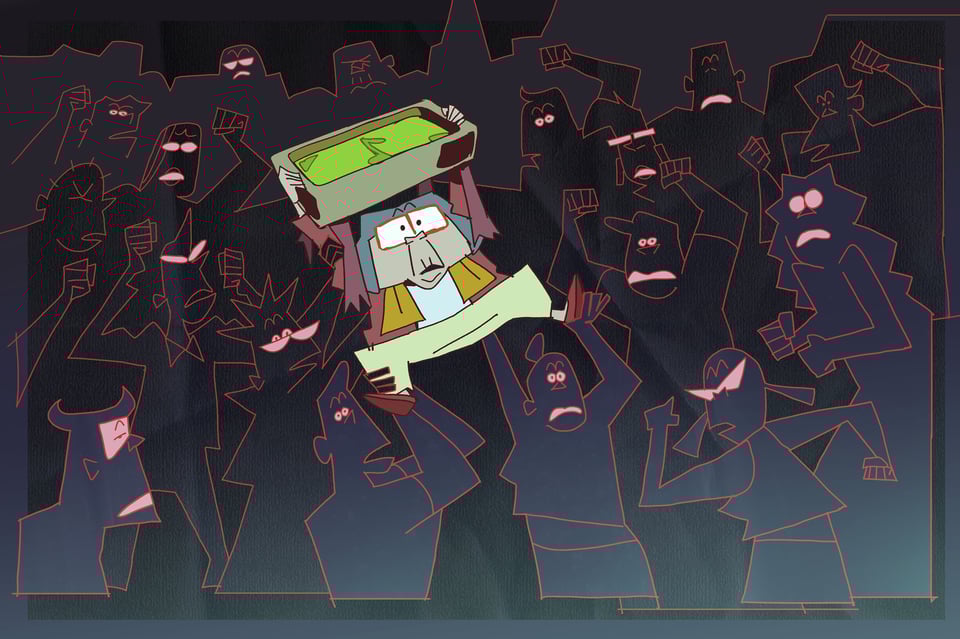
In a behind-the-scenes doc for The Elephant, Sugar spoke about looking at the aesthetics of the '80s punk scene for this segment, as a way to pre-empt what the other pieces of animation might look like. Since this is still a fairly broad descriptor, I was wondering who and what specifically from this subculture you were looking at and remixing for the segment. And what other visual elements were you pulling from?
Remus & Kiki: When Rebecca & Ian brought up the '80s punk scene as a reference point, we saw the parallels between the 'exquisite corpse' concept and the DIY, stitched together aspects of punk aesthetics. Rebecca specifically pointed to punk zines, so we dove into some online archives and pulled out print textures and collage elements to occasionally use in our BGs.
We leaned on the paper cut-out approach for the crowd scenes as well, with a secondary goal of being economical: we could get away with less colors and movement, which gave us more time to focus on the mob-blob design itself.

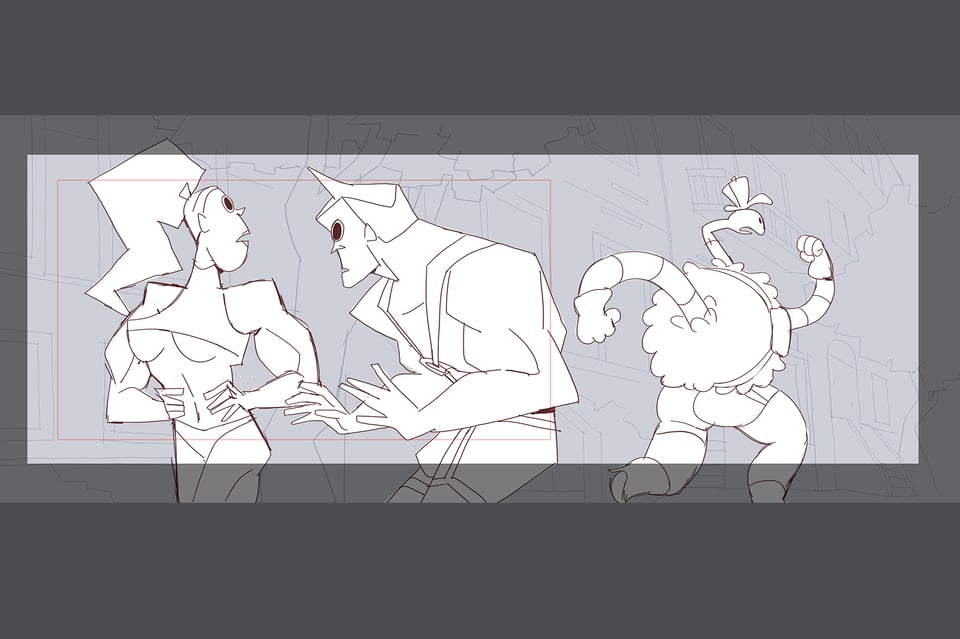
I was told by Pendleton Ward that the initial character drawings (as well as a handful of designs later on) were done through the exquisite corpse game also . What about that improvisational approach did you adopt in your own design work?
Since the project had all these mysterious elements (we didn't know anything about the other segments), we focused on staying the course and delivering on the intentions behind Rebecca & Ian's script and Jeff Liu's animatic — improvising didn't really occur to us.
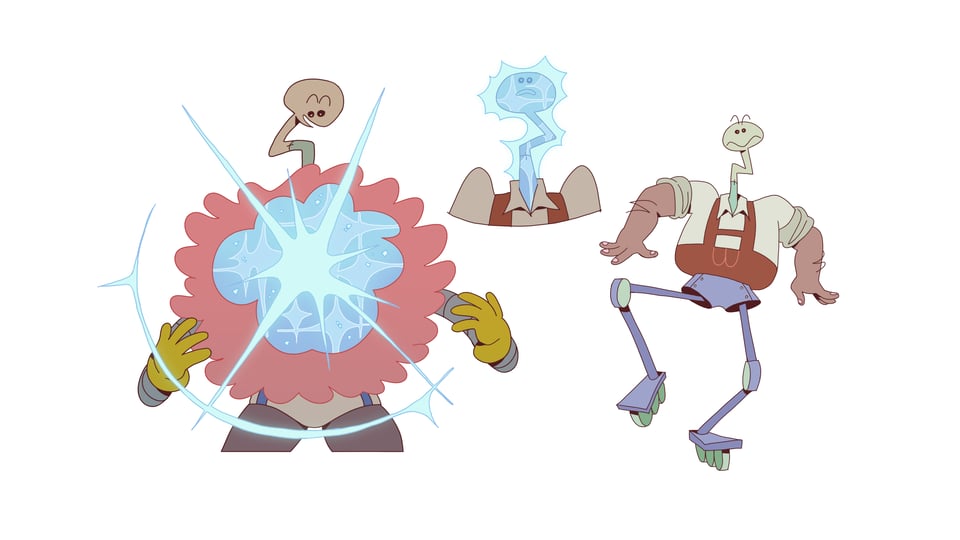
That being said, we were still given enough space for our own interpretation: for example, we never imagined the segment as explicitly taking place in the '80s. While Clip and Tutu's designs have obvious punk inspiration (we used a lot of Debbie Juvenile in Tutu's design), there's a mish-mash of eras when it comes to the other characters which were already present in the storyboard sketches. We thought this made sense, so we pushed it further along: the body-builders are '90s ravers, some club-goers look like '70s disco, the man dancing on the street has a zoot suit/Scatman John thing going on etc.
Tune in again next Tuesday for our third and final interview for The Elephant: with Over the Garden Wall creator Patrick McHale! Happy holidays!