Th3 3l3phant
Our third and final interview on The Elephant is a discussion with Patrick McHale about collaboration and tying together invisible plot threads.
by Kambole Campbell
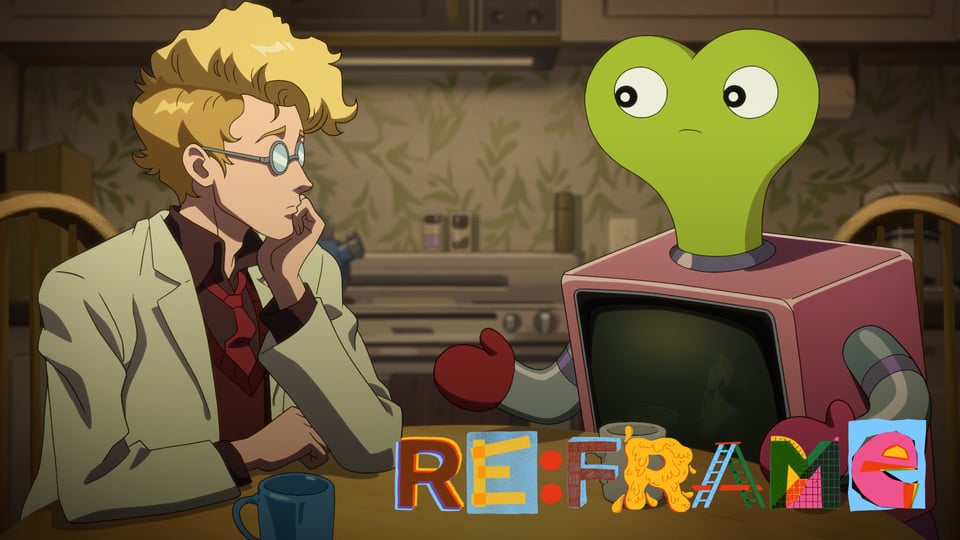
The final part of The Elephant – the legs in the exquisite corpse drawing, as production put it – had to bring things home thematically for two stories which segment director Patrick McHale (creator of Over The Garden Wall) hadn't seen. Such anticipation is tricky, but the final stretch of The Elephant ties its ideas together beautifully, and it does this by first expanding the premise just a little bit further.
There are actually segments within this segment, with different directors showing off different stylistic interpretations of the characters, as the unifying premise of the animated short is revealed. It's a journey towards meaning which the audience also shares with the protagonist, who is attempting to find stability amongst constant change. Their journey of reincarnation finally lands them in the body of the robot "Screeno," kicking off a character study between an inventor and his creation, which feels appropriate for a segment which has to make sense of all the wild experimentation which preceded it.
We spoke to McHale about his vision for this segment, how it relates to the rest, and how it was made.
What's your reaction to the other two shorts now that you've seen them? Did you manage to guess at what kind of thing the others would do?
Patrick McHale: They were a joy to watch, and it was a relief to know that it actually sort of held together. With the first two segments, the whole thing feels much more grand and meaningful than I expected.
In order to write the third act, I had to think of as many possible first and second acts as I could imagine in order to make sure my ending worked for anything that might come before. In the end, I was still completely off the mark, haha... but I think the film still holds together in its way. My top guesses for what the other directors were doing were: I thought Pen's segment might take place in a film noir setting (possibly even black and white) and that Rebecca and Ian's segment might take place in a kind of abstract otherworldly location full of other Exquisite Corpse beings. Wrong on both counts.
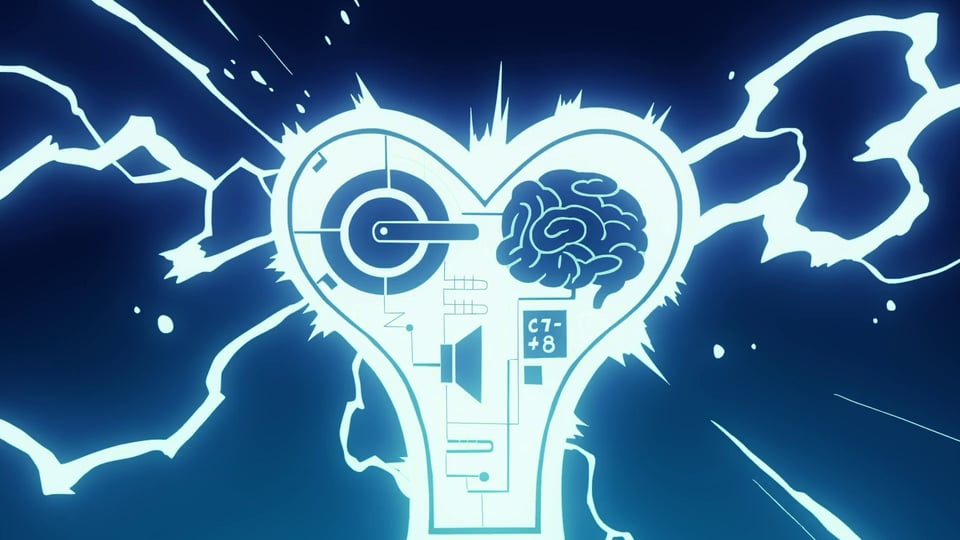
Your segment is the 'legs' in the exquisite corpse – how did that affect how you approached the story without knowledge of where the other segments had been thematically? How do you tie up threads you couldn't see?
Before we started we all agreed on the idea that our main character keeps dying and coming back to life in various forms over and over again. So by the time she gets to the third act she's tired of this endless loop and wants a way out. Since I didn't know what the other segments were doing, I decided to start mine with a quick series of lifes-and-deaths to reestablish that concept before delving into a real ending. It was a sort of safety net for myself.
It was also broken up into a few more pieces than the others, separated into the "Wish," "Bath," "War," and "Archons" stories and sequences as well as "Screeno," the part you storyboarded. What made you want to push further into a wider range of art styles? What were the difficulties in doing so?
As I mentioned, it was mostly for practical narrative reasons, but I also thought it gave some better insight into what our character is dealing with. It was also just sort of fun to surprise the other directors by having the main character unexpectedly die in the first minute or two of my segment. It was fun to play with those expectations.
Actually, I was also a little worried that my work just wouldn't be up to par with the other directors' segments, so I wanted to at least provide "quantity" of style in case I really whiffed it in the "quality" department. But in the end the people who worked on ALL my sequences really knocked it out of the park. Each is really special and unique.
The difficulty of doing so many art styles was that I felt like I was directing a bunch of different films at the same time! It was way more time consuming than a 7-8 minute short should normally be. If it wasn't for Mike Mayfield, our supervising director, and Khang Le, my art director, I would have completely unraveled.
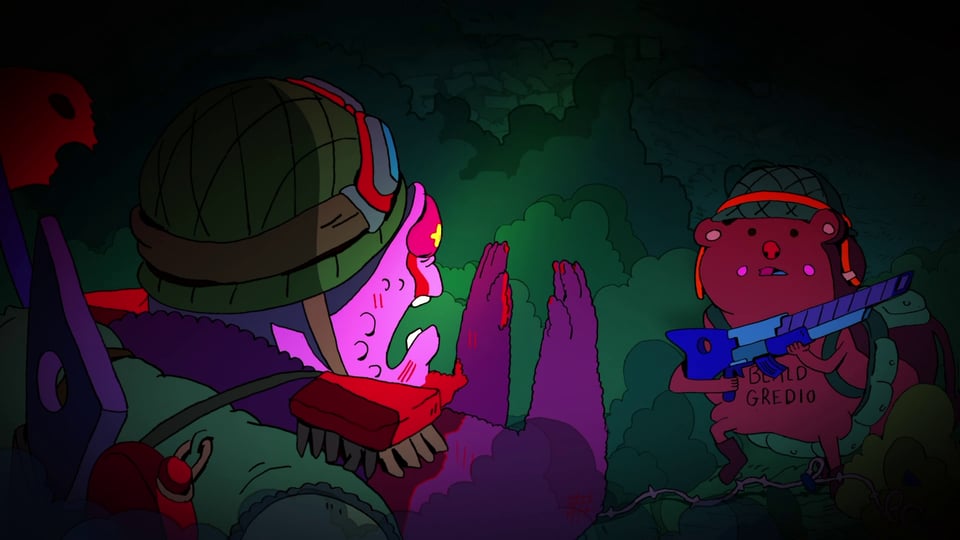
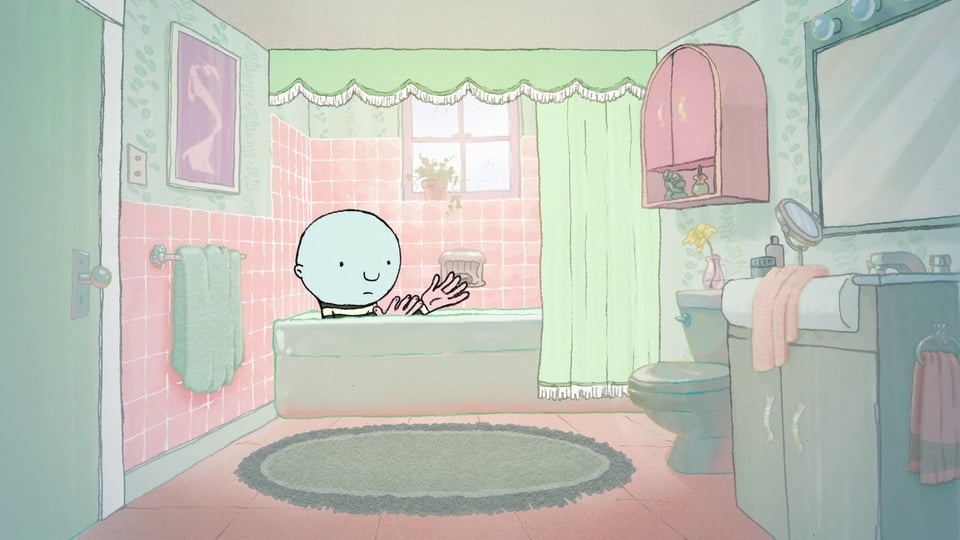
As a follow up to that, I was hoping to hear about how you worked with your collaborators like Somvilay Xayaphone who had a few roles on "Wish," or J.K.'s work on "Bath," Nick DiLiberto's work on "War," Sam Wolfe Connelly & Greg Sharp on "Archons," just to name a few – what discussions were you having about look dev, how did their work compliment yours?
First I wrote a script for my whole segment, and then reached out to various people to work on the different sequences.
I was the last to choose a character design from our initial exquisite corpse drawings, so I was left with the weird multi-armed one for the start of my segment [laughs]. I decided to have Somvilay storyboard and design that part to make sure it all started off funny. He's a good old friend, and one of the best filmmakers in the world, so any time I get to work with him is a joy. It was fun discussing the backstory of the family and hinting at fuller narratives in the props and BG details.
J. K. is brilliant, and I love her acting choices, so I felt she'd be perfect for the simple bath scene. The way she animated the main character's hands touching her face makes me smile every time.
Nick DiLiberto is someone I didn't meet until working on this project, but I was introduced to his work a few years ago and was totally blown away. He animates entire feature films on his own, and they're beautiful. He also made a series of interactive maze books called Wizards Warp that are so fun. Anyway, for his sequence I gave very little direction and just let him run with it and it turned out amazing. Go buy and watch his films and books!
As for Sam Wolfe Connelly, he’s one of my favorite artists – he did the artwork for the Over the Garden Wall soundtrack – and I've always wanted to work with him on something that would bring his artwork to life on screen. So when I had the idea for this mysterious sequence at the end, it seemed like a perfect opportunity to work with him.
And I've been a fan of Greg Sharp for years, since I saw his film "THE FUTURE" back in the day, so he's another person I just always hoped I'd someday get to work with. I was SO lucky he was willing and able to animate the Archons sequence for us. That sequence was so important and I can't imagine how it could have been done without him.
As for the Screeno sequence, I feel like I could write a whole book on all the talent that went into that. I honestly don't know where to even start. But I'll just say that it was especially wonderful to work with Digital eMation again, who also animated Over the Garden Wall. The directors and artists put in so much extra effort to make it feel special. I'm really grateful.
And a special shout out to Janelle Feng who came on for like one week to design some props for the Screeno section, but ended up drawing like a million character poses and really saving the section, in my opinion. She's an incredible artist, animator, and director. Check out her student film "La mort de Robespierre", it's extraordinary.
OK, I guess while I'm listing out important people, I should also really mention Mike Mayfield again. He oversaw ALL the segments of The Elephant, so he was one of the few people who actually knew the full story, and he was constantly doing all sorts of extra work (drawing, painting, compositing, you-name-it) to make the film as great as it could be... in addition to being an anchor in the wild seas of my insecurity and doubt.
I was told by [Pendleton Ward] that the initial drawings were also done exquisite corpse style, as were some other characters which everyone contributed to – was Screeno the same? If so, who added the TV?
I didn't want the other directors to know that our main character would die and come back to life a bunch of times in my segment, so I just did the exquisite corpse game with my family to generate the designs in my extra sequences. My son drew Screeno's head, I drew the TV body, and my wife drew the legs.