One bizarre adventure after another
The long-awaited adaptation of the fan-favorite Steel Ball Run gets off to a running start (before a long pause)
by Kambole Campbell
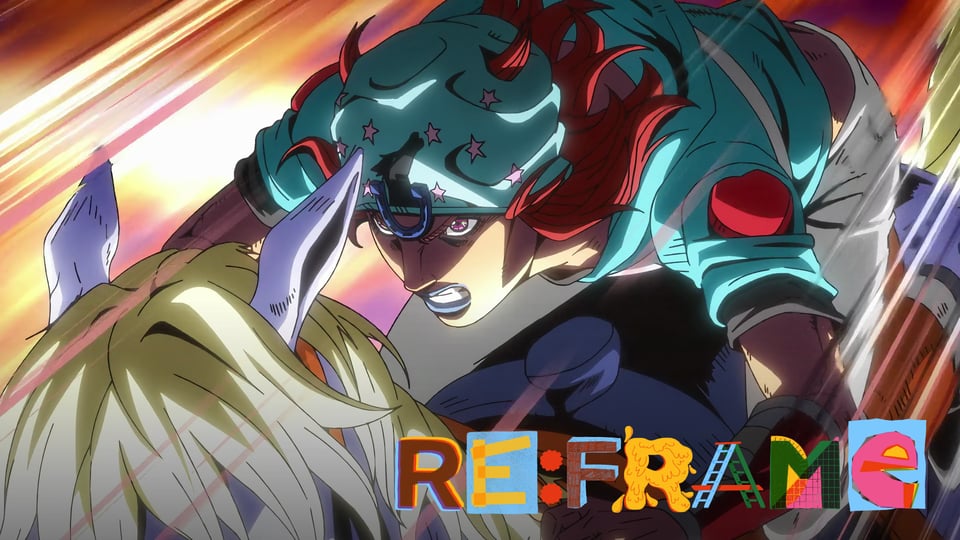
Though JoJo's Bizarre Adventure is probably most famously known for its first couple of seasons telling of a battle between generations of the Joestar family with the vampire Dio Brando, Steel Ball Run is – anecdotally anyway – a fan-favorite story among the manga readers. The adaptation has been a long time coming, then – and the double-length premiere hasn't disappointed.
Steel Ball Run opens in California in the late 19th century, in the 1890s. A massive race on horseback is about to take place, starting from San Diego with the finish line in New York. The cross-country race has a lot riding on it ($50 million) for the racers, though the young Johnny Joestar has perhaps the most to gain.
Once a prodigy in the world of jockeying, he was recently made paraplegic following a gunshot wound, one inflicted after Joestar humiliates a man waiting in line for the theater. Now unable to ride horses, he's desperate to get back to his old life of glitz and glamour, though humbled by the experience. Johnny comes across a mysterious man named Gyro Zeppeli, who has a strange power harnessed by the Steel Balls on his hip, generating a magic power of 'spin' (not unlike the 'Hamon' of the earlier series). It's a principle which quickly allows Johnny to figure out how to ride a horse even without the use of his legs, and so begins a series which I suspect may start to resemble Wacky Racers on horseback.
It's an entirely different world than in the last series Stone Ocean, representing a clean break with the continuity of the first six volumes of JoJo's Bizarre Adventure. It takes place in a sort of new universe, established following the existential terror and reality-shifting stakes of the previous season's finale. There's some continuity: the last series did take place in Florida, and Steel Ball Run's adventure across the Americas will no doubt take it to similar thematic territory. The cast immediately hints at the political arc of the story, with many of the top competitors coming from backgrounds classically persecuted or at the very least marginalized by Americans: a Black racer named Pocoloco, a Native American called Sandman (his nation yet to be disclosed), who participates in the horse race on foot.
Otherwise, that continuity is found not only in the setting but also those familiar aesthetic hallmarks; the series' well-known and well-loved lack of restraint in every element of its design. The muscular, statuesque protagonists and slightly less remarkable supporting characters are designed with equal flamboyance. People and horses are named after famous musical artists or songs (like a horse named "Ghost Riders in the Sky"). A cocky jerk named Dio is skulking about.
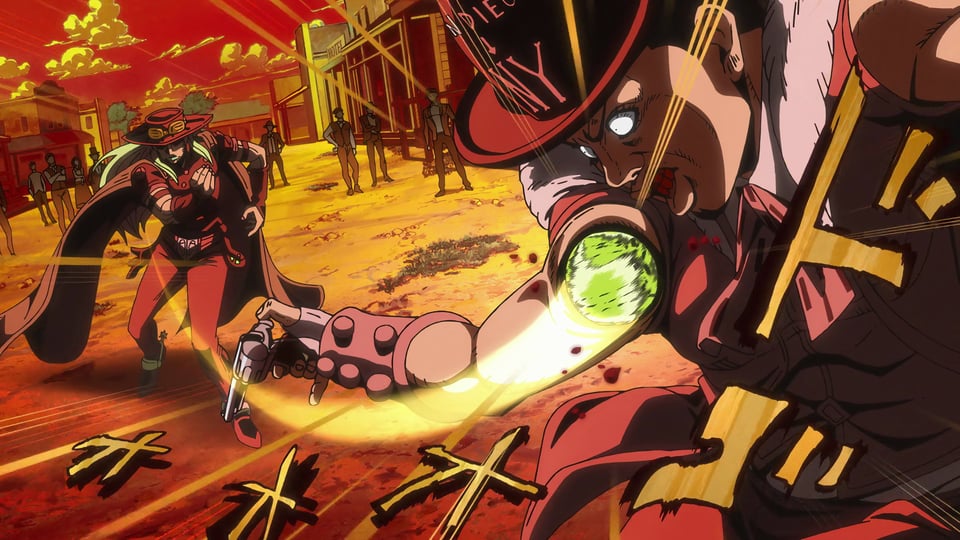
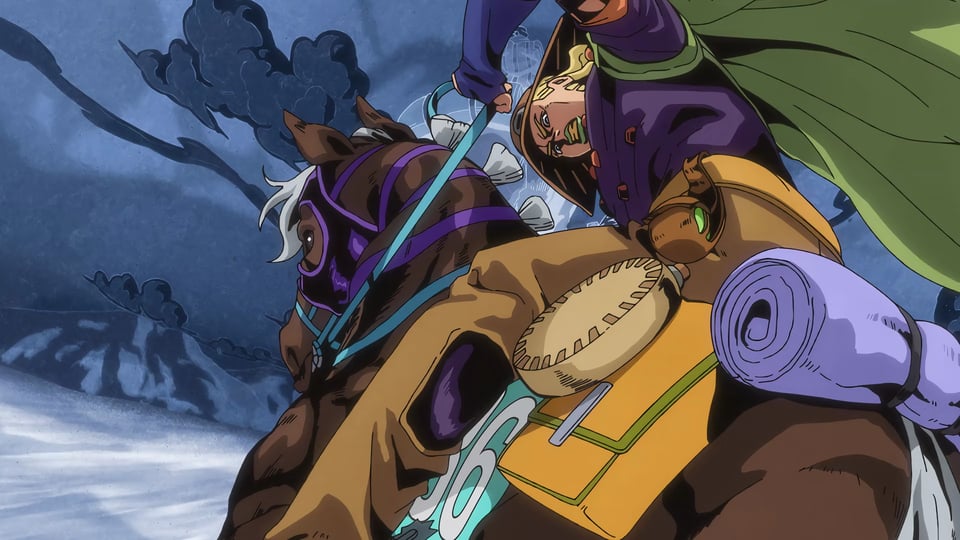
The sound design is as dramatic as ever, loud non-diegetic booms for emphasis on snap zooms or punches that sound like gunshots. There's still an incredible sense of timing, like in a moment where Gyro wins a pistol duel by making his opponent shoot themselves in the face (you kinda just have to see it). More impressive still is its animation of the horses themselves, the movement coming across incredibly naturally (with the notable exception of when patented JoJo bullshit is going on), whether using CG horses in wide shots of the competitors, or in 2D when alone or in close up). The thinking behind the animation is detailed by director Yasuhiro Kimura in an interview with Daryl Harding of AniTrendz, speaking about capturing the general feeling of horse riding if not the exact movements, and the study of riding techniques to complement this approach.
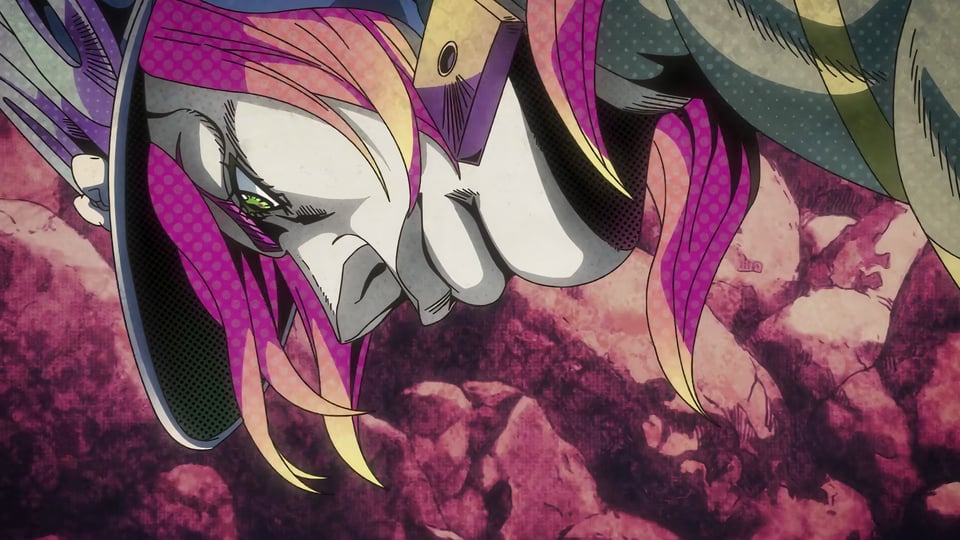
The cut ins, freeze frames, jazzy piano and sax sounds in the score, the bold lines, heavy shadows and illustrative detail on each character, intentional color mismatches. The live commentary on each bout is enabled by a train following the horses along the route: these are all pleasingly familiar details on top of this new premise. Even Steel Ball Run's theme song feels like an amalgamation of every JoJo theme so far.
Sadly, outside of the show itself there are other familiar hallmarks of its stewardship under Netflix. While Stone Ocean's rollout was mourned for its "all at once" binge releases diminishing the conversation around it, it seems like Steel Ball Run may struggle with the opposite: a painfully slow drip feed. In the same AniTrendz interview director Kimura says that he "doesn't know" when the next episode, currently in production, will be released.
The first (double-length) episode was enjoyable and polished, and that of course takes an immense amount of time and effort and scheduling which I'm not privy to. But even so, it's a shame to see JoJo once again miss out on the week to week dialogue which made engaging with series like Golden Wind so memorable. There's a grim irony in that the series about a do-or-die race across the country is looking like the slowest JoJo release yet. And, perhaps, in one of anime’s most colorful and idiosyncratic series being hamstrung by something so mundane.
/out of frame
⛓️🪚 Toussaint: I just read the new chapter of Chainsaw Man. Go read Chainsaw Man. Thank you, Chainsaw Man.
⛓️🪚 Rollin: I also just read the new chapter of Chainsaw Man. Go read Chainsaw Man. Thank you, Chainsaw Man.
⛓️🪚 Kambole: Make that three who just read the final chapter. Thank you, Chainsaw Man! In other news, I really liked the new animated trailer for the characters in Marathon, building around the fantasy of playing. All of the design around this game has been remarkable, the feeling of playing is just as engaging.