Imagining the past
One legend pays homage to another in Rintaro's new short, Nezumikozō Jirokichi.
by Kambole Campbell
A message from producer Masao Maruyama opens the latest work from the legendary Rintaro (Galaxy Express 999, Metropolis), briefly explaining the story of another director, Sadao Yamanaka. A pioneering filmmaker in Japan during the silent film era, Yamanaka died at the young age of 28 during the Second World War, and sadly, the majority of his 26 films are lost. Maruyama compares his spirit to that of Yasujiro Ozu, highlighting his focus on the common man and interest in showing people with honesty, all their vulnerability plain to see. Though the films were lost, as Maruyama continues, the scripts remain: thus, so exists Nezumikozō Jirokichi, a sort of imagining of what one of his films might look like, using the director's original script and notes.
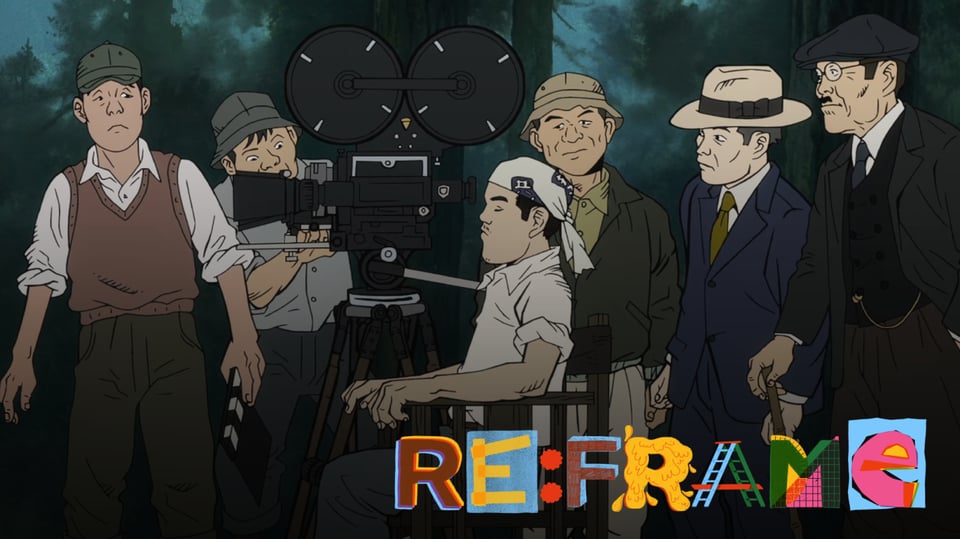
The film, which I first saw at Annecy over 3 years ago now, is a period piece following a Robin Hood-esque thief, who goes by "The Rat" – first introduced in a whimsical shot of him tiptoeing across a rooftop in time with a rodent trying to keep pace with him. He's, "the god of the poor," as one character puts it, and he’s made some powerful enemies along the way. We actually first see the film as its being made, from the point of view of Yamanaka shouting "action," imagining not just what the film looked like, but what the process of making it might have looked like as well, reminding us of the person who made it even after the perspective has switched, showing a clapperboard in front of the virtual camera.
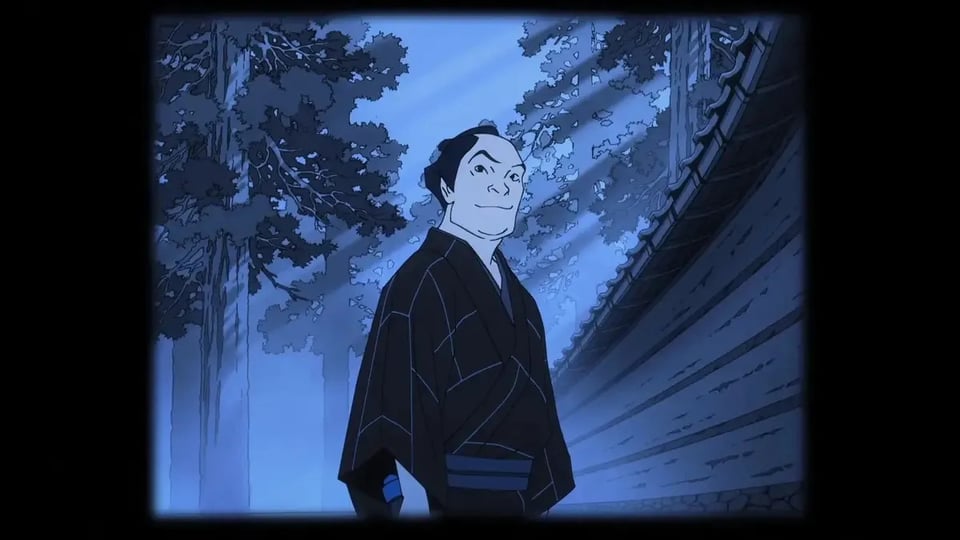
Director Rintaro commits to a silent era style and rhythm. Dialogue is accompanied by intertitle cards and only appears at the clip one would expect of a film from that time, the rest of the story is told physically and through its editing. Scenes are presented with a kind of dark blue wash rather than a pure black and white, and are laid out with a static camera which observes from angles as you'd vaguely expect from physical camera placement possible around the time (there's even a little bit of simulated gate weave, replicating the slight shudder created by the motion of film running through the camera).
The design work (notably some of which, for the Yamanaka section, is courtesy of Akira creator Katsuhiro Otomo) doesn't just act as a loving recreation of live action film from the 1930s, but nods to classical comic book design as well; the characters have more in common with Tintin than they do with other modern anime. It's a decision which only enriches the film further, allowing in more influences from outside of its depicted time and medium only makes Yamanaka feel like a greater part of this history of visual art, even though so many of his contributions can no longer be seen.
It's good to see Rintaro's short released at last: the channel it is hosted on, "BANG BANG," is run by Miyu Distribution, posting shorts after their festival run has concluded. I can only guess as to why there was a three year gap, but I'm grateful that Rintaro's own short will have the chance to be seen by a wider audience before it risks being forgotten, too.