Avatar Aang: The Last Airbender sure is nice to look at
Perhaps it would land with more impact with an actual theatrical release, though.
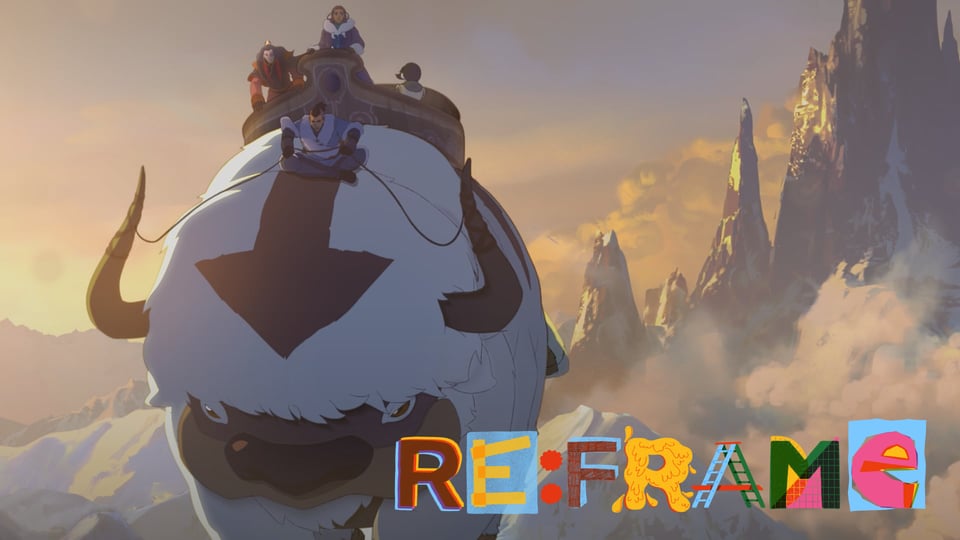
by Kambole Campbell
In the wake of a letter written by my Re:Frame colleague Toussaint, reflecting on a long-running franchise perhaps stalling itself with nostalgia, it feels a little funny to be talking about the new feature film Avatar Aang: The Last Airbender. Set in the time between the end of the original Avatar series and its follow up The Legend of Korra, it could be accused of being an animated exercise in navel-gazing, jumping back in time to follow fan-favorite characters, now in adulthood, rather than moving forward in time as has (so far) been customary for Avatar follow-ups.
The story catches up with 'Team Avatar' a decade or so after the end of the 'Hundred Year War' from the original series – the plucky team of precocious kids (with the ability to "bend" the elements through martial artistry) revolting against the oppressive status quo have now grown up, and have to reckon with their roles as stewards of a new age. This journey kicks off with the discovery of Tagah (Dave Bautista, ferocious and sensitive as ever), an ancient airbender found in suspended animation like Aang was in the original series – the film using this parallel to drive home the ideological divide between the two. It's a great setup for the villain, giving him time to travel with the team before revealing his true motives, but one which, like almost everything else in the film, eventually suffers because of a ruthlessly compressed third act.
In the feature, Aang discovers the legend of an ancient staff told to grant the power of "bending" to anyone, something which of course could bring back the culture of the airbenders and undo the "greatest atrocity" of the Fire Nation. Anyone who has watched Korra knows this doesn't work out, so the journey becomes more about Aang figuring out his priority for the resurrection of his people: is it the abilities, or the philosophies they live by? The answer probably won’t surprise you.
But until that point, Aang uses the space of peace time to finally dig into one of the other long-term goals implicit in the struggle of the original series: the preservation of his people, the nomadic airbenders. In this, directors Lauren Montgomery, Steve Ahn, and William Mata as well as writers Tim Hedrick and Christopher Yost draw a connective thread between the two shows, as The Legend of Korra in particular wrestled with battles where the moral line isn't quite so clear.
It's not quite as far as them turning into politicians as seen in flashbacks in Korra, but the pressures of authority change the dynamic enough that it doesn't feel like a pure retread of the original series. Like with Genndy Tartakovsky's Samurai Jack, or shows like Naruto: Shippuden there is a certain satisfaction in seeing characters grow up in tandem with their original audience, while maintaining its appeal to kids. It's not a film just about recapturing the past and popularity of the show, but one using the familiar cast to plumb the depths of the "lore" of the show, a reminder of a wider world which may well be explored in the upcoming Avatar: Seven Havens, a new story picking up post-apocalypse a generation after Korra.
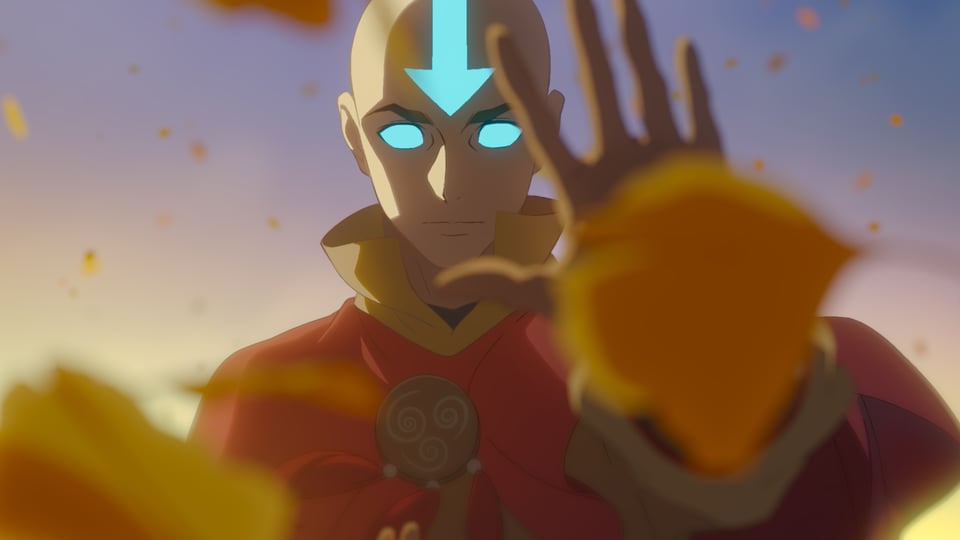
So while on one hand it initially feels a little regressive to go back to these characters, on the other, the sense that they have actually changed and now have to consider how they further this change feel like a balm to the entirely misjudged live-action remake on Netflix, not least of all because of the animation production from Studio Mir and Flying Bark. Though primarily 2D hand-drawn, the teams often cleverly disguise different mediums in plain sight. So often animation is treated, even by otherwise well-meaning critics, solely as a perfunctory accessory to the story rather than the story itself.
Even in something as broad and breezy as Avatar Aang: The Last Airbender, especially in the little (deserved!) moments of self-indulgent callback, these recollections are just as often of incredibly specific cuts of character animation rather than just a bit of dialogue. So the lavish production of Aang carries its own importance as well – even as the balance tips more into spectacle than quieter moments of acting, as the necessities of feature film timing compresses proceedings.
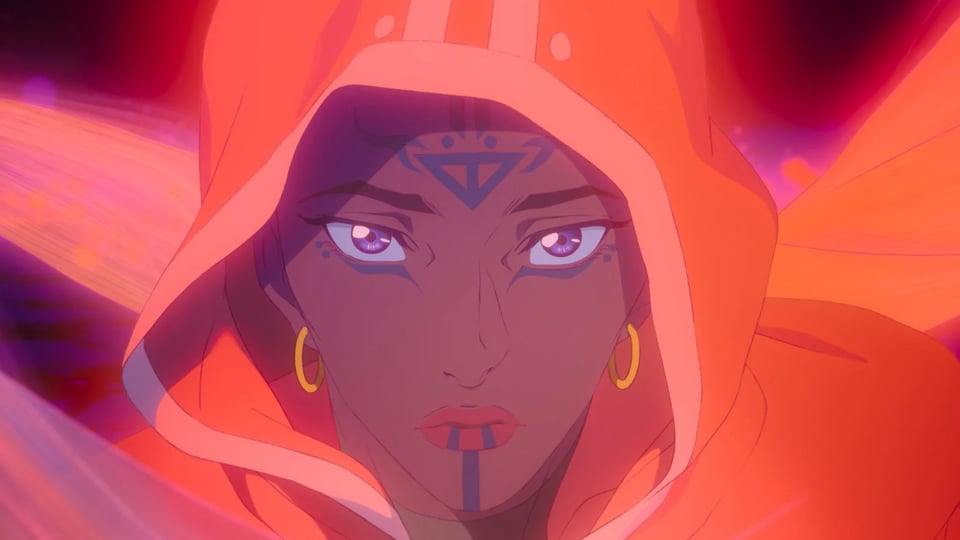
The hurried pace and the disappointing streaming scenario does leave a bittersweet taste to scenes such as those featuring the ancient Avatar Sonam (Frieda Pinto), who appears with an otherworldly glow and texture both in the present and the history she tells. It's invigorating to see new textures used to signify the world of Avatar expanding, just like how Korra in its second season switched styles as it animated the ancient history of the Avatar (also starring Steven Yeun!). And, as the upcoming Seven Havens embraces the style of new incoming studio La Chouette Compagnie to further the divide between generations.
With the new cast, who according to creators Bryan Konietzko and Michael Dante DiMartino were hired to vaguely match the ethnicity of the characters (a good thing, to be clear), there is a noticeable difference which leaves more to the artists to literally draw the line between the younger and older versions of these characters, not just through the designs but in their performances. That could be Toph's characteristic slouch or the brashness of her posing in victory. Or even how Sokka makes up for his lack of bending powers by simply being the biggest cartoon in the cast: while his friends manipulate the elements, the art style of the film bends around him, my favorite being his self-inflated retelling of the events of Avatar featuring a heroic portrait with exaggerated musculature.
It's a shame that the new cast don't get so much time to make these roles their own; the film moves at an increasingly rapid clip which ultimately flattens the meaning of everything. During a fight between Katara (Jessica Matten) and Kallak (Geraldine Viswanathan), a conflicted member of "The Denied," the two basically have to yell exactly what they're thinking, as do the other combatants, to move the story along. It makes certain things about the series feel confused in retrospect: the idea of 'bending' is caught between being something learned and something you're born with – and The Denied all suddenly knowing how to bend the elements kinda cheapens the show's embrace of the lessons and the artform mattering.
Even if the story ultimately feels as unceremonious as the release, in the visuals at least there's an elation underpinning the whole film, one borne of a team perhaps feeling shut out of the world they created 21 years ago. It's an overall gorgeous film, the sense of scale visually balanced with care for acting and actual expression beyond the fights – some of the facial expressions feel particularly transportive, characteristic of the old show. Those production values are without question, the only thing which disappoints about those visuals is that they are beholden to streaming compression, despite the wishes of those who made it. There is, perhaps, a certain irony about a film where the main character is so concerned about his culture disappearing, which is itself threatened with a similar ephemerality – with no Aang of its own to preserve it.