
Within reach
"Julia's journey to a low-cost degree with Modern States, and how a model of working on what's within reach applies to learners and Modern States."
Companion to a series on primitives for higher education. Picks up where Two steps out left off.
Julia grew up in Knoxville, Tennessee. Her father died suddenly during her senior year of high school, putting college out of reach. She moved to Washington, DC, and took a job as a housekeeper at a medical facility. She quickly realized it wasn't the life she wanted. She found CLEP and Modern States in 2019, "speed ran" 60 hours of credit, quit her housekeeping job, and enrolled at Thomas Edison State University in New Jersey. 18 months later she finished a bachelor's of communications and an associate of fine art. Her total cost across the entire degree was $17,000.
"The only thing it costs," she put it later, "is effort. And I know the people that I grew up with. The kind of people who don't have money have effort in spades." Julia's full story is here.
Julia is an example of what putting a college degree within reach looks like for one learner. The same concept of reach applies to how we work at Modern States.
Within reach at two levels
Two steps out argued that institutions can't see far enough to plan comprehensively, so a better approach is finding the next moves available from where they stand. The moves can accumulate into something the institution can't fully specify in advance. The destination resolves as the moves resolve.
Modern States followed a path like this. Recognizing that college had gotten too expensive for many people, our founder Steve Klinsky conceived of a model to keep college within reach for any learner. The resulting strategy, built around MOOC-style courses to ensure broad access and CLEP exams to maintain affordability, took advantage of resources available immediately. Free online courses existed but lacked a mechanism for validating learning. CLEP already existed but was underutilized. Accredited credit-accepting institutions existed but learners didn't have a program to access credit by exam pathways. Each piece of infrastructure was within reach for building. They hadn't been combined in the particular way Modern States put them together, but they could be. The model was built around what could make an immediate impact.
What the model produces for learners is the same shape applied at a different scale. A particular cohort of people for whom college was out of reach can now make progress towards a degree, because the model offers a sequence of moves that are individually achievable. The course is free. Completing the course costs time and effort, but just commensurate with a learner's knowledge. Each additional course and CLEP exam passed composes onto the first. The credential resolves as the moves resolve.
Four operating choices help define what within reach means. Each one is a different application of the same marginalist discipline. Each one shows up at both levels: the org's strategy and the learner's path.
Define a tractable problem
Modern States exists to make a college credential dramatically cheaper, shorter, and lower-risk for people considering one. That's the problem definition. Nearby problems (the cost of a four-year residential program, the case for or against the degree itself) are real, but they sit outside the model's direct scope deliberately.
The narrowing tracks the last post's argument. Institutions that move forward work on problems they can resolve from where they stand. Defining the problem narrowly is what makes it possible to ship something that works and to measure whether it did.
For learners, taking those steps within reach can address specific barriers to college: shrinking the overall cost or time to degree, making it possible to get started while working, trialing college-level work to build the confidence necessary to make a bigger leap.
Identify and build on what already exists
The second discipline is to use what's already at hand. Modern States built on two things that already existed: instructional technology and credentialing infrastructure.
On technology: Modern States didn't pioneer the idea of a MOOC-style course. Early MOOCs predated the work by roughly a decade, and there were multiple attempts to figure out how to validate learning that happened in MOOCs and give learners who completed them some persistent and valuable credential.
On credentialing: CLEP has run for over 50 years. About 3,000 institutions accept it. The College Board administers it. Modern States built into that infrastructure with free, high-quality preparation that composes into the existing exam, which articulates into the existing credential at thousands of institutions that already accept it.
The core instructional approach, the exams, the credential, and the institutions that grant degrees all existed already; the contribution was the missing courses specifically for CLEP exams.
Learners bring their existing knowledge and capabilities. They also can build on their prior progress to college. While Julia was a new college learner, many other Modern States success stories highlight learners who plugged gaps with CLEP exams or used the model as a bridge back to college after years away.
Start with the learners who benefit most directly
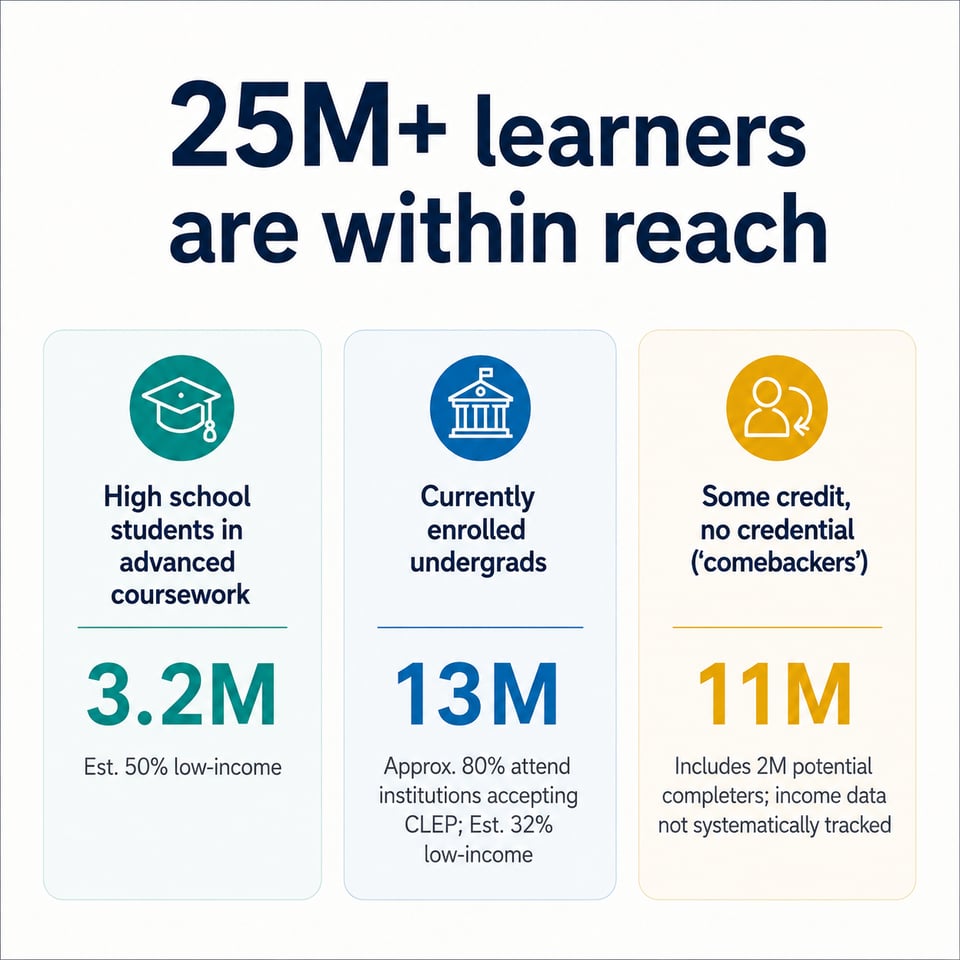
The third discipline is to start with the learners for whom the model produces concentrated value soonest. The people Modern States serves by and large are already considering college, and in many cases are actively enrolled in college. Modern States built into that existing population that was likeliest to recognize the value of a new model and put it to productive use. The economics of the model (free preparation, no commitment beyond effort) let those learners test for themselves without staking much. Outreach to people not yet considering college is critical work; other organizations in the ecosystem do it well. Modern States runs at the stage where someone is at least open to the question. They're the quick win.
Building for the visible cohort is also the most reliable way to build credibility. Each Julia is a story the next learner can see and understand. The case for trying becomes legible because someone like her did try and succeeded. That's the compounding mechanism the first post named: each delivered move reshapes what becomes visible next.
Some numbers anchor what "quick win" means in practice. About 200,000 learners will sign up for Modern States this year, and we'll cross a million cumulative learners soon. Those learners have saved an estimated $250M in college tuition savings (excluding time to degree savings, interest on debt avoided, books and fees, etc). Those numbers don't solve the college access and affordability crisis, but they move learners forward.
Importantly, being focused also doesn't mean the problem we're trying to solve is small. Even signing up 200,000 learners a year likely means that we are reaching only ~1% of the learners who are clear matches for our model.
Concentrate scarce resources on likely outcomes
The fourth discipline is to put most resources where the outcomes are most likely. The costs of Modern States' model come in two shapes.
Course content is front-loaded. Building 32 college-level courses with quality high enough to prepare learners for a CLEP took years of investment, and refinement of the catalog continues. Once a course exists, the marginal cost of serving one more learner with it is close to zero. A million more learners can enroll in College Algebra without changing the operating budget meaningfully. The expensive piece gets spent once; the use case scales near-infinitely.
CLEP exam vouchers are back-loaded. Each voucher pays for the cost of a CLEP exam at the College Board's current rate, and that's an outlay Modern States pays per learner who sits the exam. By the time a learner requests a voucher and takes an exam, though, they've taken a Modern States course, worked through the material, and completed our quizzes and final exam. That investment of time and effort is what predicts readiness and a successful exam outcome. Roughly two in three learners who take a CLEP through Modern States pass.
A subsidy that pays the expensive dollar at the front of the funnel (a seat scholarship, a textbook stipend, an enrollment bonus) gets paid whether the learner persists or not, and the same total spend produces far fewer credit-bearing outcomes per dollar. The dollar Modern States spends on a marginal learner is highly likely to convert into college credit, because it's spent at the moment when conversion is most predictable.
Ideally, learners follow a similar discipline by choosing the courses and using their time where they are best positioned to succeed. That can mean different things for different learners, such as starting in a subject where they already have content knowledge or focusing on a course of the greatest interest to enhance motivation to learn. Either way, the scarce resources for learners are time and attention, and concentrating maximizes those.
What's within reach evolves
The cohort the model can serve today isn't the cohort it can serve tomorrow, because the tools available to the org change and so does the world around it. Each move the model makes opens up moves that weren't accessible before. That's the adjacent possible, the Stuart Kauffman/Steven Johnson frame named in the first post.
As one example, Modern States is testing AI tutors in its courses now. The promise is to lower the academic-prep bar so learners who would historically have struggled to work through a college-level course independently can do it with scaffolding. If that lands, the cohort within reach expands. The course is still free; the credential is still legible; the spend still concentrates at the moment of likely success. What changes is who can use the model to good effect.
The discipline produces a moving target on purpose. Find the moves available now. Build them. Let the next moves come into view. The world keeps changing; the model changes with it.
Where this leaves the architecture
Four operating choices, then, plus the discipline of letting them evolve. Define a tractable problem. Build on what already exists, in infrastructure and in demand. Start with the learners for whom the model produces concentrated value soonest. Concentrate spend on the moment when conversion is most likely.
Each of the four shows up at both levels: a discipline the institution practices that produces a discipline a learner can use.
Sources & references
On Julia's story
"Julia's Story", Modern States Education Alliance.
On the adjacent possible
Steven Johnson, Where Good Ideas Come From: The Natural History of Innovation (Riverhead, 2010). The introduction to the concept in this series came in The virtue of quick wins.
On the broader frame
The virtue of quick wins Institutional legitimacy as a function of delivery.
Two steps out The visibility limit that makes comprehensive plans unreliable.

Add a comment: