The build barrier just fell
AI probably can't solve our civic crises, but maybe it can make a difference.
A quick note: this post diverges a bit from what I've been writing about higher education and college access. I'm telling it anyway because it runs on primitives, the same idea I keep circling in this series, and the connection is the part that matters.
Last weekend, I took my daughter to the sprinklers in Abolitionist Place in downtown Brooklyn. It was a hot afternoon, and we were meeting friends at a place where the kids could cool off. We'd been to the sprinklers the previous two days, so I just assumed they would be on.
Wrong.
We weren't the only ones who made that assumption, though. Several other school friends, and plenty of families we didn't know, showed up and then wandered away, perplexed.
What happened next
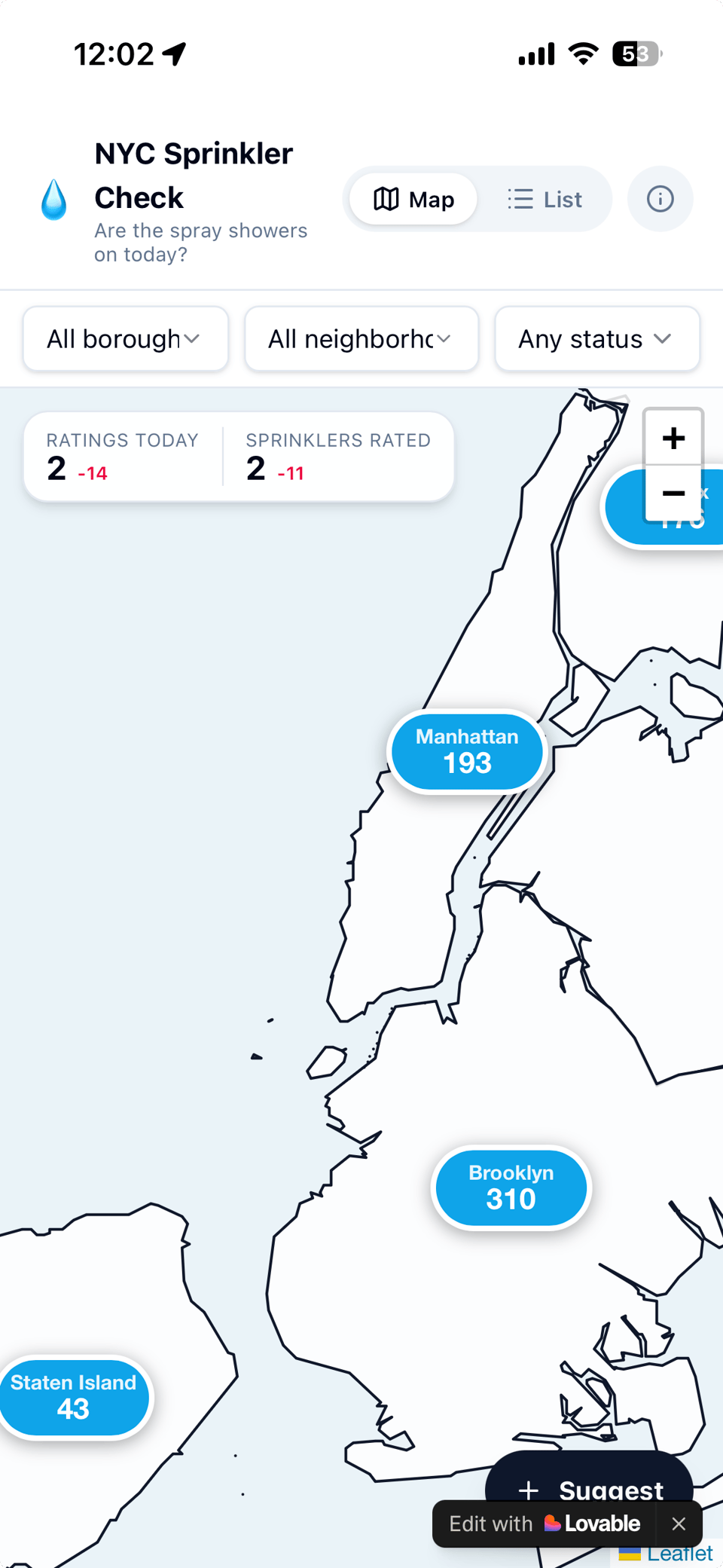
I built something. It's a simple web app that seeks to use crowdsourced reporting to show which NYC park spray showers are on today. A parent accesses a map view of all the sprinklers in the city, taps a sprinkler to report on or off, and then that report gets aggregated in the app. The reporting goes blank again at midnight, because what a parent wants to know is, Is the sprinkler on today. It's live if you want to check it out, and if you don't, you can see what it looks like below.
I'm not particularly technical. I used Claude to identify the data sets and their limitations and to define a prompt, then used Lovable on a free tier to build the app. Once I got hooked a bit, I signed up for a $25 a month account. All in, it probably took an hour to go from concept to working app, and only 10 minutes or so was actually active work time on my part; the rest was just waiting while I did other work.
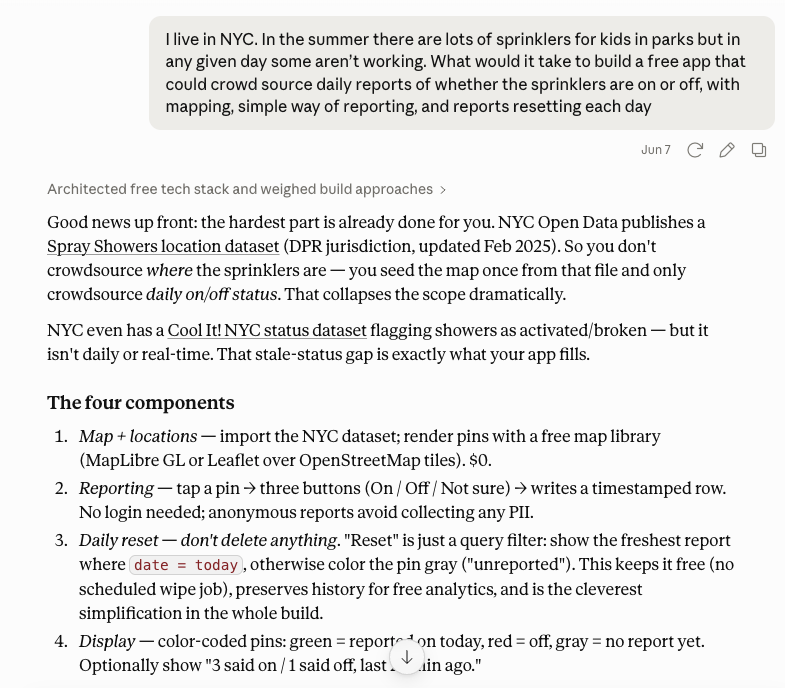
A few years ago, this would have been just a frustration I had to deal with. The person who feels the need (a parent who just wants to know if the water's on) and the person who can build the thing (a software engineer) are infrequently the same person, and paying a software engineer costs more than the solution is worth. At best, paying a software engineer ends up with an app that users have to pay for, rather than a free crowdsourced app. AI took that barrier away. The group of people who can fix a small civic gap used to be roughly "people who can code." It's now closer to "people who care" or even better, "people who are close to a problem."
Where we were five years ago
There's a version of this story, just five years earlier. In January 2021, a software engineer named Huge Ma built TurboVax in under two weeks for less than $50 (New York Times), after trying to book his mother's Covid vaccine appointment and finding the city and state systems scattered and broken. It pulled real-time appointment availability from the main NYC and New York State systems into one free site and a Twitter bot. On its busiest day it served around 4.2 million page views, and it helped tens of thousands of New Yorkers get shots (including my wife and me). Most of the coverage called it the thing the government should have built and didn't.
Two things stand out. The first is that a citywide, life-and-death need was riding on whether one person happened to have professional skill and sufficient motivation and a couple of free weeks. The growing capability of AI to allow laypeople like me to build hopefully reduces the need for that kind of luck.
Second, Ma's two weeks were mostly focused on stitching fragmented official feeds into one usable stream, not on the actual build. The tangible product, that is, building the app, risks obscuring a critical need here, and the emergence of tools like Lovable make the need even more pressing. Easy and quick building doesn't make data good, and bad data makes even the best-designed tool worse than useless. Once the build costs almost nothing, the data underneath becomes the thing that decides whether you can build at all, and ensuring good public data is not easy.
So where do we go?
Claude found the dataset that I needed on NYC Open Data, which seeded my work, but the data itself wasn't accessible to the tools I was using. I needed to download it; simple enough. But then it turned out that the actual sprinkler I cared about, at Abolitionist Place, is actually run by the Downtown Brooklyn Partnership, not the Parks Department, so it falls outside the city's dataset entirely. That needed to be correct and documented; again, simple enough for me, but who knows how many other sprinklers out there are maintained by EDCs or BIDs or other acronyms nobody even knows?
When the data is clean, the payoff is large. Publish one good data feed and you get an unknowable number of citizen-built apps on top of it, ones you never had to fund or imagine. In the Covid example, New York eventually added real-time appointment availability to its own official site, after the citizen builders had already done it. The instinct was to fix the city's own page, rather than publish the feed everyone else could build on. The more useful move, I think, is to publish the clean, queryable feed and let other people build the interfaces. Become a reliable source of primitives, and a lot of the apps take care of themselves.
Most public agencies haven't already done this for a reason that goes beyond inertia. Clean public data is close to an orphaned good. The cost of producing and maintaining it is concentrated and unglamorous, and the benefit is spread thin across people who mostly don't know they need it yet, and who can't very well lobby for a dataset they've never seen. It's the problem with public goods: goods whose benefits are broadly diffuse tend to get underprovided, because no one has a large enough private stake to organize around them. A spray-shower feed has no constituency. A unified vaccine-appointment feed didn't either, until the week it suddenly did.
Maybe the cheap-build era changes this. When building on top of a dataset costs almost nothing, the latent constituency finally gets a way to show itself; every citizen app built on a public feed is a small, visible signal that the feed was worth maintaining. Some of the funding world is starting to move in the same direction. In October 2025, Jennifer Pahlka (who founded Code for America and wrote Recoding America) launched the Recoding America Fund, a six-year, $120 million pooled fund catalyzed by Renaissance Philanthropy, aimed at state capacity: the government's ability to actually deliver, including how it builds and maintains digital infrastructure. The bet underneath it looks, to me, a lot like a much better resourced effort to deal with my problem. Get government better at publishing clean, usable primitives, and the people downstream increasingly can build much of the rest.
The next barrier
The map I can now build in an afternoon is only as good as two things: the data underneath it, and the thing I haven't even talked about yet: the neighbors who show up to keep it current. An empty map showing where all the sprinklers are is not that useful because the data for that already exists; it only works if parents report, day after day. That's actually the hardest part of all of this, and figuring it out isn't a new problem.
Startups call this the cold-start problem: the product is close to worthless until enough people use it, and nobody wants to be the early user who finds it empty. There's a different description that matters a lot more. American civic participation has been thinning for decades. Robert Putnam named the trend in Bowling Alone in 2000, and by and large it has kept going. One cost might be a decline in solving small, local problems together.
Here's the part I find myself hopeful about. Mark Moore and Archon Fung have a concept they named calling publics into existence: a concrete, shared problem can summon a public that wasn't organized before. 'Which sprinkler is on today' is about as concrete and shared as a problem gets, and the ask it makes is tiny: two taps, for the benefit of a neighbor you'll never meet. The sprinkler problem isn't actually a serious one, but the coordination it needs is the same muscle that's gone slack, and the cheap-build era hands us a lot more chances to exercise it, on problems people actually share. Some of those will matter more than sprinklers.
The smallest version of this, my spray-shower map, and the citywide version, TurboVax, are the same bet. Both rest on a clean primitive that someone has to provide, and a public that has to show up.
Sources & references
TurboVax / Huge Ma
Sharon Otterman, "N.Y.'s Vaccine Websites Weren't Working. He Built a New One for $50," New York Times, Feb 9 2021.
"New York Never Built a Good System for Scheduling Vaccine Appointments, so a Random Software Engineer Did It in His Spare Time," Reason, Feb 10 2021.
"NYC updates vaccine website with real-time appointment availability," 6sqft.
Sprinkler tracker / NYC data
NYC Open Data, NYC Parks Spray Showers (dataset id im58-6hb9).
On public goods and state capacity
Jennifer Pahlka, Recoding America: Why Government Is Failing in the Digital Age and How We Can Do Better (2023). And the Recoding America Fund, a six-year, $120M pooled fund launched October 2025 and catalyzed by Renaissance Philanthropy; see GovTech coverage.
On civic engagement and calling publics into being
Robert D. Putnam, Bowling Alone: The Collapse and Revival of American Community (Simon & Schuster, 2000).
Mark H. Moore and Archon Fung, "Calling Publics into Existence: The Political Arts of Public Management," in Ports in a Storm: Public Management in a Turbulent World (Brookings Institution Press, 2012).
-
I’ve been following this series from the first post. I commend it to others interested in the education system and for its periodic linkage to other domains and “big ideas” published elsewhere about people and the public sectors meant to serve them. These linkages, like those to Putnam, Moore and Fung, and Pahlka’s work in this post reveal the breadth of Pestronk’s familiarity with a broad literature on present dilemmas and potential solutions as well as his ability to synthesize social science in new and useful ways. His own work already advances access to college credits thereby reducing the cost to obtain knowledge and sought after credentials. I hope his kids and the others who discovered a broken sprinkler which failed to delight them were able to get wet elsewhere…and that their next trip cools them as anticipated. A hot, humid, sweaty City is no place through which to drag disappointed kids and an awful place to be without relief for anyone. Share Pestronk’s posts. They deserve a wide audience.

Add a comment: