
Escalator temporarily stairs
Most of higher education makes learners pay up front for a payoff that arrives at the end. Designing the cost to follow the value removes the trap.
A companion to a series on primitives for higher education. See The virtue of quick wins for the broader frame.
The comedian Mitch Hedberg had a bit about escalators that I was thinking about the other day.
"I like the escalator, man, 'cause the escalator can never break. It can only become stairs. There would never be an 'Escalator Temporarily Out of Order' sign, only an 'Escalator Temporarily Stairs, Sorry for the Convenience.'"
It's funny to me in part because it evocatively captures a real design property. When an escalator breaks down, it keeps doing most of its job. You still get to the next floor; you just walk.
An elevator is another story. A stuck elevator at best fails in a way that forces you to walk the stairs, and at worst, leaves you stuck in a claustrophobic box.
These are different failure modes. Elevator failure is a real problem. Escalator failure isn't what you want, but it's annoying rather than catastrophic. It reverts to a slower working state and keeps every step you already climbed.
Why this matters for higher education
I was thinking about Mitch Hedberg because I was thinking about how higher education fails, and how that failure mode contributes to growing skepticism of a college degree.
Traditional higher education costs follow an elevator failure model, as do the economic benefits of higher education. A learner attending college pays a large amount of money for access, up front, and then regularly for a few years after. That learner then (hopefully) accrues credits that move them towards a degree. That degree is what then starts paying back the education, through the college degree wage premium. But that repayment starts several years down the line, and the costs start accruing today.
Even worse, if a learner drops out of college, they generally don't get "partial credit" for the wage premium. It's all or nothing: if you have the degree you get the benefits, if you don't have the degree you don't get the benefits. Credits on a transcript usually transfer, and the learning you did to earn them doesn't evaporate when you stop, so you're not totally stranded, but what gets stranded when someone stops out is the money. The tuition was paid up front, and it doesn't get refunded because things didn't work.
Our model at Modern States works differently. There's no cost up front, because our courses cost nearly nothing to deliver to an incremental learner. We cover the cost of the CLEP exam for learners who complete our courses, so there's also not any financial cost when a learner completes a course and seeks to earn transferable college credit. A learner is making progress towards an economic outcome (the degree) but they're not accumulating financial debt in that pursuit. If they stop, the only real thing they've lost is time.
It's not an entirely fair comparison, because Modern States covers CLEP exam costs as part of our philanthropic mission. But note that the gentler failure mode would by and large hold true even if learners were paying for CLEP exams at the end of their courses: they accumulate debt only gradually, and only related to specific progress.
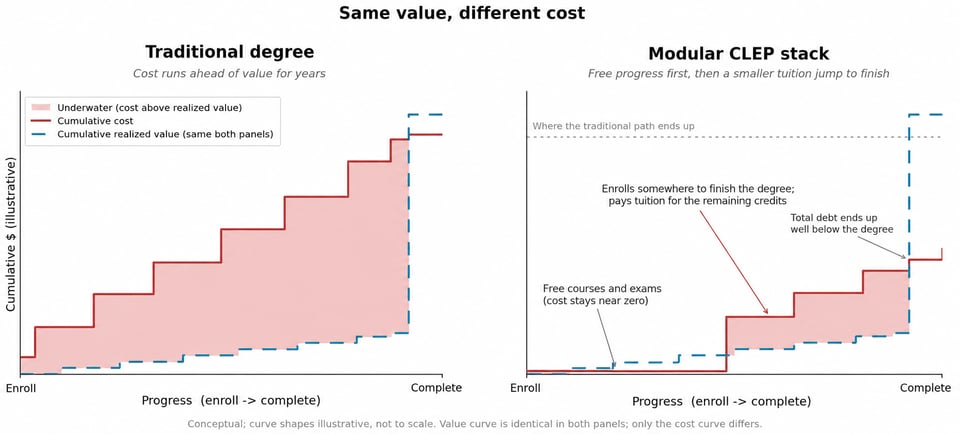
A clean way to see this is above: plot two curves against a learner's progress from enrollment to completion: cumulative cost, and cumulative realized value. Where the cost curve sits above the value curve, the learner's investment is underwater. How deep underwater, multiplied by how long it lasts, is a rough way to visualize the risk a learner is staring down at the start of the journey, and that they eat if they stop partway.
On the traditional degree path, cost is front-loaded in big steps and keeps compounding during any pause, while realized value stays close to flat until the credential lands at the very end. The learner is underwater, intimidatingly so, for an extended period of time.
The modular path keeps that same value curve but changes when the cost arrives and how much of it there is. The early stretch is close to free, so a learner banks real progress while staying above water. CLEP exams and Modern States usually can't carry someone all the way to a degree, though, so at some point they enroll somewhere to finish and take on tuition for the remaining credits. That's a real jump, and it does pull them underwater for a while. But it arrives later and the total debt at the end lands well below what the all-in degree path piles up.
Income-driven repayment is another design that chips away at the same problem from the opposite end. These plans tie a borrower's monthly payment to what they actually earn, so the cost of the degree flexes with the value it delivers instead of landing as a fixed bill no matter how things turn out. It doesn't erase the up-front sticker, and the balance still accrues, but it converts a rigid, front-loaded fare into something contingent on whether the climb paid off. It shows that there are multiple ways to deal with the risk, one dealing with the price itself and the other shifting risk from the learner to an institution (repayment side).
What actually accrues early
In either model, the early steps aren't where the payoff lives. The big earnings jump comes from finishing a degree, and it's at the end of either path. Regardless of model, the credential is the thing that generates the big value.
But in one model, the learner spends a lot of time trying to swim to the surface, where in the other, the learner has made (hopefully confidence-building) progress before they make the most consequential investment decisions.
The escalator doesn't get you all the way to the top. It just doesn't strand you on the way up, and for someone trying to decide whether college is worth it, that might make all the difference.
Tie cost to the moment value shows up
If the problem is escalator-value paired with elevator-cost, one fix is to stop charging the elevator fare. Tie the cost curve to the same event that generates the value.
Credit-by-exam does this about as cleanly as anything I've found. A CLEP exam costs $97, or nothing if a learner uses a free voucher, and College Board only bills when the exam is actually sat, not when the voucher gets issued. The cost and the value share a single realization event. You pay at the specific moment you try to earn the credit, and not before.
That alignment is the reason our model works both for us as a funder and for learners as beneficiaries. There's no front-loaded fare to strand, and the modularity and low cost of CLEP make each incremental investment manageable.
It's worth being explicit about why the escalator version is even available to us. The Modern States model is built out of primitives: small, independent components that each do one job and compose with the others. Each course is one, and a learner can access each course discretely rather than as a bundle. Because each piece stands on its own and costs almost nothing to deliver to one more learner, a learner can take a single step with little risk, and Modern States' marginal cost comes only when they sit the exam.
A traditional college program is integrated: instruction, assessment, credit, and support are joined into one product you buy whole and up front. Primitives are what let the path come apart into steps that each hold their value on their own. This is a property of the system architecture; the philanthropy lowers the cost further, but the shape would mostly hold without it. It's also why the cost can be tied to the realization event in the first place, because when the pieces are separable, you can attach the price to the one piece that actually produces the credit.
If modularity is what keeps a single learner above water, the next question is what it does to the risk of a whole system trying to widen access at scale. The next post takes the same property up there: the modularity that keeps one person from sinking is also what keeps the larger project from blowing up.
Sources & references
On the escalator bit
Mitch Hedberg, escalator routine, Comedy Central Presents (1999). Source of the quote.
On income-driven repayment
Income-driven repayment, Federal Student Aid. Ties monthly federal loan payments to what a borrower earns. (This is just one example of this style of repayment.)
-
Appreciate the visual of a learner having to swim to the surface just to make a traditional ed investment pay off.
Giving a learner the ability to wade into the water and know how it feels before jumping in is super important. Individuals can affirm the water is where they want to be and builds their confidence they can swim. This is especially important for our most vulnerable, who often do not have a life guard or life vest to save them.

Add a comment: