
656: quantum of sollazzo
Hello, reader!
Quantum #655 had an open rate of 46% and a click rate of 9%.
The most clicked link was Chrome's most recent experiment, based on drawing and geo.
You should consider attending the State of Open Conference by Open UK (of which I am an ambassador). It's on June 5th in Edinburgh.
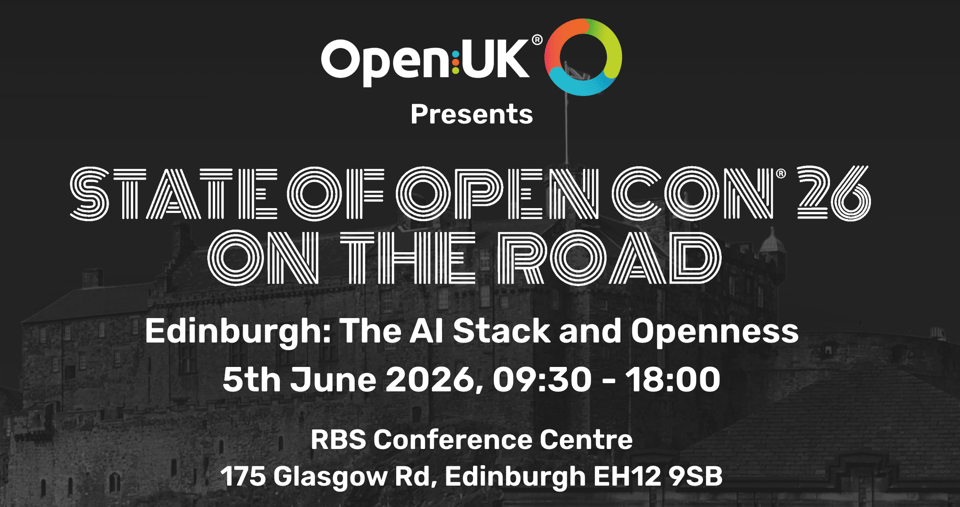
Watch video, but make sure you read the caption :-)
'till next week,
Giuseppe
Topical
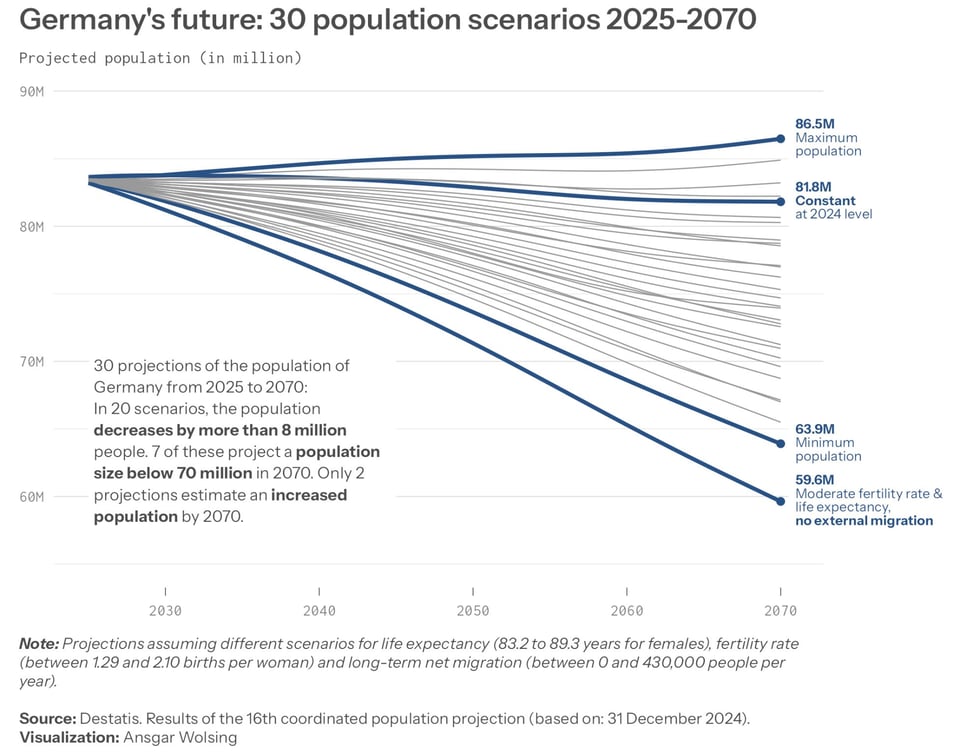
Germany's future: 30 population projections 2025-2070
Germany faces a significant demographic challenge, according to new projections from the Federal Statistics Office (Destatis) covering the period 2025-2070. Analysis and chart by Ansgar Wolsing, for the 30 day chart challenge.
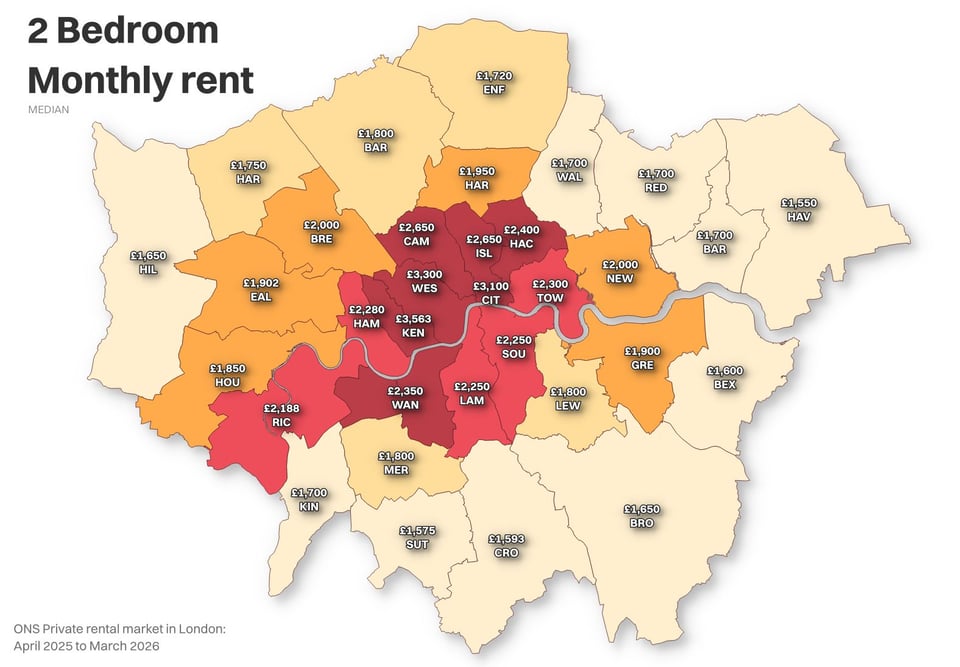
London Rent Data Analysis
Alasdair Rae visualises the latest London rental market data. There are stark disparities in housing costs across different boroughs. The post focuses on median monthly rents for two-bedroom properties and studios.
Brain food, delivered daily
Every day we analyze thousands of articles and send you only the best, tailored to your interests. Loved by 505,869 curious minds. Subscribe.


Tools & Tutorials
OpenET
"OpenET empowers water management from local to global scales by delivering transparent, scientifically rigorous satellite-based evapotranspiration (ET) data through accessible tools."
It's Satellite Open Data for Water Management. Pretty good!
(via Luis Villa)
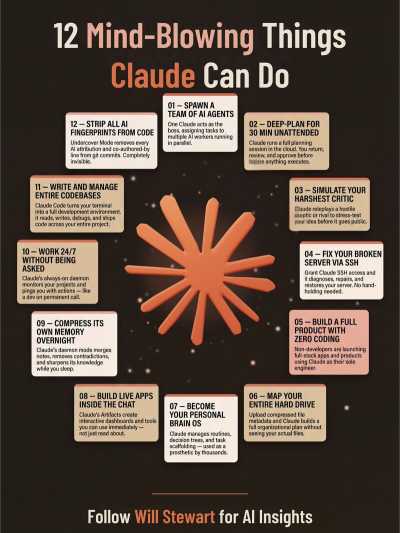
12 Advanced Things Claude AI Can Actually Do
"90% of people are only using 10% of Claude. The other 90% of Claude is waiting for you to give it a real job."
Ok, I'm never really too convinced by 90/10 percent statements, but there's some good thoughts in here on how to use Claude better.
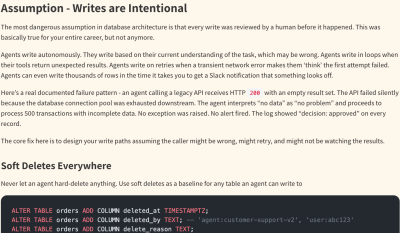
Databases Were Not Designed For This
"The contract goes something like this: the caller is a human-authored application, running deterministic code, issuing predictable queries, reviewed by a developer before deployment. Writes are intentional. Connections are brief. When something goes wrong, a human notices. The database can be dumb and fast because the application layer is smart and careful.
For forty years, this contract held. ...
It is no longer correct. Agentic AI systems violate this contract at every layer simultaneously".
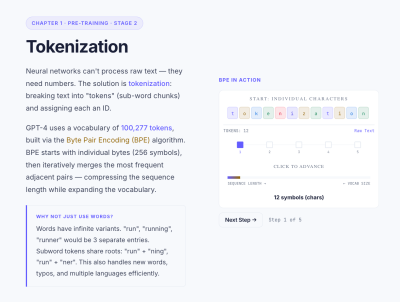
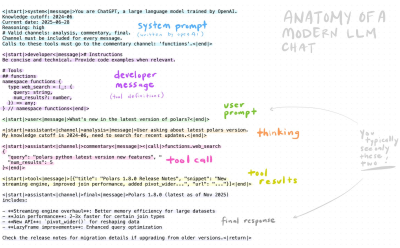
How LLMs Work — A Visual Deep Dive
An interactive web guide with a visual and interactive walkthrough of how large language models are built, from raw internet text to conversational assistant.
Getting Started with Claude Code: A Researcher's Setup Guide
Paul Goldsmith-Pinkham: "Part 1 of a series on AI coding tools for empirical research, accompanying my Markus Academy video series. This series follows an earlier Markus Academy mini-series with Ben Golub in December 2025, which focused on using LLMs for theoretical economics work with Cursor and his software Refine.ink.
These blog posts are companion pieces to go with the videos I recorded with Markus."
This article explains why researchers must engage with AI coding tools: they dramatically accelerate research workflows—making data cleaning, debugging, and analysis faster.
Datatype
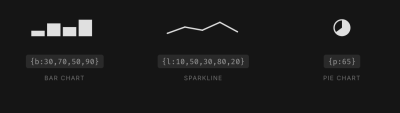
"Datatype is data as type. Datatype is an OpenType variable font that turns simple text expressions into inline charts. No JavaScript, no images, no rendering library — just type the syntax and Datatype's ligature substitution does the rest."
A Dab of DuckDB
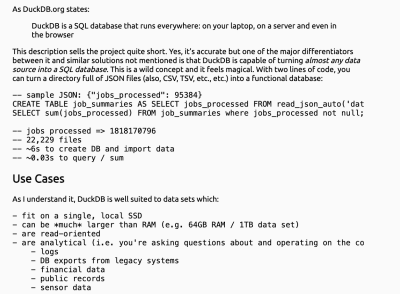
Pete Doherty explores DuckDB, as a newcomer to it. The article covers practical implementation details including CLI usage, Rust client integration, and configuration options for strict versus permissive data imports. $
LLMs running on my laptop can drive coding agents now
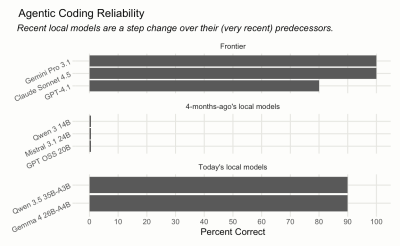
Simon P. Couch suggests: "Qwen 3.5 and Gemma 4 are a step change for local coding agents.". The article offers some benchmarks to back up Couch's argument that these new models achieve 9/10 success rates, compared to 0/10 just months ago. It's run on a M4 MacBook Pro with 48GB RAM.
Bayesian Workflow book: Website
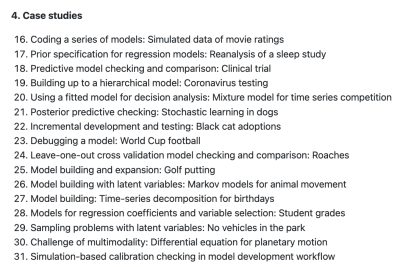
This website announces the forthcoming book Bayesian Workflow by Andrew Gelman, Aki Vehtari, Richard McElreath, and collaborators, scheduled for publication by CRC Press in June 2026. The book explores the practical aspects of applied Bayesian statistics, systematizing the often-overlooked tacit knowledge in statistical modeling. It emphasizes iterative model building, validation, computational troubleshooting, and simulation-based experimentation. Rather than providing a rigid checklist, it offers "a flexible framework for understanding and resolving challenges in statistical modeling and decision-making under uncertainty." The book features real-world case studies, code examples in R and Stan, and extensive exercises covering model development, inference, validation, and computational challenges. It targets practitioners using probabilistic programming languages, researchers, instructors, and even non-Bayesian statisticians. The comprehensive content spans theoretical foundations, statistical and computational workflows, and diverse practical applications from clinical trials to animal movement patterns.
Five ggplot2 functions I wish I'd known about earlier
Dataviz guru Nicola Rennie: "There are a few small tweaks you can make to your ggplot2 code to improve your charts. However, they’re not often mentioned. So here’s a few functions and arguments I wish I’d known about earlier."
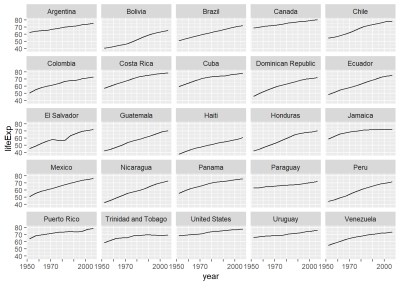
Data Thinking
A Dispatch from the Jagged Frontier of Analytics Engineering
Jason Ganz: "So today I’m going to go over, firsthand, the current areas where coding agents succeed and fail in complex analytics engineering tasks."
Prediction Market Accuracy: Crowd Wisdom or Informed Minority?
Academic paper KLAXON. "Prediction markets are remarkably accurate, yet the source of this accuracy remains poorly understood. The conventional view attributes it to crowd wisdom, whereby prices aggregate information from a large and diverse pool of participants. We show instead that accuracy is driven by a small minority of informed traders. Using the universe of transactions from a large prediction market platform, we identify these traders and show that they, around 3% of all accounts, generate the bulk of price discovery. Their trades predict future prices and final outcomes, make prices more accurate throughout a market's lifespan, and react to news the moment it arrives. The remaining majority does not produce accuracy; rather, it funds it. Their trades generate most of the volume, but little of the information, and their losses flow as profits to the informed minority. Prediction market accuracy thus reflects the wisdom of an informed minority, not the wisdom of the crowd."
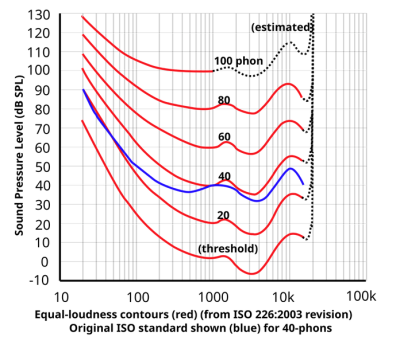
The Measurement of Loudness
"The decibel unit (dB) was adopted in the 1920s to replace an older unit of "miles of standard cable (MSC)" which represented the loss of power over a mile long piece of standard telephone cable. You could easily imagine a telephone tech at the end of a line taking measurements and saying that a line sounds like it had traveled through 15 miles of cable.
But once telephone systems got more advanced and it was possible to boost signals for longer transmission, engineers needed a way to both add and subtract signal."
Claude101
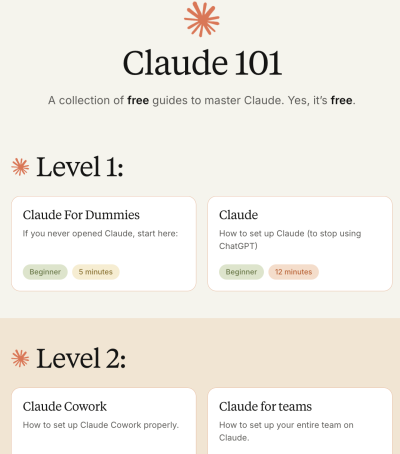
"A collection of free guides to master Claude." It's based on multiple levels and it includes anything from chatting effectively, to Cowork, Design, Code, API, and more.
Dataviz, Data Analysis, & Interactive
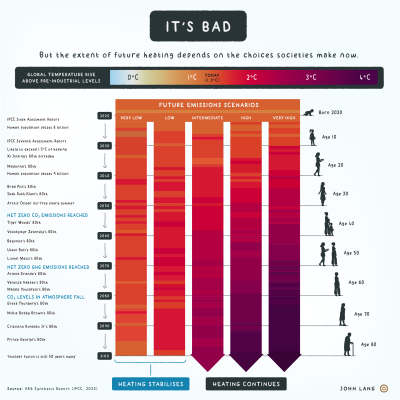
Climate Trunk | A visual guide to climate and energy
Climate Trunk is a visual guide to climate and energy. "One visual a week, for two years. Watch the Trunk grow." (via Durand D'Souza)
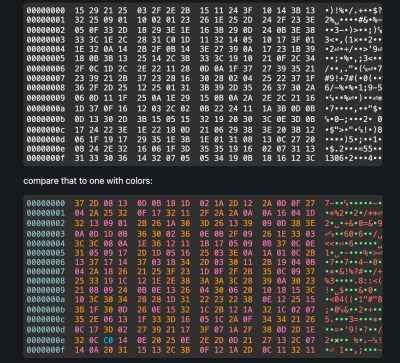
your hex editor should color-code bytes
This article advocates for color-coding bytes in hex editors to improve pattern recognition and data analysis, demonstrated through multiple examples (including file headers, compressed data, and bitmap images).
This reveals structural patterns that are difficult to spot in monochrome displays.
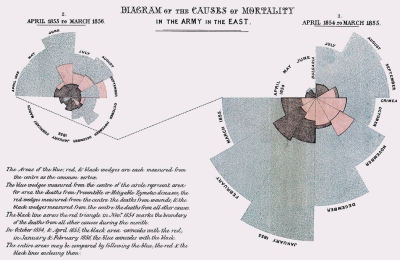
The handmade beauty of Machine Age data visualizations
A essay that explores how William James, W.E.B. Du Bois, and Francis Galton pioneered data visualisation in the late 19th century.
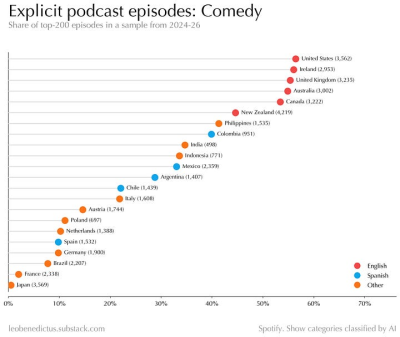
Is the Anglosphere also the Swearosphere? 🤬
Data analysis by Leo Benedictus: how Spotify podcast listening habits vary across 22 countries. It reveals that explicit content is significantly more popular in English-speaking nations.
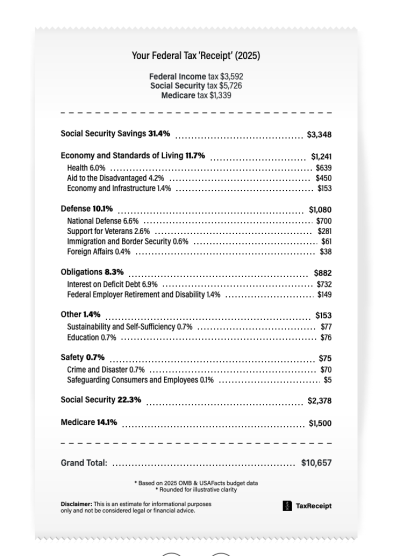
What do your federal taxes pay for?
USAFacts's tax calculator, showing US citizens how their federal tax dollars are allocated across government spending categories.
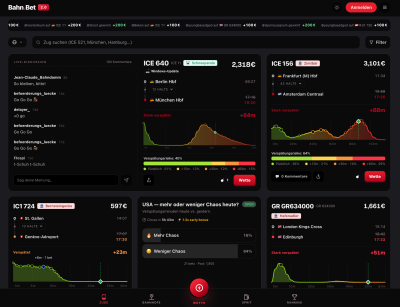
Bahn.Bet — Bet on German Train Delays
Bahn.Bet is a betting platform focused on German train delays. DB trains are notoriously unreliable, and this app gamifies the frustration.
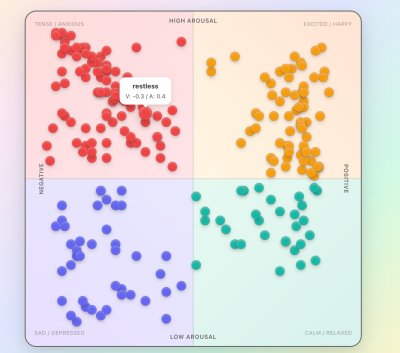
Emotion Explorer
"When asked how we are feeling, "good", "bad", and "OK" is an excellent place to begin. It is the starting point for many of us in our emotional literacy journey.
This project helps those curious to dive a level further."
AI
Introducing talkie: a 13B vintage language model from 1930
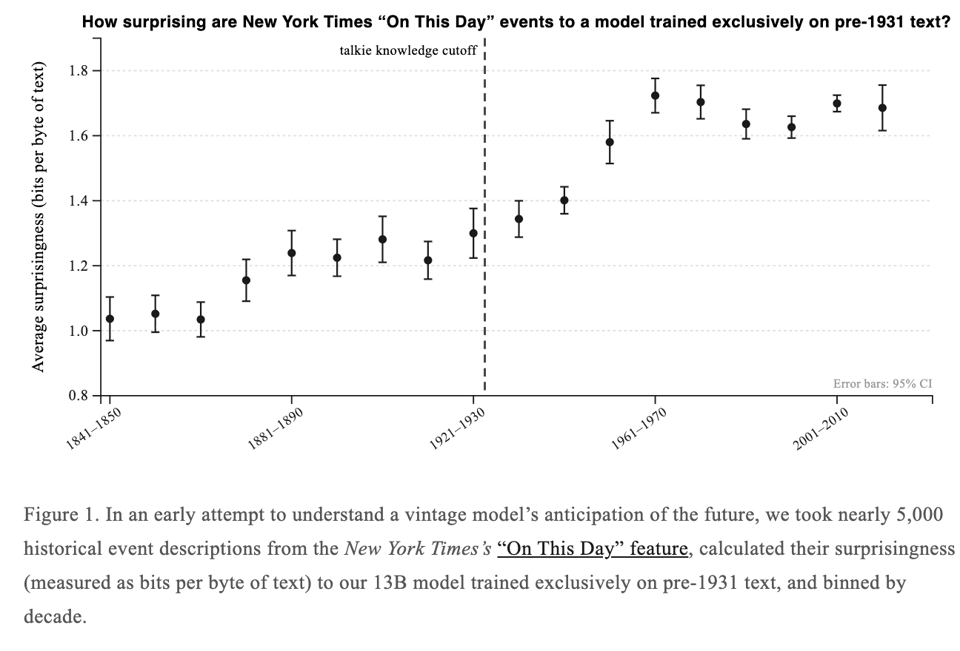
This article introduces Talkie, a 13-billion parameter language model trained exclusively on English text published before 1931. It creates what the authors call a "vintage" language model.
The model enables novel experiments in AI capabilities, such as testing whether LLMs can predict future events, reinvent historical discoveries, or learn modern programming languages without prior exposure to code.
AMA – Ask Me Anything! Submit a question via this anonymous Google form. I'll select a few every 4-5 weeks and answer them on here :-) Don't be shy!

The Quantum of Sollazzo grove now has 40 trees. It helps managing this newsletter's carbon footprint. Check it out at Trees for Life.
'till next week,
Giuseppe @puntofisso.bsky.social