
The Elegance of One Big Chart
A love letter to the game design of really good charts, plus (minor) news updates and a bit of babble about Demonschool!
Welcome back! I hope you had a nice holiday. I personally enjoyed a nice two week break celebrating my birthday, Christmas, Boxing Day, New Year’s Eve, New Year’s Day, and probably five other holidays I’ve forgotten. And as always happens when I have more than a few days of free time on my hands, I end up massively overthinking game design, so this month you get a game design… it’s not really a “rant.” Passionate observation? Enthusiastic babbling? Take your pick, because I’m going to talk about charts.
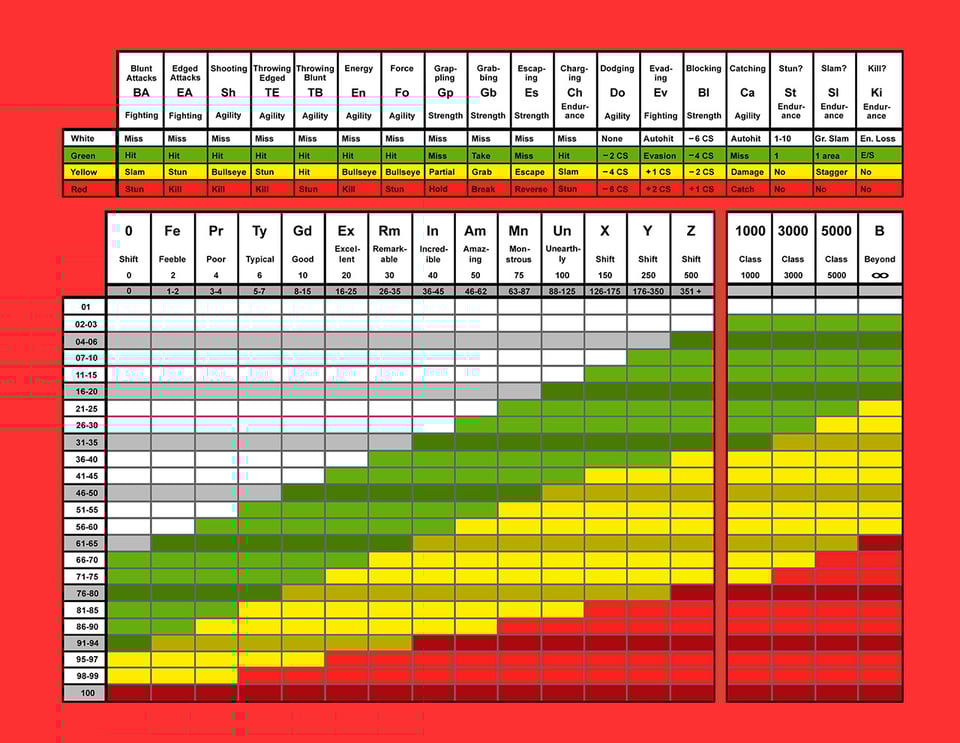
For a long time, charts were seen as an old-fashioned way of communicating information in games. As tabletop RPGs and related game designs (I’ll explain that caveat in a moment) evolved from wargaming, they took a love of charts with them, but over the decades charts were seen as too finicky, too intimidating, or requiring too much work to look things up. Like many elements of game design, fads come and go, and sometime around the 1990s fewer and fewer charts in games was the norm.
Interestingly, that trend seems to be reversing, and that’s probably because of the rise of solo gaming. While playing something approximating an RPG by yourself has been around since the 70s (particularly gamebooks, which fit neatly into that caveat from earlier), over the past few years more freeform and improvised solo experiences have become popular, and a lot of those experiences centre around prompts. They’re basically questions, nuggets of lore, or situations, like someone in an improv troupe giving you a noun to build a skit around. And while they might be called names like “oracles” or “seeds,” they’re just a load of charts to make random rolls on and look things up.
Because I started designing games myself in the late 90s, my own design instincts still err on the side of fewer charts whenever possible. Occasionally they’re useful for displaying key information, but I try to avoid introducing them as key gameplay elements, because I had so internalised the mantra that looking up things on a chart takes too much time. And yet, the current Marvel RPG (Marvel Multiverse Role-Playing Game) has a one-roll system, and it works great, but it doesn’t take appreciably less time than looking up the results on a big chart from 1986. Which got me thinking that how we use charts in game design is perhaps more of a concern than merely the existence of charts.
This intersection of charts and solo gaming came to a head last month, as I fell down a rabbit hole of solo gamebooks both traditional and modern. Many of them have some form of combat that boils down to “roll dice for yourself, roll dice for your opponent, and maybe roll dice for damage” for every round of combat. All of them, that is, except for my other childhood gaming love from the 1980s, Lone Wolf.
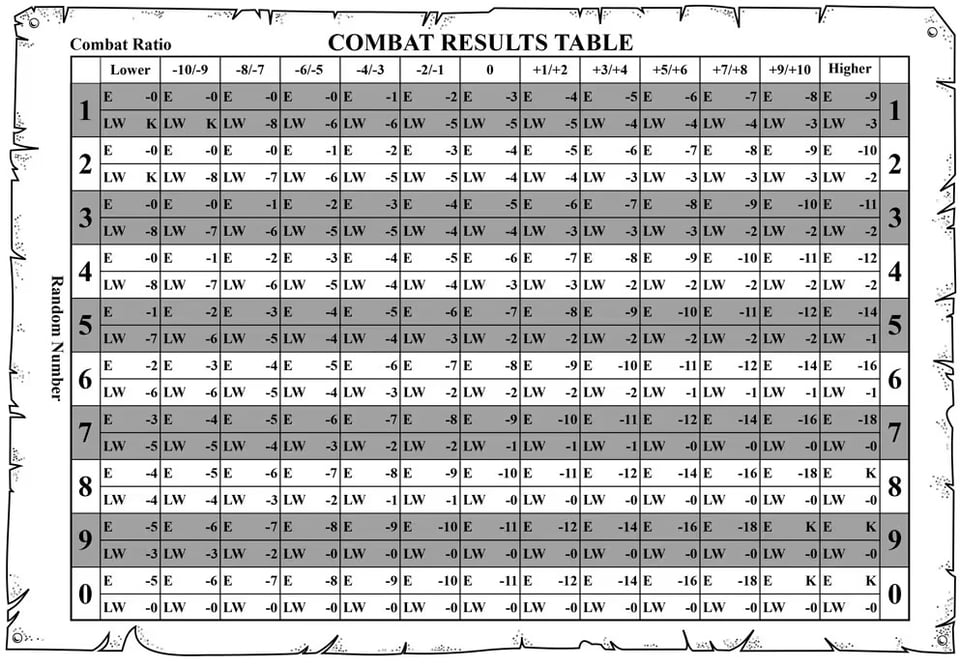
For those that don’t know, a quick explanation. Lone Wolf (and a few assorted tie-in books in the same world) was a series of 30+ gamebooks written by Joe Dever in the 1980s and 1990s. Like many similar books of the era, they’re “pick-your-path” books that require you to make decisions and turn to a specific numbered section in the book to continue the story. When conflict occurs, you resolve things with randomisation along with a character sheet, and an explicit rule that if you died, you had to start the book over from the beginning. Lone Wolf was distinctive in a few ways, one of which was the combat results table I posted above.
The first thing about it is that, unlike pretty much every other gamebook, it doesn’t use six-sided dice. Instead it has a separate table with the numbers 0-9 on it, and you close your eyes and drop a pencil on the chart to get a random number. This has led to some people cheekily claiming it’s “diceless,” which it isn’t, but it does mean you really only need the book, a writing utensil, and a piece of paper to play. That said, I’ve always just used a d10, and that’s so common in the community that the official Lone Wolf store even sells d10s now. Anyhow, having a range from 0-9 (with 0 acting a bit like an Ace in a deck of cards, in that sometimes it’s worst result and sometimes it’s the best result) gives you a wider range of options for design, although on the surface it gets rid of the nice bell curve of two six-sided dice.
But that’s where another clever bit comes into play. At the start of the combat, you subtract your opponent’s skill from yours to get a Combat Ratio, and once you find the right column, every roll on the chart tells you both how many Endurance Points you and your opponent each lose, with particularly unbalanced fights allowing for one-shot kills regardless of Endurance points.
And yet, the results are not mirrored on the chart. What I mean by that is that if your Combat Ratio is +6, meaning you’re massively overpowering your opponent, the best roll results in you losing no Endurance and your opponent losing 16. However, if you reverse that to a Combat Ratio of -6, the worst result (i.e. as if the opponent rolled the best result on you) is the opponent losing no Endurance and you losing 8. There are only three dice results where Lone Wolf instantly dies, but five where the opponent can. The results are clearly skewed toward keeping the player alive, while still offering some risk.
Readers, I have been playing these books in some form or capacity for decades, and I didn’t notice this until last month. If these numbers and combat results were something you had to calculate yourself each time, you’d immediately notice you aren’t losing as much as your opponent, but because it’s in a huge chart that only weirdo game designers like me would carefully study, it’s easy to miss how the math is weighted in the player’s favour. And, because it’s one dice roll (sorry, “random number selection”) instead of two, three, or more as in other gamebooks, combats can feel genuinely tense while still allowing for the occasional random weirdness of a minor villain who does a lot of damage, or taking out a major villain with one shot.
Don’t believe me? One of the great things about this series is that Joe Dever willed the original text to the community a couple decades ago, so you can play the original books for free, legally. And there are nice updated versions for sale through Joe Dever’s estate.
If you’re a designer, don’t turn your nose up at a well-designed chart.
News
The downside of taking a couple weeks off is that I don’t have much to reveal on the news front. However, five new episodes of my actual play with Red Moon Roleplaying are available to listen to, covering the iconic (and long) Masks of Nyarlethotep campaign!
My Media
I mentioned last month that I got a lot of great games from two back-to-back conventions. The Steam Winter Sale (along with some well-timed gift cards for my birthday) didn’t help matters, so I have a lot of games I’m excited about, which I’ll trickle out over the next few newsletters, until I forget and get excited about a new thing. But today I want to talk about Demonschool.
The game’s a bit hard to describe, so I’ll let the Steam page do the heavy lifting for me:
Demonschool is a new-style tactics RPG where motion equals action. Defeat big weirdos in between the human and demon worlds as Faye and her misfit companions, while navigating university life on a mysterious island.
This is an excellent example of me buying a game thinking it’ll scratch a particular itch, only for it to fail and instead satisfy a need I didn’t know I had. The most common description of the game I had heard prior to getting it was “Like Persona but in college,” and that sounded like something I’d want. And you do have magic powers and fight monsters in a strange world while managing your time in an academic setting. But that’s where the similarities stop.
It failed as a Persona-like (is that a word? It is now) in that time management isn’t really a thing. Each day has three phases, and you can do all the available activities for that day in that phase before you have to do the conveniently-labelled plot-relevant task. Studying happens in the background (at one point, Faye even makes a joke about how they almost never go to class), and it’s easy to max out friendships with other characters quickly, except where the story gates you from progressing. It doesn’t have the same “time as resource management” gameplay I enjoyed about Persona.
Combat also isn’t JRPG. Instead, it’s a puzzle strategy game, much more inspired by things such as Into the Breach. You can rewind and redo your actions on your turn as much as you want, until you push the button to commit to your plan. Then the combat explodes across the screen, and you see how well your plan worked. But while you are trying to maximize damage and occasionally use powers like in a typical strategy RPG, the gameplay is much more about getting characters into the right position and lining up enemies for larger shots. Enemies have well-broadcast reactions, which you can spend actions to avoid, or accept to put yourself in a better position for a strategic punch. It keeps each fight reasonably fresh in a way that most JRPGs struggle with. This gameplay trailer gives you an idea of what I’m talking about.
Anyhow, it’s a surprisingly compelling game, and much funnier than a horror game about punching demons has any right to be.
Speaking of which, I have a procrastination demon to punch. See you next month!