
What.a.week
Sanchez is our best friend now
Welcome to the 56th edition of the Dispatch, in which we distract ourselves from the horrors of an abhorrent war by rolling our eyes at market participants who couldn’t, a week ago, seem to imagine how bad this could be.
Also: we have a new essay out, which is mostly about Canada, and what Mark Carney’s assertive language in Davos meant in terms of sovereignty, lightly updated for the attacks on Iran. In the archives, check out our interview with Isabella Weber on energy emergencies; Alex Turnbull’s essay about modelling energy system shocks, and our 2025 piece about the image vs the reality of LNG.
You can email us (Kate here; Tim here); follow us on Bluesky (Kate, Tim, Polycrisis account). Our publishing schedule is shifting in advance of some big changes in the next few weeks but, in the meantime, the Polycrisis discord is pretty busy (email for an invitation).
- Kate & Tim
Horrible, not very good days
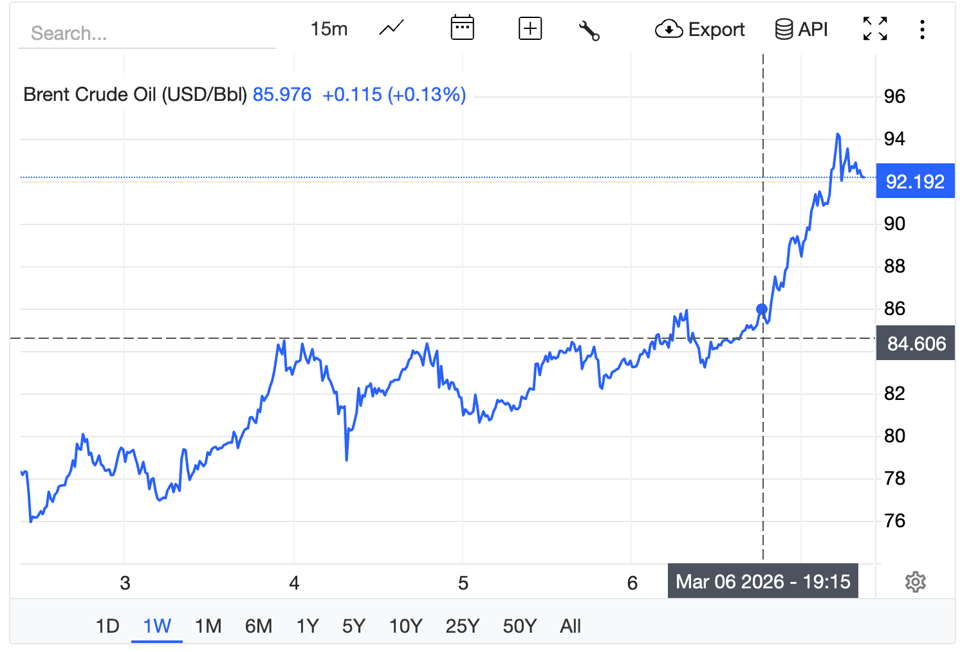
Until day 6 of this war, investors still thought it was going to be a short one, with limited impacts. On Friday — almost a week after the bombing started — was when Mr Market finally woke up to the prospect of a Long And Regional War instead of their Short And Contained War scenario:
Katie Martin at the FT described the consensus view like this:
“And yet, every conversation I have had with analysts and investors in the past few days, and the tone of almost every research note, has been something like this: “Don’t worry. Yes, this could get bad. Very bad. But Donald Trump doesn’t want high petrol prices in the run-up to the midterm elections in November, so his military will not stick around. The conflict won’t last long, oil and gas supplies will quickly get back to normal. History says the wisest path is to keep a cool head and stay invested, especially as the US, home to the world’s dominant financial markets, is nicely insulated from any energy supply shock.”
This suggests multiple fallacies were driving the complacency.
First is the assumption that the US is insulated because of its own oil reserves. Every year or so, when some oil-related interruption happens we get to re-learn that crude oil actually comes in different grades which are not completely interchangeable. That is nerdy stuff that can take you into the weeds of refinery capabilities and logistics and so forth. But it seems much simpler to understand that having your own massive reserves of a resource does very little to protect your country, from a global supply shock if it’s run by an industry that is free to sell on to global markets.
Unless you, the state, can control the industry enough to enact something like actual export bans or quotas, you will have to pay the international market price to your local suppliers.
The second fallacy is the assumption that the Iranian regime would be easily persuaded to back down. Instead what’s happening is that, facing the prospect of losing everything in defeat, they are reaching for everything they have. They have nothing to lose.
“The enemy gets a vote” is the first thing that anyone ever learns about international relations strategy. The Trump White House clearly continues to demand unconditional surrender of the Iranian regime, as if they will just keel over. "I started a fight and said the fight was over. Surely the other guy will understand there is no need to throw a punch because I have declared I am done fighting."
The third source of misjudgement is the US regime itself. Surely some logic will prevail? If bombing schoolchildren is insufficiently repulsive to voters, then surely pain at the pump and/or the sheer unpopularity of war among MAGAs would do it? But hoping for a recognisably coherent worldview in the US administration is futile. The piecemeal efforts to provide assurances of protection (military or financial) for shipping in the Strait of Hormuz; the haphazard comments about using the Strategic Petroleum Reserve are good illustrations. (The SPR is at barely 60% capacity, in case you were wondering; about a third of China’s estimated SPR) And why should that be a surprise, at this point?
How bad could it get?
A week ago we were mostly hearing that Iran only sells a couple of million barrels per day, so oil markets that were already a bit oversupplied wouldn’t be rocked.
Now we are learning about the interplay between urea and LNG shipments through Hormuz and the global food supply, and the number of desalination plants in the Middle East and exactly how vulnerable they are:
The UAE has hit a desalination plant in Iran. After Iran hit a desalination plant in Bahrain. After the US hit a desalination plant in Iran. www.jpost.com/middle-east/...
— elia ayoub (@ayoub.bsky.social) March 08, 2026
The range of harms radiating out from this war seem to be almost infinite. Barring all-out water wars (which might be rash), a historical analogy might be the 1973 OPEC embargo.
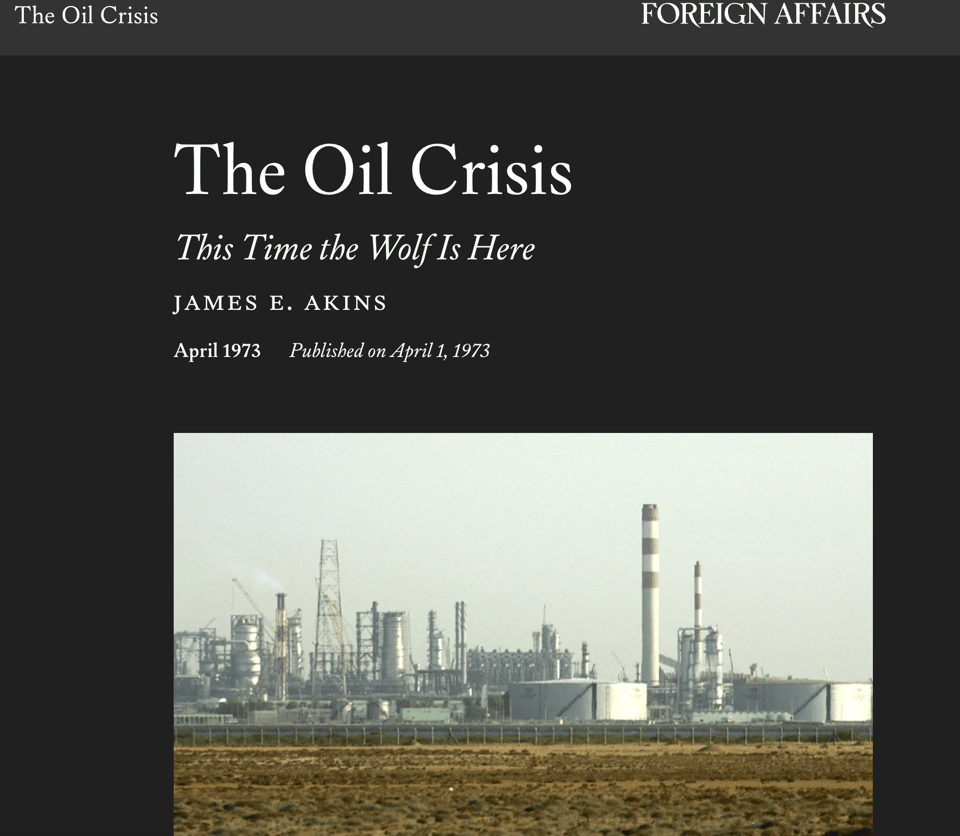
As Philip Delves Broughton, author of a forthcoming book about the embargo, wrote: “The effect of the changes catalyzed by an energy crisis tend to endure beyond the crisis itself. The volatility causes personal, corporate and national fortunes to be made and lost. Habits and regulations that seem like temporary adaptations become permanent.”
From 1973, those included: Japan’s nuclear generation and its strict, economy-wide energy efficiency measures; transformation of the US auto industry; development of North Sea oil and gas; and severe and widespread supply-side inflation and recession.
For oil producers, it entails the nightmare of “demand destruction” that Saudi officials have often spoken of. The threat to them is more stark this time because so many better alternatives to oil dependency exist.
Won’t someone stop it?
It’s hard to abandon optimism that this war ends soon. Surely this much pain being inflicted on so many powerful interests just can’t continue. But, again, this appears to require the US accepting a kind of strategic defeat because it appears unlikely Iran will back down before effecting much more pain.
How does it end?
The Saudis, Emiratis, Qataris are going to want to end the war quickly. Oil and gas production is being shut in. Their data centres are being bombed. They’re already indicating they will start pulling back their vast foreign overseas investments. This time around, the oil price spike will not mean a big surge of footloose petrodollars.
So, how would pressure be exerted on the US? Here are some possibilities:
South Korean chip manufacturers: Losing their LNG that they need (for now) for their semiconductor facilities that are needed for AI data centres
Gulf countries: Losing export income; losing the image of safe expat destiny; data centres bombed; and the threat of demand destruction
US tech sector: Can be hurt by all of the above
Shipping industry: Unclear if they will be swayed by US attempts to pivot the Development Finance Corporation into an oil tanker / LNG carrier / cargo insurer
So much for the new middle powers
The lack of justification for attacking Iran has only led to the mildest resistance from western allies. The UK has allowed the US to use its military bases. Carney’s position is “hard to decipher” but falls short of Canada’s refusal to accept the premise of the Iraq war in 2003.
At least the prime minister of the Kingdom of Spain is standing firm:
Sánchez: “You may have heard that Spain is alone. They’re the same people who said that when we recognized the State of Palestine, and then others followed. “We are not alone — we are the first. Those who will end up alone are the ones defending the indefensible.”
— Mark Chadbourn (@chadbourn.bsky.social) March 07, 2026
Friendship ended with Carney, now Sanchez is my best friend.
LINKS
The Iran war is unfathomably depraved - Current Affairs
Against all enemies - John Ganz
The dry and the wet burn together Eskandar Sadeghi-Boroujerdi, LRB
Why are we bombing Iran? Sarah Miller
-
Great summary. I really hadn't considered the threat of destruction of oil demand. Maybe the only silver lining at all in this is the potential for further global weaning off fossil fuels (and hopefully a humbling of US arrogance)
Add a comment: