
What.a.time
A week when decades happened
Hey readers,
Welcome to the 56th edition of the Dispatch, in which we distract ourselves from the horrors of a really abhorrent war by rolling our eyes at market participants who couldn’t, a week ago, already see how bad this would be.
Also: we have a new essay out, which is mostly about Carney and Canada and what Carney’s confrontational stance to the US meant, and mostly written before the US and Israel attacked Iran; although we noted that the response of Carney and other western alliances to the war suggests the old ways haven’t been forgotten when it comes to defense.
That’s all for this week. You can email us (Kate here; Tim here); follow us on Bluesky (Kate, Tim, Polycrisis account). And do join our discord channel!
Horrible, not very good days.
Until Day 6, investors still thought it was going to be a short war, one with limited impacts. Katie Martin at the FT summed up the consensus view like this:
“And yet, every conversation I have had with analysts and investors in the past few days, and the tone of almost every research note, has been something like this: “Don’t worry. Yes, this could get bad. Very bad. But Donald Trump doesn’t want high petrol prices in the run-up to the midterm elections in November, so his military will not stick around. The conflict won’t last long, oil and gas supplies will quickly get back to normal. History says the wisest path is to keep a cool head and stay invested, especially as the US, home to the world’s dominant financial markets, is nicely insulated from any energy supply shock.”
Every year we have to learn that crude oil has different grades that need differently equipped refinaries. It now seems that every fossil fuel exporting country has to regularly re-learn that having your own massive supply does not guarantee said country will not have to worry about that resource, because of fugibility, the existence of internatoinal markets; you’ll always pay a sleepover, that having a lot of oil (or any resource really) does not mean that you don’t have to worry about supply of that commodity.
Anyway, Friday — almost a week after the bombing started — was when Mr Market finally woke up to the prospect of a LONG AND REGIONAL WAR instead of their head in the sand view of a SHORT AND CONTAINED war scenario.
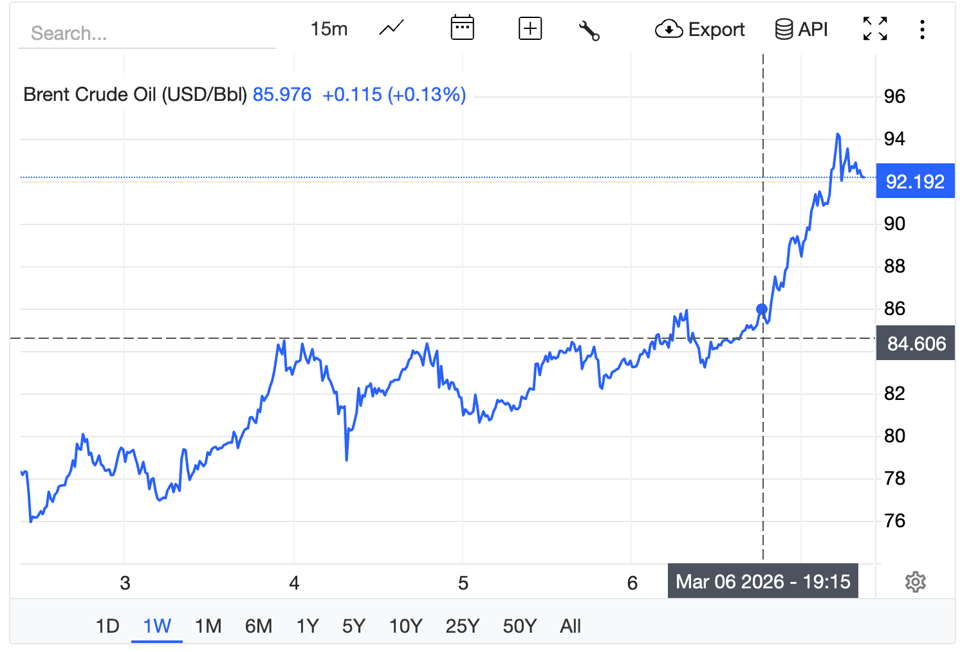
“The enemy gets a vote” is literally the first thing that anyone ever learns about international relations strategy, yet shockingly came as a surprise to markets. The Trump White House continues to demand unconditional surrender of the Iranian regime, as if they will just keel over. "I started a fight and said the fight was over. Surely the other guy will understand there is no need to throw a punch because I have declared I am done fighting."
The Saudis, Emiratis, Qataris are going to want to end the war quickly. Their data centres are being bombed. They’re already indicating they will start pulling back their vast foreign overseas investments. This time around, the oil price spike will not mean a big surge of footloose petrodollars roaming around the world. Too much to spend on military.
It isn't about geography of data centers being in the zone of Iranian fire, but the risk perceptions on the financing side – ie Gulf sovereign wealth funds, Softbank etc – that had been giving out blank cheques to AI companies.
FT Exclusive: Pressure on the Gulf states’ budgets could cause them to review their overseas investments &future commitments as they consider options to ease the financial strain caused by the US-Israeli war against Iran End of footloose petrodollars @katemac.bsky.social www.ft.com/content/ab7d...
— Albert Pinto (@70sbachchan.bsky.social) March 06, 2026
took six, seven days (depending on your hemisphere) for oil traders to wake up to reality of war not ending soon.
It
Won’t somebody stop it?
Almost as baffling and awful as the war itself is the sense that no-one in the real world was very prepared either. has modelled even the first order effects of a war with Iran and Isreal that shuts off the Strait of Humuz, even though it’s been lurking geopolitical risk for several decades now. And a nihilistic US administration has brought it much higher above the non-zero probability threshold for several months now.
Look, we get it. It’s hard to abandon optimism that this war ends soon. Surely this much pain being inflicted on so many powerful interests just can’t continue.
Here are some of our favourite scenarios, as of this minute:
S Korean chip manufacturers: losing their LNG that they need (so far) for their facilities
Gulf countries: Getting their data centres bombed, losing their sleek safe haven luxury nihilistic expat image;
US tech sector: getting furious about all of the above
Shipping magnates + Lloyd’s of London crowd: throwing shade on the US attempts to pivot the Development Finance Corporation into a cargo ship insurer.
It could be a combination of those factors that constricut. it’s a copmlicated thing, the brain :( Or maybe it’ll just go on and more people will be brutally killed and everyone else will experience a massive supply-side inflation shock whose ramifications will continue for years.
At least the prime minister of the Kingdom of Spain is standing firm.
Sánchez: “You may have heard that Spain is alone. They’re the same people who said that when we recognized the State of Palestine, and then others followed. “We are not alone — we are the first. Those who will end up alone are the ones defending the indefensible.”
— Mark Chadbourn (@chadbourn.bsky.social) March 07, 2026
LINKS
The Iran war is unfathomably depraved - Current Affairs
Against all enemies - John Ganz
The dry and the wet burn together Eskandar Sadeghi-Boroujerdi, LRB
Why are we bombing Iran? Sarah Miller