
Canada's new non-alignment
What sovereignty means now
Hello readers! Welcome to the second dispatch of 2026. Below, some thoughts on Canada’s strategy to do the seemingly impossible task of decoupling from the US. Yes, it’s going to be painful, and building a coalition to endure that pain is part of Mark Carney’s plan, as demonstrated in his Davos speech.
We’re working on our first 2026 essay; although the January 2025 one is holding up eerily well… countries are indeed working “around and without” the US; the startling moment of Davos was seeing how wealthy countries are coming to terms with this reality which the rest of the world has been contending with for years/decades.
In the meantime, you can email us (Kate here; Tim here); follow us on Bluesky (Kate, Tim, Polycrisis account). And do join our 2026 book club over at the discord channel.
— Kate and Tim
What was Carney’s Davos speech about?
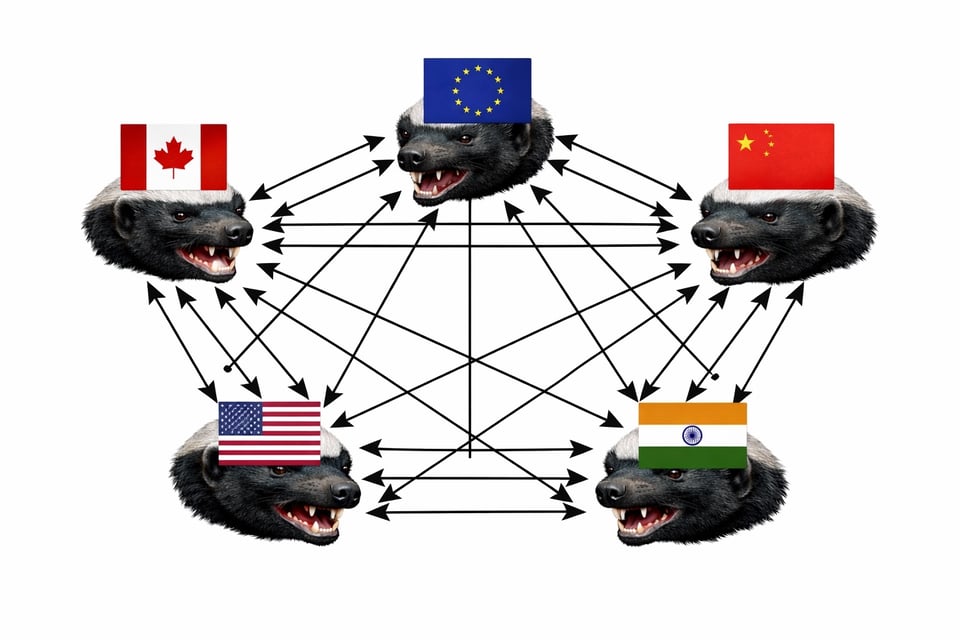
There was much excitement about a G7 country calling out the illusory nature of the “rules-based order” at Davos.
Carney’s speech was heavy with signalling to his domestic audience — of course — but it also proclaimed a credible demonstration of sovereignty that has been in the works for almost a year.
Canada’s predicament of depending on the world’s biggest rogue state for almost three-quarters of its export earnings seems hopeless. It can’t possibly diversify quickly enough to avoid any pain. But a preparedness to bear that pain is part of the Carney government’s strategy. They’ve been working not just to build non-US export markets, but also to politically withstand the pain that the US might inflict in the months and years ahead.
Sovereignty exists when a country’s leader can credibly say their constituency is ready to be hurt, because what they value is worth the cost. Canada’s risking American security ire and market access to forge its own path is a show of force. Europeans accepting higher taxes for military autonomy sends a similar message.
Since it became clear the Trump 2.0 administration would happily inflict harm on any other country, the Canadian PM has been busily building on broad public solidarity against the new common enemy to the south, constructing an industrial and regional coalition robust enough to project a new stance into a chaotic world.
Chinese agriculture, European defense
A high profile winner of this strategy is Canada’s agriculture industry; China is cutting its punitive tariffs on Canadian canola and already allowing other goods such as beef back into the country.
And in December, Canada became the first foreign partner to Europe’s SAFE fund, which provides EUR150bn of loans for member countries to boost their defense budgets through 2030; giving Canadian companies superior access to a huge European military spending pipeline.
Autos
Canada’s auto industry is suffering from US tariffs and Ontario governor Rob Ford criticised the federal agreement to drop 100% tariffs on Chinese EVs and allow 49,000 vehicles in on more normal tariffs rates of 6%. Carney’s play is that the agreement will facilitate Chinese investment into Canada’s auto industry that will position it for the future. One element of the agreement, he said, was “an expectation that there will be Chinese investment partnering with firms in Canada that meets our labour standards… We don’t want to be competitive in the industry of 2000, 2010, we want to be competitive in the industry of the future.”
There are plenty of signs that Canada’s central government is is aware of the effective bifurcation between the US and the rest of the world on the automotive industry – and it has no intention of being stranded. The Canadian department of industry is drafting a plan, to be released in February, that Bloomberg reports will:
“opens the door to Chinese companies assembling vehicles in Canada for the first time — but under restrictions that may include using Canadian software and creating joint ventures with domestic firms, according to a government official, speaking on condition of not being identified”.
Even hardcore US allies like Argentina don’t care for US gas-guzzlers; Milei’s free trade policy just saw a massive shipment of BYD vehicles arrive.
Oil
In contrast to the auto industry, the oil component of the Carney sovereignty coalition is more about vibes and short-term prospects.
Canadian news media is full of speculation that China will buy more of its oil to supplement lost Venezuelan supply. China has bought more Canadian crude since the US blockade on Venezuelan oil shipments last year; but expanding reliance on oil imports is not in China’s bingo card. The Canadian news is full of talk of a new pipeline from the west; but no-one wants to fund it and experts think Chinese investment is highly unlikely.
But Carney’s government has catered to the oil industry by rapidly ticking off most of the policy demands from Alberta: cancelling carbon taxes, industry emissions caps, and rolling back other environmental safeguards on hydrocarbon projects. It’s in no-one’s interest to point out that shakiness of counting on new Asian demand for Canadian crude.
International solidarity?
Carney’s speech urged middle powers to show solidarity, but on a case-by-case basis:
This is not naive multilateralism. Nor is it relying on their institutions. It's building coalitions that work, issue by issue, with partners who share enough common ground to act together. In some cases, this will be the vast majority of nations.
What it's doing is creating a dense web of connections across trade, investment, culture on which we can draw for future challenges and opportunities.
He sees a fluid world where countries are all continuously dancing, finding new partners on a case-by-case basis rather than settling into blocs of broad commitments. For years, Canada had fallen in with the US when it came to China; arresting the Huawei executive Meng Wangzhou and following the Biden administration in putting 100% tariffs on Chinese cars in 2024.
REST OF WORLD
Meanwhile a new report found China’s investment and construction in BRI countries reached unprecedented levels last year:
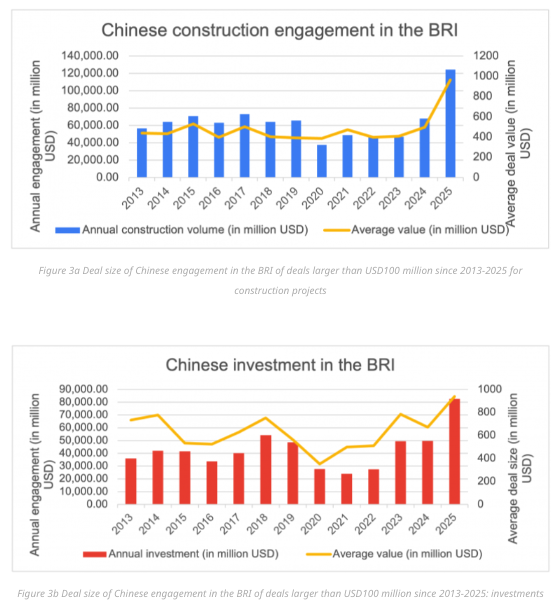
The author, Christoph Nedophil Wang of Griffith University, expects numbers to be even higher this year, and points out that many of these deals have been big - “With this, the “small yet beautiful projects”(小而美)in the BRI propagated through official channels during COVID should be seen as bygone.”
The FT notes that many of the deals are resource-backed, reflecting (again) China’s interest in raw materials.
LINKS
What the USAID cuts did to Lesotho - The Dial
Adam Tooze on the evolution of Carney thought
Alex Williams (ex-Employ America, now at Common Wealth) has a new email newsletter, Forces of Production. Join the cool kids and sign up.