
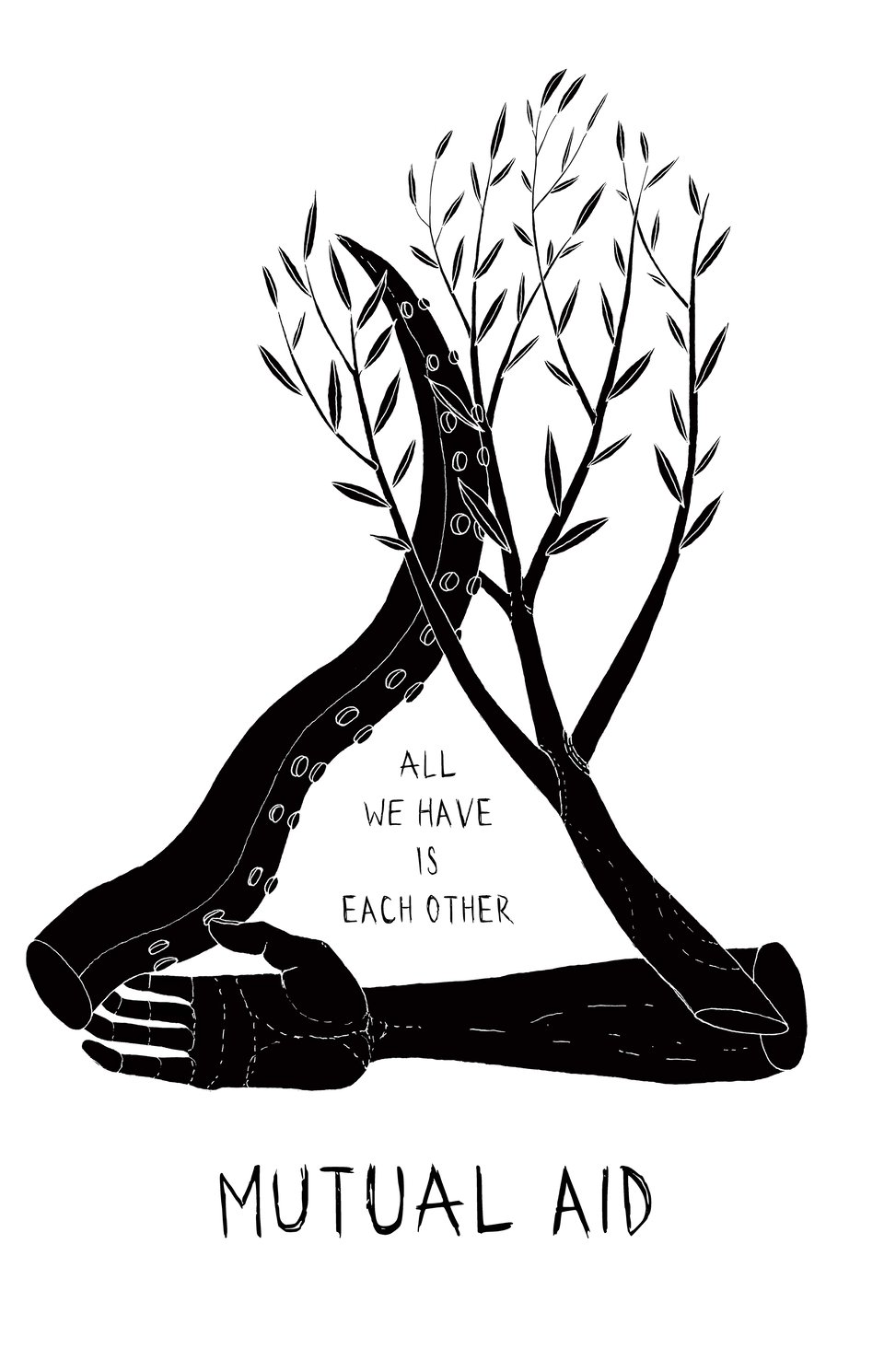
Andrea Conte’s Interspecies Mutual Aid is part of Just Seeds’ graphics collection, and just feels perfect to start off this month’s update!
Last month we talked about the idea of fully resourced communities as the first big theme from our research project asking how urban and regional planning practice can support restorative justice, transformative justice and abolition.
The second big theme is that these communities need to be produced through ecosystems of care. This theme really puts a spotlight on process, and the importance of planners playing a support role, following the folks who have been most impacted by community violence, policing, prisons and carceral violence, and building ongoing relationships in the process.
As one contributor to the podcast Amplify RJ put it:
I think it's another kind of like calling in to folks that want to be that protector or that saviour. That we don't need saviours, right. We need solidarity and we need people that actually listen, and to show they love me.
As planners there are also opportunities to think about how to be in solidarity with broader ecosystems as well, thinking with that interspieces mutual aid.
We’ve put together some other ideas for planners to work in communities of care and we’re excited to share them with you, feel welcome to share further!
à bientôt
planningforabolition@carleton.ca
ps: also more to come in our Pathways to Community Safety series this fall, we hope you’ll join, and we’d still love to hear what you want to hear more about.
Learning + Action
speaking of ecosystems, here are some ways abolition, policing, prisons and carcerality, and environmental planning cross paths.
- Extreme heat, flooding, wildfires – Colorado’s formerly incarcerated people on the hazards they faced behind bars [The Conversation]
- No Cop City, No Cop World [Haymarket Books/Youtube]
- Ontario will designate Ring of Fire a special economic zone ‘as quickly as possible’ [The Trillium]
- The Elbows are Up: Ontario’s “Special Economic Zones” and Indigenous Rights [Yellowhead Institute]
- Exploring carceral food systems: Tensions, experiences and possibilities [Canadian Food Studies]
- The Struggle for Food Sovereignty While Incarcerated [Hammer & Hope]
- Preserving, protecting and passing on Indigenous growing practices [Unreserved - CBC]
You just read issue #3 of Planning for Abolition. You can also browse the full archives of this newsletter.